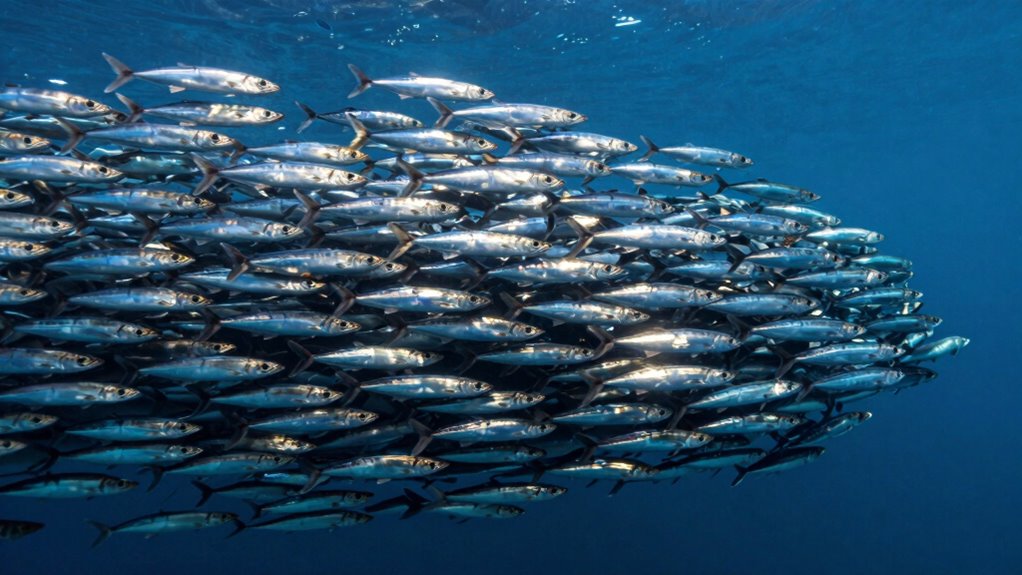
When threatened, you see sardines form a dense, swirling mass that acts as a living shield. This tight, coordinated movement confuses predators by creating a moving, unpredictable barrier. The group shifts rapidly, making it hard for predators to target any one fish. Their collective response increases survival chances markedly. If you’re curious about how this clever defense works and the secrets behind their synchronized movements, there’s more fascinating detail ahead.
Key Takeaways
- Sardines form a dense, swirling mass that confuses predators and makes individual targets difficult to isolate.
- Their synchronized movements create a moving, protective sphere that disrupts predator attacks.
- The tight formation disperses predator focus, reducing the chance of any single sardine being targeted.
- Constant adjustments and rapid responses maintain the integrity of the protective shoal.
- Collective signals and cooperation enhance communication, reinforcing the shoal’s effectiveness as a living shield.
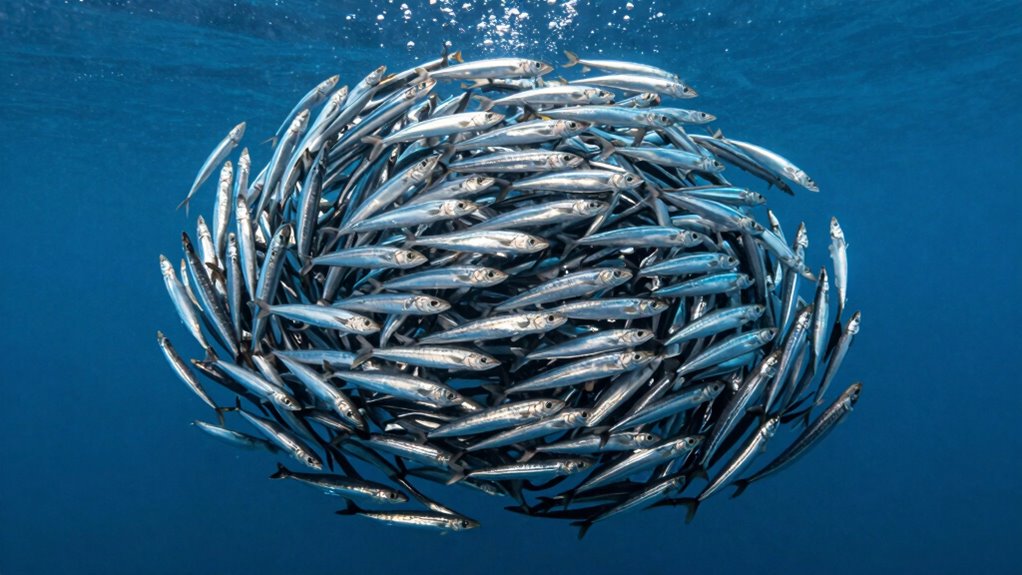
When predators threaten, a shoal of sardines instinctively forms a dense, swirling mass that acts as a living shield. This behavior, known as schooling, is a remarkable survival strategy that maximizes predator avoidance. As soon as danger appears, your instincts drive you to join others of your kind, creating a tightly packed, moving sphere. This formation confuses predators by making it difficult to single out any individual, effectively dispersing their attack. The schooling behavior isn’t random; it’s a coordinated effort that relies on quick, collective responses, which increase your chances of survival. The tighter the group, the less likely a predator will successfully target one sardine. You and your schoolmates constantly adjust your positions, maintaining close proximity while swirling in unison. This dynamic movement creates a confusing visual pattern, making it hard for predators to focus their attack on a single target. The synchronization of your movements is crucial for maintaining the effectiveness of this defense mechanism, relying on real-time responses and subtle signals. The dense formation also decreases your individual vulnerability by spreading out the predator’s attack power. Instead of a single sardine being caught, the predator faces a barrage of moving targets. The collective movement, synchronized in real-time, helps you react swiftly to threats, reinforcing the protective barrier around you. When a predator strikes, your schooling behavior allows you to respond instantly—either by darting away or by tightening the school to increase confusion. This rapid, unified reaction is essential for predator avoidance. You’re not just random fish swimming together; you’re part of a highly organized defense mechanism that hinges on your ability to coordinate with others in the shoal.
This survival tactic also benefits the group by creating a shared vigilance system. While some sardines keep watch, others act as decoys, drawing the predator’s attention. The schooling behavior enhances communication among you and your peers through subtle movements and signals, ensuring everyone stays alert and responsive. This collective effort is supported by natural adaptation, which allows for such sophisticated cooperative behavior to evolve. Understanding these collective behaviors provides insight into how evolution shapes survival strategies in aquatic environments. The coordinated effort is a sophisticated form of collective behavior that exemplifies natural adaptation for survival. When danger subsides, you resume your more relaxed swimming, but the instinct to form a school remains an integral part of your life. Additionally, research shows that these behaviors are refined through generations, demonstrating the importance of evolutionary processes in developing survival strategies. The collective effort to avoid predators demonstrates how effective schooling can be, turning what might seem like simple swimming into a sophisticated, cooperative survival strategy. By sticking together in this swirling mass, you markedly increase your odds of making it through the predator’s attack unscathed.

Kauvysaq 11-Piece Enrichment Set with Training Rings and Resting Leaves, Betta Fish Toys, Stimulating Natural Behaviors and Reducing Fish Stress, Durable Plastic Aquarium Accessories for Betta Fish.
- Complete Enrichment Set: Includes training rings, floating balls, leaves
- Vibrant Colors: Yellow and red training rings for stimulation
- Durable Plastic Construction: High-quality materials for long-lasting use
As an affiliate, we earn on qualifying purchases.
As an affiliate, we earn on qualifying purchases.
Frequently Asked Questions
How Does the Shoal Coordinate Their Movements so Precisely?
You observe the sardines coordinating their movements through subtle communication signals, like changes in speed or direction. These signals help them respond quickly, creating a unified predator evasion tactic. When one sardine shifts, others instantly follow, forming a living shield. This real-time coordination allows the entire shoal to react swiftly, confusing predators and increasing their chances of survival without any obvious leader guiding the movement.
What Predators Are Most Effective Against Sardine Shoals?
You should know that predators like dolphins, sharks, and larger fish are most effective against sardine shoals. They rely on predator camouflage to blend into the environment, making them harder to spot. The dense shoal density confuses predators and reduces their success rate, as attacking a tightly packed group is risky. This coordinated movement and high density act as a living shield, protecting sardines from their most dangerous enemies.
Do Sardines Communicate Within the Shoal?
You might be surprised to learn sardines communicate within the shoal through Sardine signaling, which helps coordinate their movements. During shoal synchronization, they respond to subtle cues like vibrations and changes in water pressure, allowing them to move as a unified mass. This complex communication keeps predators confused and enhances their survival. It’s fascinating how these tiny fish work together, creating a living shield that’s greater than the sum of its parts.
How Quickly Can a Sardine Shoal Change Direction?
You’ll find that a sardine shoal can change direction within seconds or just a few moments, thanks to their rapid, coordinated responses. During sardine migration, they react swiftly to threats or environmental cues, creating a living shield. Fishing impacts can disrupt this agility, causing delays or disorganized movements, but overall, their ability to quickly shift directions helps them evade predators and maintain tight group cohesion.
What Environmental Factors Influence Shoal Size and Behavior?
Like a flock of birds guided by unseen forces, your sardines respond to their marine habitat. Water temperature influences their size and behavior, prompting them to cluster tightly or disperse. Changes in water quality, currents, and predator presence also shape their shoal size and movements. When environmental conditions shift, sardines adapt swiftly, forming larger or smaller groups, turning their shoal into a living shield, protecting them from threats lurking in their watery world.
Conclusion
As you watch a sardine shoal, imagine being surrounded by a swirling, shimmering wall of life. Their collective motion acts as a shield, much like a fortress protecting its inhabitants. Remember the story of a fisherman who once saw a massive school turn suddenly, confusing a predator and saving countless lives. Just like those sardines, we’re strongest together—our unity can turn chaos into safety, proving that in community, we find true resilience.