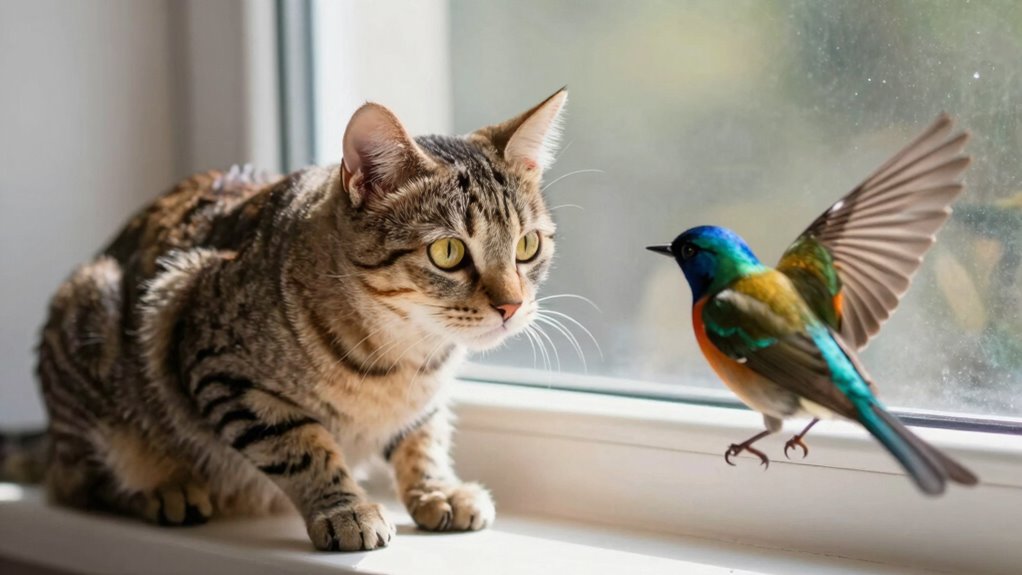

When you see your cat chatter at birds, it’s because their intense focus and hunting instincts kick in. They become excited or frustrated as they watch prey move, often making quick, chattering sounds that mimic a kill bite. This behavior is an involuntary response to their natural drives, channeling energy and excitement. If you want to understand more about why cats do this and how it connects to their instincts, keep exploring these fascinating behaviors.

Get pet supplies delivered free — and shop member deals
- Fast, free delivery on millions of items
- Access to Prime Big Deal Days deals on October 6–7
- Prime Video, Amazon Music and more included
Key Takeaways
- Cats chattering at birds likely reflects their hunting instinct and excitement during prey observation.
- Vocalizations and quick jaw movements mimic the killing bite, an involuntary hunting response.
- The behavior indicates heightened focus and arousal as cats watch potential prey.
- Natural environment stimuli fulfill their innate desire to stalk and hunt, triggering chattering.
- Providing enriching toys and outdoor exposure can help satisfy hunting drives and reduce frustration.

Have you ever noticed your cat making quick, chattering sounds when watching birds through the window? That peculiar noise is more than just a random act—it’s a fascinating behavior rooted in your cat’s natural instincts. When cats engage in bird watching, they often produce these chattering sounds as a way of expressing excitement, frustration, or anticipation. It’s a vocalization that seems to bridge their focus on the birds outside with their innate hunting instincts. You might see your cat’s eyes darting from one bird to another, ears tuned in, and paws tensing up, all signs that their mind is deeply engaged in the pursuit. The chattering acts as a kind of internal stimulus, a way for your cat to channel their energy and sharpen their hunting skills even when they’re just observing from indoors. Some experts believe that the chattering results from a reflexive jaw movement, possibly a mimicry of the killing bite, or an involuntary response linked to the excitement and tension of the moment. Additionally, this behavior underscores the importance of biodiversity in providing natural stimuli for cats, satisfying their innate hunting instincts. Recognizing this behavior can also help you understand how hunting instincts are deeply embedded in your feline companion’s nature. Understanding this behavior helps you appreciate how deeply embedded the hunting instincts are in cats. Their vocalizations and body language, including the chattering, are complex expressions of their natural drive to hunt. Even if your cat is safely indoors, these behaviors enable them to fulfill their biological needs. It’s also worth noting that some cats might chatter more than others, depending on their personality and hunting drive. Providing appropriate toys and activities that simulate hunting can help satisfy these instincts and reduce the likelihood of frustration or boredom. Engaging your cat with interactive play that mimics prey movement can further enrich their environment and tap into these natural behaviors.
interactive cat toys that simulate prey
As an affiliate, we earn on qualifying purchases.
As an affiliate, we earn on qualifying purchases.
Frequently Asked Questions
Do All Cats Chatter at Birds or Only Certain Breeds?
Not all cats chatter at birds; it often depends on their feeding habits and territorial instincts. Cats with a strong prey drive or those who are more territorial are more likely to chatter when they see birds. Chattering is a way for them to express excitement or frustration. While some breeds are more prone to this behavior, individual personality and instinct play a bigger role than breed alone.
Can Cats Learn to Control Their Chatter?
You can’t fully train cats to control their chatter, as it’s instinctive and linked to their natural hunting and vocalization patterns. However, you can use training techniques like distraction and positive reinforcement to reduce excessive chatter. By noticing triggers and redirecting your cat’s attention, you help manage their vocalization patterns. While some cats chatter less over time, complete control isn’t realistic, since it’s deeply ingrained in their hunting instincts.
Does Chattering Harm a Cat’s Vocal Cords?
Chattering typically doesn’t cause vocal cord strain in cats. It’s a natural response to behavioral triggers like spotting prey or feeling excited. Your cat’s vocal cords are built for this kind of vocalization, so occasional chattering isn’t harmful. However, if your cat’s chatter becomes persistent or sounds strained, it’s a good idea to consult a vet to rule out any underlying issues.
Is Chattering a Sign of Aggression or Excitement?
Chattering often signals excitement rather than aggression, especially during bird hunting. When you see your cat’s vocalization triggers activate, it’s usually a sign of keen interest and anticipation, not hostility. The rapid, chattering sound reflects their instinctual drive to hunt. You can interpret this as your cat’s way of expressing enthusiasm and focus, rather than anger, as they prepare to stalk or pounce on their feathered target.
How Does a Cat’s Age Affect Its Chatter Behavior?
As a cat ages, its chatter behavior can change due to behavioral triggers and vocal development. Kittens might chatter more out of curiosity and excitement, while older cats may chatter less or differently, influenced by their experiences and physical changes. You’ll notice that age affects how intensely or frequently your cat vocalizes when spotting birds, reflecting their evolving instincts and communication skills during different life stages.
Conclusion
As you watch your cat’s chatter fade into silence, you realize that those fleeting moments hide a secret. What exactly sparks that burst of excitement—and what might your feline friend be dreaming of beyond the window? The mystery lingers, tempting you to look closer, to understand what drives that wild, instinctual reaction. In those quiet seconds, a world of untold stories waits, leaving you enthusiastic to uncover what truly fuels your cat’s enigmatic fascination with the birds.
Halloween Picks
halloween
As an affiliate, we earn on qualifying purchases.