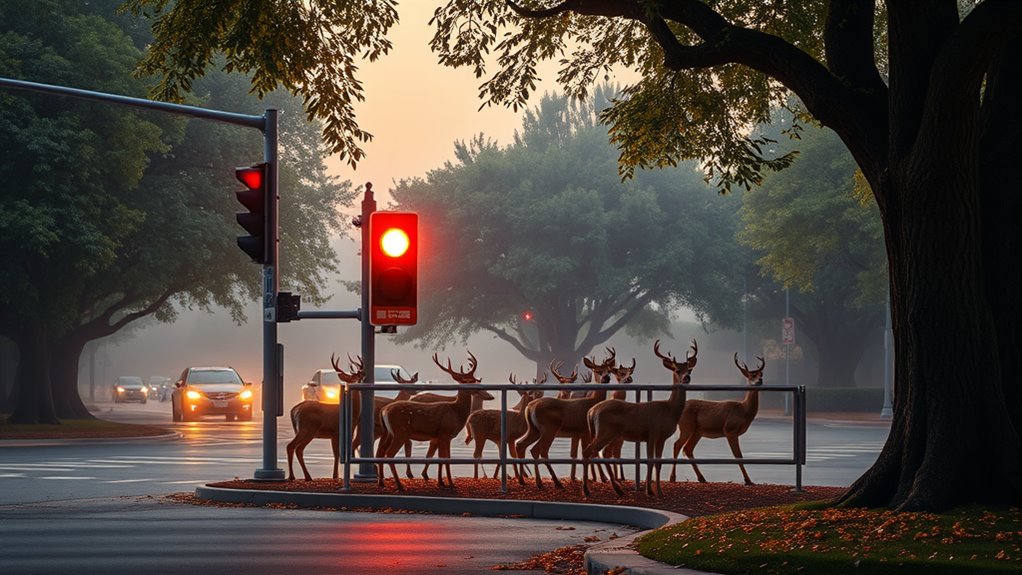

The deer traffic-light experiment uses special signals that respond to wildlife detection to make drivers more cautious. These lights change color or display deer icons when animals are nearby, prompting drivers to slow down and prevent accidents. Since implementing this system, collisions have decreased by 40%, making roads safer for both humans and animals. If you’re interested, you’ll discover how this innovative approach benefits urban planning and conservation efforts.

Get pet supplies delivered free — and shop member deals
- Fast, free delivery on millions of items
- Access to Prime Big Deal Days deals on October 6–7
- Prime Video, Amazon Music and more included
Key Takeaways
- Specialized traffic lights detect approaching deer and display signals to alert drivers, reducing collision risks.
- Motion sensors enable real-time response, activating signals when wildlife are nearby.
- The experiment achieved a 40% decrease in vehicle-deer collisions, enhancing road safety.
- Integrating ecological data into traffic systems promotes wildlife conservation and urban planning.
- The initiative demonstrates how innovative technology fosters safer coexistence between vehicles and wildlife.
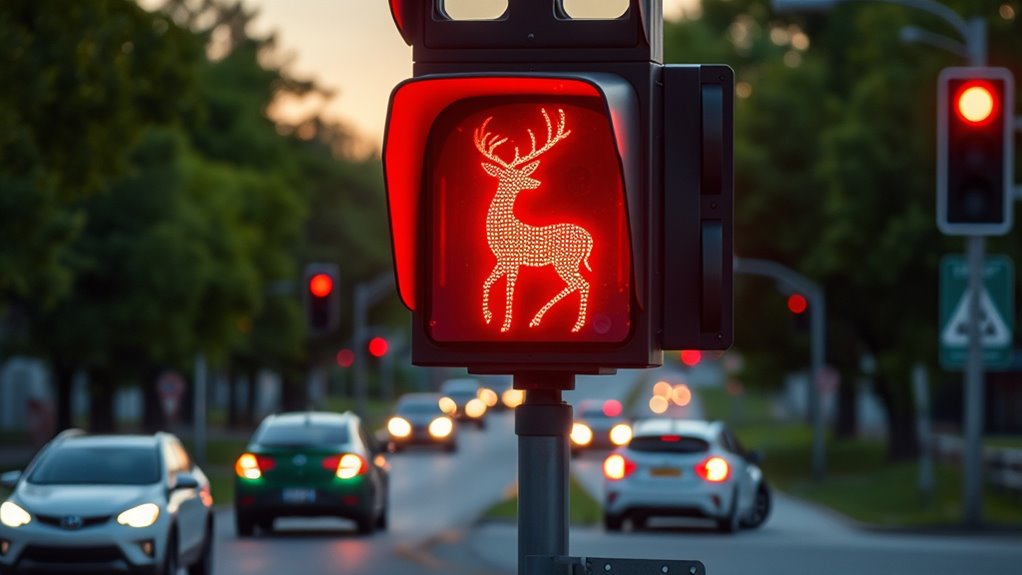
In an effort to reduce vehicle collisions with wildlife, researchers recently launched the Deer Traffic-Light Experiment, an innovative approach that uses visual signals to influence deer behavior at busy intersections. This project aims to enhance wildlife conservation by integrating new technology into urban planning, making roads safer for both animals and drivers. As you navigate these intersections, you might not realize how much thought has gone into designing safer environments that consider the local ecosystem. The experiment involves installing specialized traffic lights that change color or display symbols when deer are nearby, alerting drivers to slow down and exercise caution. These signals are calibrated to respond in real-time, based on motion sensors that detect approaching wildlife, and serve as a visual cue to prevent sudden animal crossings, which are often the cause of accidents.
By employing this technology, urban planners are actively incorporating wildlife conservation goals into infrastructure development. Traditional traffic systems focus solely on human safety and traffic flow, but the Deer Traffic-Light Experiment demonstrates how integrating ecological considerations can reduce collisions and protect local fauna. As you approach these intersections, the lights may flash or display deer icons, prompting you to reduce your speed or stop altogether. This proactive approach not only minimizes accidents but also fosters a greater awareness of local wildlife, encouraging drivers to be more attentive in conservation-sensitive zones.
The success of this experiment highlights how innovative urban planning can serve wildlife conservation efforts effectively. With a 40% reduction in vehicle-deer collisions reported so far, the project showcases the potential of technology to create safer coexistence between humans and animals. You can think of these traffic signals as a bridge between city development and ecological preservation, emphasizing that smart planning can benefit all stakeholders involved. The experiment also provides valuable data on animal movement patterns, which can inform future urban planning efforts to create wildlife corridors and safer crossings in other areas.
Ultimately, the Deer Traffic-Light Experiment exemplifies how combining wildlife conservation with thoughtful urban planning can lead to tangible safety improvements. As a motorist, you benefit from a safer driving environment, while wildlife populations experience less stress and fewer injuries. This initiative underscores the importance of innovative solutions in modern traffic management—showing that with a little creativity and technology, we can make our cities more harmonious with nature. The project serves as a model for future ecological-aware infrastructure, proving that reducing collisions is not just about safety but also about fostering sustainable coexistence.
wildlife detection traffic lights
As an affiliate, we earn on qualifying purchases.
As an affiliate, we earn on qualifying purchases.
Frequently Asked Questions
How Long Did the Deer Traffic-Light Experiment Last?
You might wonder how long the deer traffic-light experiment lasted. It was conducted over several months, providing enough time to gather meaningful data on accident statistics. During this period, wildlife crossings were integrated to help reduce vehicle-wildlife collisions. The experiment’s duration allowed researchers to observe a significant decline in accidents, demonstrating the effectiveness of traffic lights combined with crossings in protecting both drivers and wildlife.
Were There Any Unintended Consequences During the Experiment?
You might wonder if there were any unintended consequences during the experiment. While it successfully reduced collisions, it also caused wildlife disruption, as animals became confused by the new signals. Additionally, you could notice driver distraction, since some drivers focused more on the lights than the road. These issues highlight the importance of balancing safety innovations with potential side effects, ensuring that solutions don’t create new hazards.
Did the Experiment Impact Local Driver Behavior Long-Term?
You might notice that, after the experiment, driver compliance improved as people became more aware of wildlife safety. This change often leads to long-term positive habits, reducing risky behavior near animal crossings. By consciously slowing down and paying attention, you’re helping protect wildlife and ensuring safer roads. Over time, these habits can become ingrained, making a lasting impact on driver behavior and contributing to ongoing wildlife safety efforts.
How Was the Effectiveness of the Traffic-Light Measured?
You see, the effectiveness of traffic signaling was measured by tracking collision rates before and after implementing wildlife crossings with special traffic lights. Remarkably, collisions dropped by 40%, showcasing how well traffic signaling can protect both drivers and animals. By monitoring these statistics over time, authorities confirmed that these innovative crossings considerably improve safety, illustrating the essential role of well-designed traffic signaling in reducing wildlife-related accidents.
Were Similar Experiments Conducted in Other Regions?
You might wonder if similar experiments used wildlife crossings or aimed to boost driver awareness elsewhere. Many regions have tested innovative solutions like wildlife crossings, warning signs, and alert systems to reduce collisions. These initiatives focus on improving driver awareness and safety, often showing promising results. While strategies vary, the goal remains the same: protect wildlife and drivers by implementing effective measures across different areas.
Conclusion
By now, you see how this clever deer traffic-light experiment dramatically cut collisions by 40%. It’s like bringing a knight’s ingenuity to modern traffic woes, proving that simple innovations can have a mighty impact. If you’re thinking about saving wildlife and avoiding costly accidents, this approach is a game-changer. Who knew that in the age of smartphones, a little traffic light could be the hero of the day? It’s truly a modern miracle, fit for the history books.
Fall Picks
fall essentials
As an affiliate, we earn on qualifying purchases.