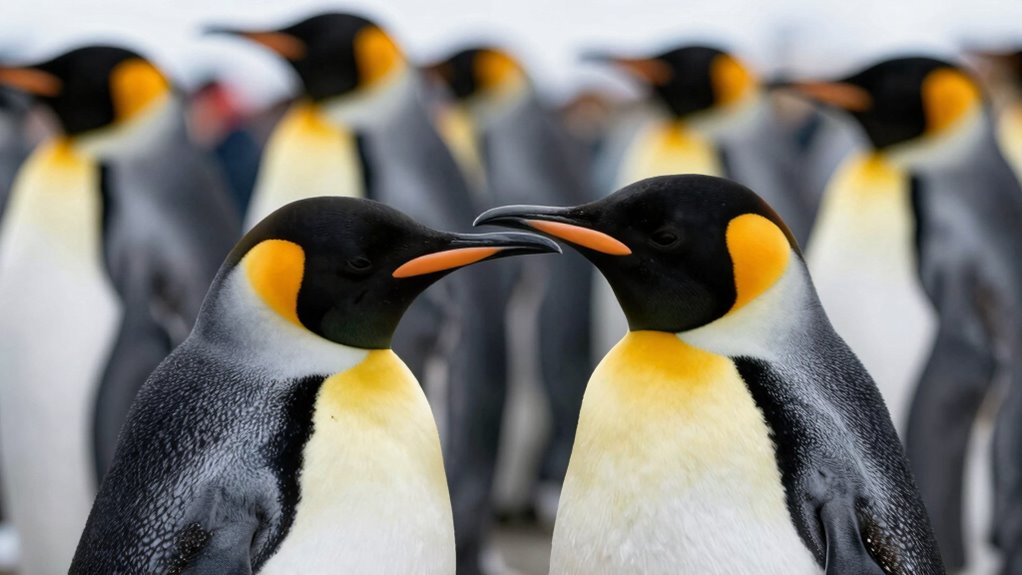

You can see that penguins recognize their mates through a clever system of vocalizations and feather patterns. Each penguin has a unique call, like a voice fingerprint, which they use to identify each other in noisy colonies. They also recognize subtle differences in feather markings and body posture. This combination of sound and sight helps them find their partners amid the chaos. Keep exploring to learn more about how these remarkable birds maintain their bonds.

Get pet supplies delivered free with Prime
- Fast, free delivery on millions of items
- Prime Video, Amazon Music and more included
- Member-only deals all year
Key Takeaways
- Penguins use unique vocalizations, acting as individual voice fingerprints, to identify their mates in noisy colonies.
- Distinct feather patterns with subtle markings help penguins visually recognize each other.
- Body posture and movements serve as additional visual cues for mate recognition.
- The combination of vocal and visual signals ensures accurate identification despite environmental noise.
- Recognizing mates through these methods maintains pair bonds and supports reproductive success.
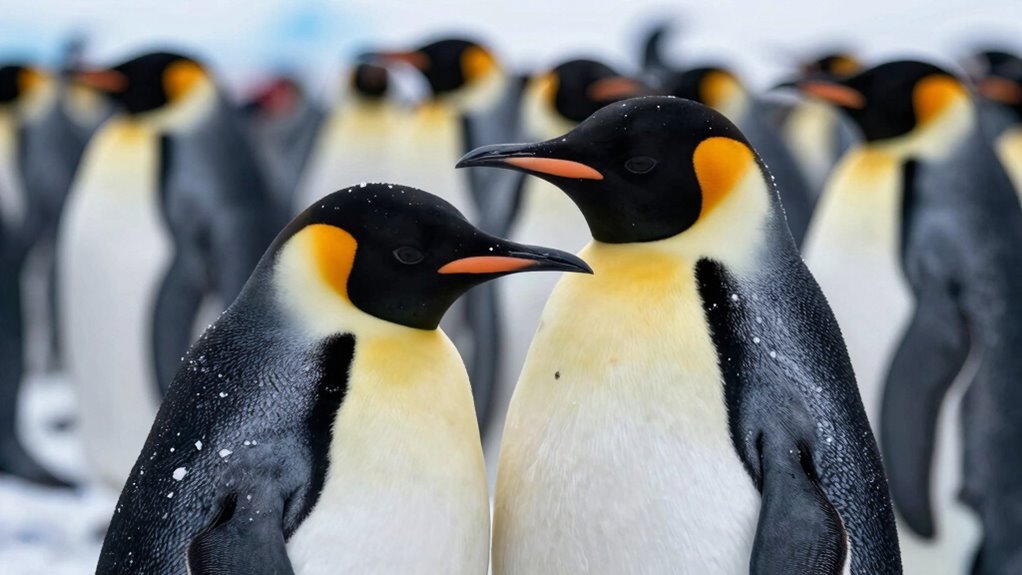
Many animals form strong bonds with their mates, but penguins take recognition to another level. When you’re in a bustling colony filled with hundreds or even thousands of these birds, distinguishing your partner can seem impossible. Yet, penguins have remarkable ways to find each other among the chaos. They rely on unique cues like vocalizations and feather patterns that make each penguin identifiable in a crowd.
Penguins use unique vocal calls and feather patterns to identify and stay connected with their mates in crowded colonies.
You’ll notice that penguins are incredibly vocal, especially during the breeding season. Each penguin develops a distinct set of calls known as *penguin vocalizations*. These sounds aren’t just simple squawks; they are complex, individual melodies that serve as a kind of voice fingerprint. When you observe a pair, you’ll see them engaging in a kind of duet, calling back and forth with a rhythm unique to their relationship. If you’re watching from a distance, these vocal cues are often the clearest way for a penguin to locate its mate. The female or male will recognize their partner’s voice amid the cacophony, allowing them to reunite even in a noisy colony.
But vocalizations aren’t the only method they use. Penguin feather patterns also play a *pivotal* role. Each penguin’s feathers have a unique arrangement, much like a fingerprint. These patterns, which include subtle variations in color and markings, help penguins visually identify each other. When you’re close enough, you might notice how a penguin’s chest or face has distinctive markings that remain consistent over time. These feather patterns are an example of an individual recognition trait that is crucial for maintaining bonds. They help a penguin to recognize its mate even if the vocalizations are muffled or if the sounds are drowned out by the colony’s noise. Researchers have also found that some penguins use visual cues like body posture and movements to aid in recognition, especially in dense colonies. Additionally, environmental factors such as the lighting conditions can influence how well visual cues are perceived during recognition.
Together, the combination of vocal cues and feather pattern recognition makes it possible for penguins to find their mates in crowded colonies. It’s a sophisticated system that relies on both sound and sight, ensuring that each penguin can maintain its pair bond despite the chaos of breeding season. Your observations might reveal how these small details—an individual call or a particular feather marking—are *indispensable* to their survival and reproductive success. Understanding penguin recognition methods highlights how their adaptation to noisy environments is crucial for their reproductive success. In a world filled with countless similar faces and voices, penguins have mastered the art of recognition, making their bonds stronger and more resilient than you might have initially thought.
As an affiliate, we earn on qualifying purchases.
Frequently Asked Questions
Do Penguins Recognize Each Other’s Voices?
Yes, penguins recognize each other’s voices. They use distinct Penguin vocalizations as Mate recognition signals, allowing them to identify their partner even in crowded colonies. When a penguin hears its mate’s unique call, it responds with a specific vocalization, helping maintain pair bonds. This vocal recognition is essential for their survival and breeding success, especially in noisy environments where visual cues might be less effective.
How Long Do Penguin Pair Bonds Last?
Like a timeless love story, penguin pair bonds often last for life, showcasing remarkable mate fidelity. Their bonding duration can span many years, sometimes their entire lives, because these connections are built on trust and familiar calls. You can imagine their bonds as a steady dance, unwavering through seasons and storms, where each partner’s recognition and devotion strengthen over time, creating a lifelong partnership that mirrors nature’s enduring rhythm.
Can Penguins Recognize Their Mates After Separation?
Yes, penguins can recognize their mates after separation. They use mate identification skills, relying on unique vocalizations and visual cues to find each other again. Separation effects don’t erase these bonds; instead, penguins often reunite quickly during breeding seasons. Their ability to identify mates helps guarantee successful pairing and raising chicks, even after being apart for a while. This remarkable recognition skill plays an essential role in their social and reproductive behaviors.
Do Penguins Use Any Visual Cues Besides Their Faces?
Imagine spotting a friend in a crowd by their unique style—penguins do something similar. Besides faces, they recognize mates through feather patterns and body postures, which act like a signature. These visual cues help them identify each other even amidst hundreds of peers. So, when you see a penguin tilt its head or display a distinctive feather design, it’s using more than just facial recognition to find its partner.
Are There Differences in Recognition Methods Among Penguin Species?
Yes, different penguin species use various recognition methods tied to their unique mating rituals and nesting behaviors. For example, some species rely heavily on vocal calls, while others recognize mates through distinctive visual cues like plumage patterns or unique markings. During nesting, they often develop specific behaviors or calls that help them identify each other amidst crowded colonies. These adaptations guarantee successful pair bonding despite environmental challenges.
Conclusion
Just like a lighthouse guides ships through a storm, a penguin’s unique call and appearance help it find its mate amid hundreds of others. Imagine standing in a crowded room, and suddenly, you spot your best friend’s smile—easy to recognize because it’s uniquely theirs. Penguins do the same with their mates, relying on subtle cues that stand out in the chaos. It’s a beautiful reminder that even in a crowd, love finds its way through the noise.
Evergreen bestsellers Picks
bestsellers
As an affiliate, we earn on qualifying purchases.