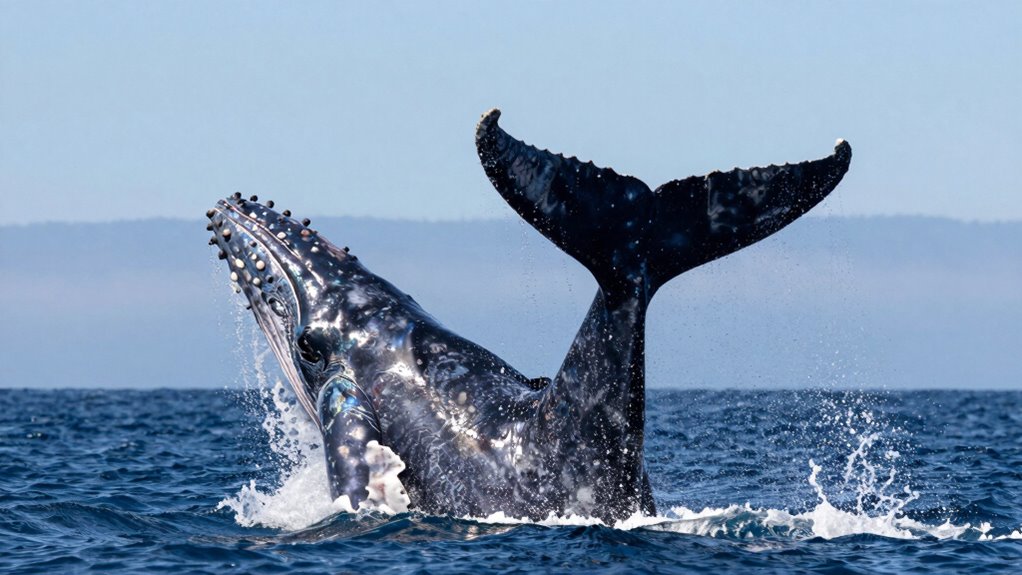
Whale tail slaps communicate a lot beneath the surface. They signal territory, social status, or migration plans, and create loud sounds that travel long distances underwater. You’ll see them as warnings to predators or signals to other whales about food sources or threats. These powerful displays help whales stay connected, protect themselves, and adapt to their environment. If you keep exploring, you’ll uncover even more fascinating details about what these impressive actions truly mean.
Key Takeaways
- Whale tail slaps serve as long-distance communication signals for social, territorial, or migratory purposes.
- They act as auditory alarms to alert pods or warn predators like orcas and sharks.
- Tail slaps help maintain social cohesion and coordinate group activities underwater.
- The intensity and context of slaps reveal behavioral cues related to environmental conditions.
- Powerful tail slaps function as strategic defense mechanisms to deter threats and ensure survival.
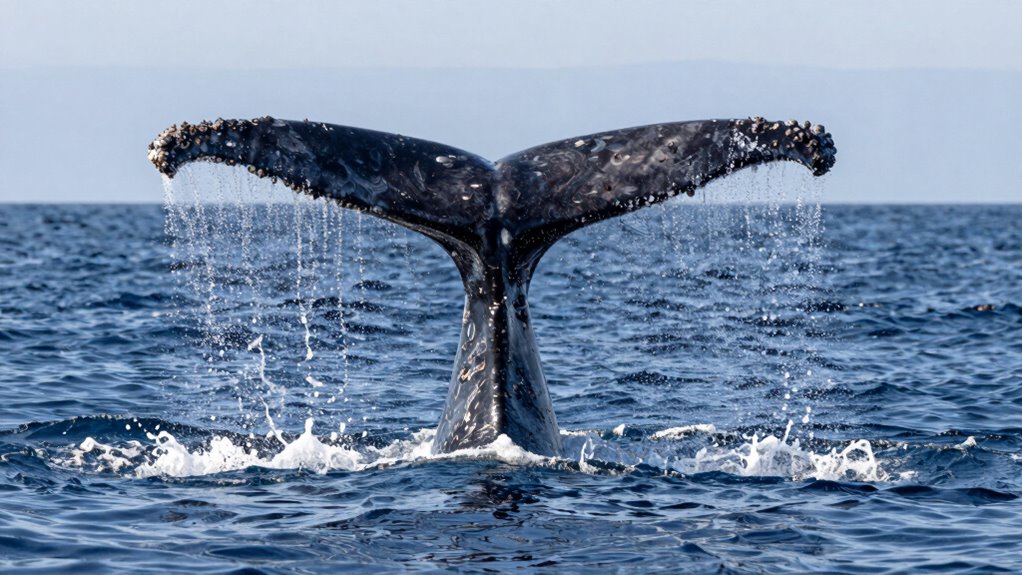
Whale tail slaps are more than just a spectacular display of strength; they often carry hidden messages within the ocean’s depths. When you observe a whale forcefully slapping its tail against the water, you’re witnessing a form of marine communication that goes beyond simple physical movement. These powerful swats aren’t random; they serve as signals to other whales, conveying messages about territory, social status, or even upcoming migrations. The loud, resonant sound waves created by tail slaps can travel long distances underwater, alerting nearby pods to the presence of food sources or potential threats. This method of communication is especially essential in the vast, often murky waters where visual cues might be limited. By understanding the context and intensity of these slaps, you can gain insight into what the whales are trying to convey, making this behavior an indispensable part of their social fabric. Additionally, the auditory signals produced by tail slaps are vital for maintaining cohesion within whale groups over large distances. Beyond communication, whale tail slaps also serve a critical role in predator deterrence. When you see a whale lift its tail high before slapping it down with force, it’s often a warning sign to predators like orcas or large sharks. The loud slap acts as an auditory alarm, startling potential attackers and signaling that the whale is alert and ready to defend itself. This defensive behavior helps keep the whale safe from harm, especially when it’s vulnerable, such as during resting or nursing. The physical power behind the tail slap isn’t just for show; it’s a strategic move, meant to intimidate or dissuade predators from approaching further. This behavior is a prime example of how whales use their physical capabilities as part of their survival strategies. Understanding the communication methods of whales reveals how they coordinate and protect themselves in their environment. Recognizing the importance of acoustic communication enhances our appreciation of how whales navigate their social worlds and respond to threats. If you’re watching from a distance, these aggressive displays serve as a reminder that whales aren’t passive victims—they’re equipped with effective tools for survival. The combination of visual and auditory signals creates a formidable defense mechanism that helps protect these massive creatures in the wild. Furthermore, recent studies highlight how behavioral cues like tail slaps can be influenced by environmental factors, emphasizing the importance of context in interpreting whale actions.
Occer 12×25 Compact Binoculars for Adults and Kids, Large Eyepiece Waterproof Binocular with Low Light Vision,High Powered Easy Focus Binoculars for Bird Watching,Outdoor Hunting,Travel,Sightseeing
【HIGH-POWERED LARGE EYEPIECE BINOCULARS】 This binoculars for adults has 12x magnification, 25mm objective lens and wide field of…
As an affiliate, we earn on qualifying purchases.
As an affiliate, we earn on qualifying purchases.
Frequently Asked Questions
Do Whale Tail Slaps Vary Between Different Whale Species?
Yes, whale tail slaps vary between species. You’ll notice different tail slap patterns in orcas, humpbacks, and gray whales, each serving specific purposes. These slaps play a role in whale communication, signaling territory or alerting others. Orcas might use rapid, powerful slaps, while humpbacks tend to produce longer, rhythmic patterns. Observing these variations helps you understand their behaviors and the messages they send through their unique tail slap patterns.
How Do Researchers Study Whale Tail Slap Behaviors?
Studying whale tail slap behaviors is like listening to a complex symphony—you need the right tools. Researchers use underwater cameras, acoustic signaling, and tagging devices to record and analyze these behaviors. They observe how whales slap their tails, noting patterns linked to social bonding or communication. By tracking movements and sounds, scientists uncover the meanings behind these displays, deepening our understanding of whale social lives and communication.
What Environmental Factors Influence Whale Tail Slap Frequency?
Environmental noise and water temperature considerably influence whale tail slap frequency. You’ll notice whales increase their slap activity in noisy environments, possibly to communicate or assert dominance. Warmer water temperatures can also affect their behavior, making them more active or altering their usual patterns. As you observe, these factors shape how often whales perform tail slaps, reflecting their responses to changing surroundings and helping researchers understand their communication and social interactions better.
Are Whale Tail Slaps Related to Mating Displays or Communication?
Whale tail slaps are like vocal fireworks, signaling more than just surface activity. You can see them as breaching signals, capturing attention during vital moments. These powerful displays often foster social bonding, serving as non-verbal communication in the vast ocean. They’re not just about showing strength; they’re about connecting with others, sharing intent, and reinforcing social hierarchies within their pod.
Can Whale Tail Slaps Indicate Distress or Danger?
Whale tail slaps can indeed indicate distress or danger, serving a behavioral significance in their communication. When whales engage in tail slapping, they often produce acoustic signaling that alerts others to potential threats. You might observe this behavior during stressful situations, such as predator presence or injury. These slaps help whales convey urgency, warn nearby pods, and coordinate protective responses, making them an essential part of their survival communication.

Scuba Rattle Stick Diving Safety Tank Signal Bell Shaker with Clip, Loud Underwater Sound Compact Design, Non-Corrosive Metal Aluminum Alloy Noise Maker Communication Device, Snorkeling Dive Equipment
Convenient Alert System: Knocking the cylinder of this Scuba Rattle Stick produces a loud, clear sound with steel…
As an affiliate, we earn on qualifying purchases.
As an affiliate, we earn on qualifying purchases.
Conclusion
So, next time you see a whale slap its tail, remember it’s more than just a splash. It’s a message, a warning, a call to attention. It’s a signal, a story, a language waiting to be understood. Just as you listen and observe, so do they communicate with their powerful tail slaps. Embrace the mystery, decode the signals, and appreciate the depth behind every splash. Because in their gestures, there’s meaning, there’s life, there’s connection.

Dissect-It Super Shark Lab Dissection Kit, 40-Piece Realistic Synthetic STEM Science Kit with Tools, Reusable Toy Marine Biology for Kids Ages 6+
Shark Dissection Kit: Experience the thrill of scientific exploration with the simulated Super Shark Lab dissection kit for…
As an affiliate, we earn on qualifying purchases.
As an affiliate, we earn on qualifying purchases.

Sea Animal Noisemaker with 16 Sounds, Whale Sounds, Dolphins, Seals, Otters, Walrus Aquarium Electronic Sound Maker – Portable Ocean Themed Sound Effects Board For Kids, Birthday Noise Maker Toy Gift
16 UNIQUE OCEAN THEMED SOUNDS – Sounds include Dolphin, Seal, Whale, Orca Whale, Sea Gull, Otter, Walrus, Shark,…
As an affiliate, we earn on qualifying purchases.
As an affiliate, we earn on qualifying purchases.