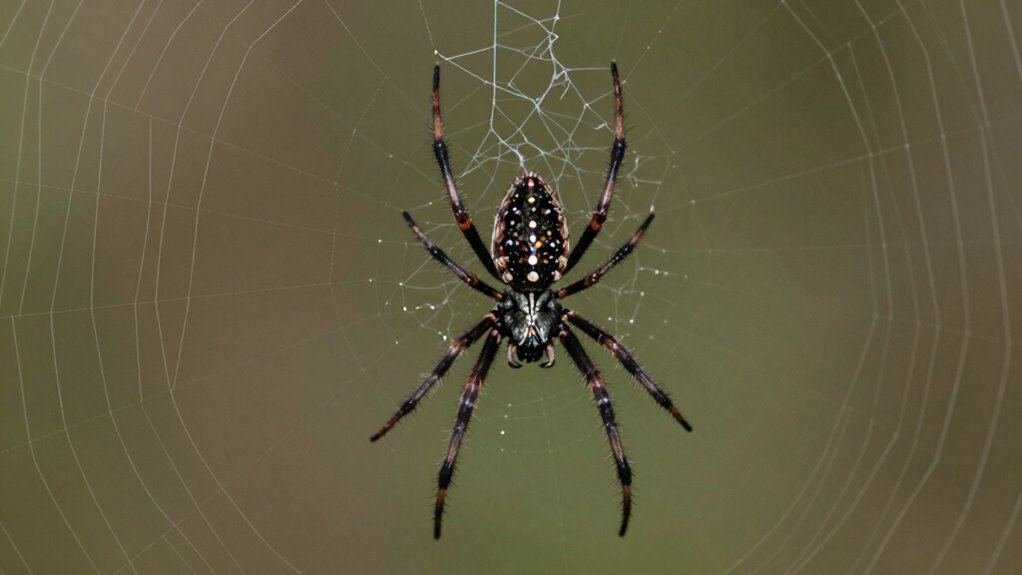

You might wonder if spiders can hear without ears—luckily, they do. Instead of traditional ears, they rely on vibrations to sense sounds from their environment. These vibrations travel through web silk or surfaces and are detected by specialized sensory organs on their legs and body hairs. This adaptation helps them locate prey and avoid danger. If you keep exploring, you’ll discover more about how their incredible vibration detection keeps them thriving.

Get pet supplies delivered free with Prime
- Fast, free delivery on millions of items
- Prime Video, Amazon Music and more included
- Member-only deals all year
Key Takeaways
- Spiders lack ears but detect vibrations through web and surface contact.
- They rely on sensory hairs and specialized organs to perceive environmental vibrations.
- Vibrations from sounds travel via webs or surfaces, enabling detection without traditional hearing.
- Their vibration sensitivity helps in hunting, avoiding predators, and environmental awareness.
- Evolutionary adaptation has enhanced their ability to perceive sounds through non-ear mechanisms.

Although spiders lack ears, they still manage to perceive sounds effectively. Instead of traditional ears, these creatures rely on alternative methods to detect vibrations and sounds in their environment. You might be surprised to learn that spiders are highly sensitive to ground-borne vibrations, which travel through their webs and the surrounding surfaces. When a small creature walks nearby or a predator approaches, the vibrations travel through the web, alerting the spider to potential danger or prey. Their ability to detect these vibrations is an incredible example of adaptation to their environment, allowing them to thrive without conventional hearing organs. This specialized sensitivity is a testament to their remarkable evolutionary adaptations.
Spiders detect sounds through vibrations in their webs and surfaces, not through traditional ears.
Your spider’s web spinning is not just a way to catch food; it’s also a crucial part of its sensory system. The intricate silk threads act like antennae, transmitting vibrations directly to the spider’s legs and body. These vibrations help the spider distinguish between different types of stimuli—whether it’s the subtle movement of a trapped insect or the heavy footsteps of a predator. Interestingly, their silk threads are uniquely suited to transmit vibrations efficiently, making their web a highly tuned sensory apparatus. This ability to sense vibrations through their webs allows them to respond quickly, either by immobilizing prey with venom delivery or by retreating to safety. Additionally, their sensory organs are finely tuned to pick up even the faintest tremors, enhancing their environmental awareness. It’s fascinating how this vibration detection is aided by their body hairs, which act as additional sensors.
Venom delivery is a critical part of how spiders hunt and defend themselves. When your spider detects the vibrations of an unsuspecting insect caught in its web, it swiftly moves toward the prey. Its legs are equipped with specialized sensory organs that pick up even the faintest tremors, guiding the spider’s precise movements. Once in position, it injects venom to immobilize or kill the prey efficiently. This process depends heavily on their ability to perceive vibrations, since they often rely on subtle cues rather than visual or auditory signals.
What’s remarkable is how well-adapted spiders are to their environment despite not having ears. Instead of relying on sound waves in the air, they pick up on vibrations through their web spinning and the surface tension of their silk. This adaptation makes them highly responsive to their surroundings, whether it’s detecting a prey’s movement or sensing a threat nearby. Your spider’s ability to perceive sounds through vibrations is a testament to evolution’s ingenuity, allowing it to thrive without conventional hearing organs. So, even though they don’t hear in the traditional sense, spiders are far from deaf—they simply listen in a different, incredibly effective way.
As an affiliate, we earn on qualifying purchases.
Frequently Asked Questions
Do All Spider Species Have the Ability to Hear?
Not all spider species can hear, but many use vibrations for communication and predator detection. You’ll find that spiders sense their environment through specialized organs called slit sensilla, which detect ground vibrations and air movements. This ability helps them communicate with others and avoid predators. So, while some spiders rely heavily on vibrations instead of hearing, not every species has the same capacity for auditory perception.
How Do Spiders Detect Vibrations Without Ears?
Imagine a spider as your vintage Walkman, but instead of headphones, it relies on vibration detection. You can bet that its sensory hairs, spread across its body and legs, act like tiny antennas. These hairs detect even the faintest vibrations from prey or predators. When vibrations hit these sensory hairs, they send signals to the spider’s nervous system, helping it respond swiftly without needing ears.
Can Spiders Respond to Sound Stimuli?
Yes, spiders can respond to sound stimuli through environmental sensing. They don’t hear like humans but detect vibrations and air movements that signal danger or prey. You might notice this during spider communication, where they respond to vibrations in their web or surroundings. Their sensory system allows them to interpret these cues, helping them react swiftly to environmental changes or potential threats.
Are Spider Hearing Abilities Linked to Their Web-Building?
You see a spider delicately weaving its web, each strand a silent signal receiver. Its hearing abilities are linked to web communication and sensory adaptation, allowing it to detect vibrations instead of sounds. When prey or threats disturb its web, the spider senses these cues through specialized hairs and vibrations, not ears. This intricate system turns its web into a sensory extension, making sound detection a matter of tactile perception rather than auditory organs.
Do Spiders Use Their Hearing to Hunt Prey?
You might think spiders rely on hearing to hunt, but instead, they use vibrations for predator detection and web communication. When prey touches their web, spiders sense the vibrations through their legs, helping them locate and catch prey efficiently. They don’t hear sounds like humans do but are highly sensitive to web vibrations, which serve as a critical tool for hunting and avoiding danger.
Conclusion
So, even without ears, you might think spiders are silent creatures, but they’re far from deaf. Instead of eardrums, they use sensitive hairs and slit sensilla to pick up vibrations and air movements—like a whisper on the wind. It’s a surprising contrast: they lack traditional ears but still perceive a world full of sound. In a way, their silent presence is a proof to nature’s ingenuity, proving that hearing isn’t limited to just ears.
Halloween Picks
halloween
As an affiliate, we earn on qualifying purchases.