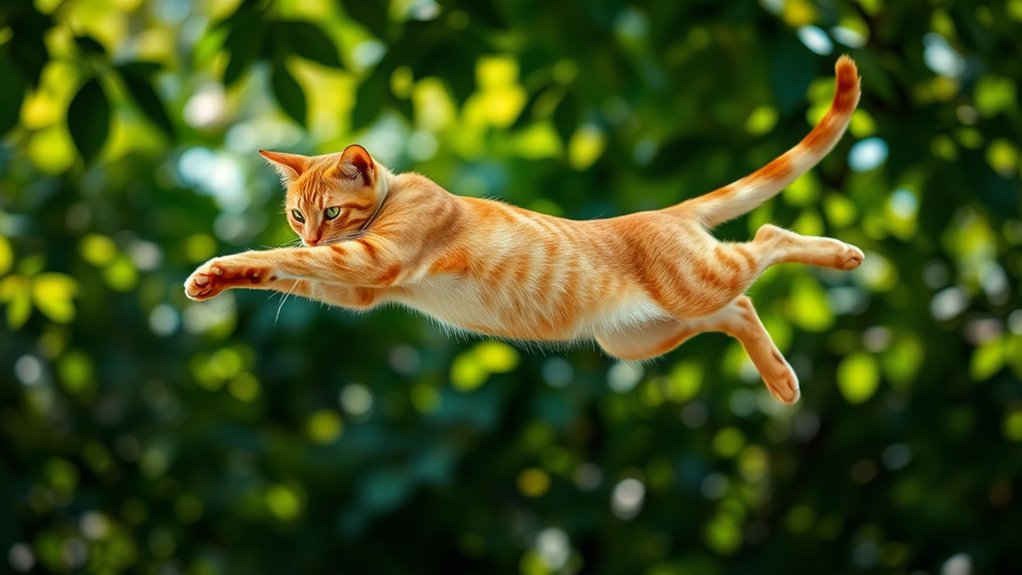

Cats land on their feet due to an instinctive reflex called the righting reflex. This allows them to twist their bodies mid-air and orient their feet downward before landing. Their flexible spine and a specialized tail help with balance and control during falls. Additionally, their lightweight bodies and ability to spread out increase air resistance, reducing impact forces. Want to uncover more about their extraordinary adaptations and how they navigate their environment?
Key Takeaways
- Cats possess a righting reflex that allows them to twist their bodies mid-air to orient their feet downward before landing.
- Their highly flexible spine, with more vertebrae than humans, enables quick bending and twisting during falls.
- The tail serves as a counterbalance, stabilizing the body and aiding in mid-air orientation.
- Cats can spread their bodies to increase air resistance, slowing their descent and reducing impact forces.
- Their lightweight skeletal structure and agility contribute to a lower risk of injury when landing.

When you watch a cat leap from a high surface, you might wonder how it always seems to land on its feet. This remarkable ability is a combination of instinct, anatomy, and something called the righting reflex. Cats have evolved over thousands of years to master this skill, and it’s fascinating to see it in action. When a cat falls from a height, it instinctively twists its body in mid-air, allowing it to orient itself so that its feet are positioned downward.
One of the key components of this righting reflex is the cat’s flexible spine. Unlike humans, a cat’s spine is made up of more vertebrae and has more elasticity. This flexibility lets the cat bend and twist its body as it falls. As it starts to tumble, the cat’s brain processes the fall and sends signals to its muscles, allowing it to adjust its position rapidly. You might notice how quickly a cat can flip itself around—this is largely due to its exceptional cat reflexes.
The cat’s flexible spine and quick reflexes enable it to twist and land on its feet safely during falls.
Now, let’s talk about the tail. You might not realize it, but a cat’s tail plays a significant role in maintaining balance. As they fall, the tail acts as a counterbalance, helping to stabilize their body during the twist. When a cat extends its tail out, it shifts its center of gravity, allowing for smoother adjustments. Think of the tail as a rudder on a ship; it helps steer the cat’s body into the right orientation for landing. Without this tail balance, a cat would struggle to adjust its position mid-air effectively.
Interestingly, cats are capable of landing from heights that would seriously injure other animals. Their unique skeletal structure and low body weight make them less susceptible to injury when they fall. Studies show that cats have a natural ability to spread their body out as they fall, which increases air resistance and slows their descent. This phenomenon is known as the “cat righting reflex” and is just one of the many reasons why cats are such agile creatures. Additionally, this ability highlights the importance of utilizing vertical storage solutions in the environment around them, as it allows cats to explore and navigate their surroundings more freely.
Frequently Asked Questions
Do All Cat Breeds Have the Same Landing Ability?
Not all cat breeds have the same landing ability. You’ll notice breed variations that affect their agility and coordination. For instance, some breeds like the Abyssinian or Bengal might be more adept at landing on their feet due to their athleticism. Age differences also play a role; younger cats tend to recover quicker than older ones. Keep these factors in mind when observing your feline’s acrobatics during their playful leaps!
Can Cats Be Trained to Fall Safely?
You can’t really train cats to fall safely like you would a dog, but you can use training techniques to help them develop agility and confidence. Start with low jumps and provide positive reinforcement. Incorporate safety precautions by ensuring their environment is free from hazards. While you can’t teach them to land perfectly every time, fostering their natural instincts can help them navigate heights more effectively.
What Injuries Can Cats Sustain From Falls?
When it rains, it pours, and cats can face a variety of injuries from falls. Common issues include broken bones, especially in the legs, as well as spinal injuries and internal trauma. The fall height impacts the severity; higher falls often lead to more serious injuries. To aid fall injury prevention, guarantee your home is safe by securing windows and removing hazards. Keeping your feline friend indoors can help prevent dangerous tumbles.
How Do Kittens Learn to Land on Their Feet?
Kittens learn to land on their feet through a combination of instinct and practice during their development. As they explore their surroundings, they engage in playful activities that enhance their agility and coordination. When they fall, their bodies instinctively adjust to position themselves for a safe landing. This process builds their confidence and skills, allowing them to refine their cat agility over time. So, don’t be surprised when you see them gracefully navigate their world!
Are There Any Exceptions to the Cat Righting Reflex?
Yes, there are exceptions to the cat righting reflex. In some cases, cats with physical disabilities or injuries may struggle to right themselves. Additionally, very young kittens, lacking coordination, might not execute this reflex effectively. During reflex evolution, these exceptions highlight how not all cats will perform perfectly. So, while most cats land on their feet, you’ll find a few who face challenges in doing so, reminding you of nature’s unpredictability.
Conclusion
In conclusion, you’ve seen how cats possess an incredible ability to land on their feet thanks to their unique skeletal structure and reflexes. This remarkable skill is a proof to the saying, “Practice makes perfect.” Just like cats refine their abilities through experience, you too can learn and improve in various aspects of life. Whether it’s a new skill or overcoming challenges, remember that persistence can help you achieve your own graceful landings.