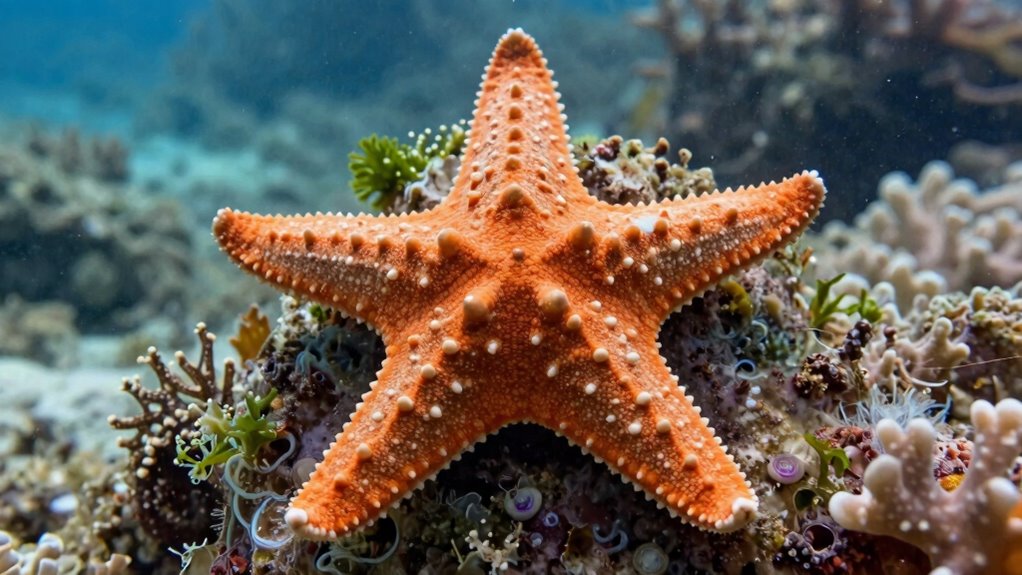

No, starfish don’t have brains. Instead, they rely on a decentralized neural network made up of nerve rings and radial nerves spreading throughout their arms. This setup allows them to process sensory information from their environment and react quickly without a central command center. Their unique nervous system helps them find food, avoid predators, and perform complex behaviors like opening shells. Curious to discover how this system keeps them resilient? Keep exploring to find out more.

Get pet supplies delivered free with Prime
- Fast, free delivery on millions of items
- Prime Video, Amazon Music and more included
- Member-only deals all year
Key Takeaways
- Starfish lack a centralized brain; instead, they have a decentralized nerve net system.
- Their nerve rings and radial nerves coordinate sensory and motor functions across their body.
- They do not have a brain responsible for processing information or controlling movement.
- Their neural network enables complex behaviors like opening shells without a brain.
- This decentralized system allows high resilience and adaptability in their marine environment.

Starfish may seem simple at first glance, but their nervous systems reveal surprising complexity. Unlike animals with centralized brains, starfish lack a single, dominant brain structure. Instead, their nervous system is decentralized, spread across their body through a network of nerve rings and radial nerves. This setup allows them to process marine sensory information from all around them without a central command center. You might think this makes them less intelligent, but their ability to sense their environment and respond effectively shows otherwise. Their marine sensory capabilities enable them to detect light, touch, and even chemical signals in the water, helping them find food, avoid predators, and navigate their surroundings. This decentralized system is highly efficient in their aquatic habitat, providing quick and localized responses that keep them safe and active. Additionally, their decentralized neural network** allows for a high degree of resilience and adaptability, making them well-suited to survive in diverse and challenging marine environments. When it comes to neural regeneration, starfish display remarkable abilities that further challenge the idea that they lack complexity. If parts of their nerve cords or arms are damaged, they can regenerate these parts entirely, including the nervous tissue. This process involves the growth of new nerve cells and the re-establishment of neural connections, allowing the starfish to recover from injuries that might be fatal in other animals. Neural regeneration in starfish isn’t just about healing; it’s a sign of their resilience and adaptability in the unpredictable marine environment. You can imagine how this ability might have evolved to help them survive predatory attacks or accidents in rocky reefs and sandy ocean floors. This regenerative capacity, combined with their decentralized nervous system, makes starfish fascinating creatures. They don’t rely on a brain to coordinate their movements or interpret their environment; instead, their entire neural network works together to keep them alive. Their marine sensory system feeds information into this network, allowing them to instinctively react to changes in their surroundings. As a result, they can perform complex behaviors such as opening shells of prey or finding their way across the ocean floor, all without a centralized brain. It’s a testament to how evolution has shaped them into resilient, highly adaptable marine animals** capable of thriving in a variety of conditions. So, while they may not have a brain in the traditional sense, starfish possess a sophisticated, decentralized nervous system that enables impressive sensory processing and neural regeneration.
starfish neural network educational model
As an affiliate, we earn on qualifying purchases.
As an affiliate, we earn on qualifying purchases.
Frequently Asked Questions
How Do Starfish Navigate Without a Brain?
Starfish navigate without a brain by relying on their decentralized neural network, which runs through their arms. This network allows them to process sensory information and coordinate movement effectively, enabling marine animal navigation. You can think of their nervous system as a distributed system, rather than a central brain, giving them the ability to respond to environmental cues and move across the ocean floor with remarkable precision.
Can Starfish Learn or Remember Things?
Starfish have limited learning capabilities, but recent studies suggest some level of starfish intelligence. You might be surprised to learn they can remember certain stimuli, like avoiding harmful areas or recognizing food sources. Their simple nervous system allows basic responses, indicating they can learn from experience. However, their learning abilities are quite primitive compared to creatures with brains, so their starfish intelligence remains relatively basic.
Do All Starfish Species Lack Brains?
Imagine a starfish as a juggler, handling multiple tasks without a central brain. All starfish species lack brains; instead, they have a nerve net that controls their movements. This setup suits their starfish reproduction and habitat needs perfectly, allowing them to adapt and survive in diverse environments. So, whether in coral reefs or tide pools, they operate efficiently without a traditional brain, showcasing nature’s ingenuity.
How Do Starfish Coordinate Their Movements?
You might wonder how starfish coordinate their movements without a brain. They rely on a decentralized nerve net and a unique water vascular system that controls their tube feet. This system allows them to respond to stimuli and move efficiently, especially when hunting as marine predators. Their remarkable regeneration abilities also help them recover from injuries, maintaining coordination even after losing limbs, ensuring they stay effective predators in their environment.
What Sensory Organs Do Starfish Use?
Imagine a star-shaped compass guiding your journey; that’s what starfish sensory organs do. You’ll find their sensory receptors mainly on their arms, detecting light, touch, and chemicals, while their extensive nerve networks act like a body’s central nervous system. These receptors and nerve networks work together, allowing starfish to sense their environment, find food, and avoid danger, even without a brain. It’s a quiet, resilient system of awareness.
Conclusion
You might be surprised to learn that starfish don’t have brains at all. Instead, their nerve nets and eye spots at the tips of their arms help them navigate their environment. Remarkably, despite lacking a centralized brain, starfish can regenerate lost arms and even entire bodies. Did you know that some species can survive with up to 75% of their body missing? This resilience shows that even without a brain, starfish are incredible survivors in the ocean.
Halloween Picks
halloween
As an affiliate, we earn on qualifying purchases.