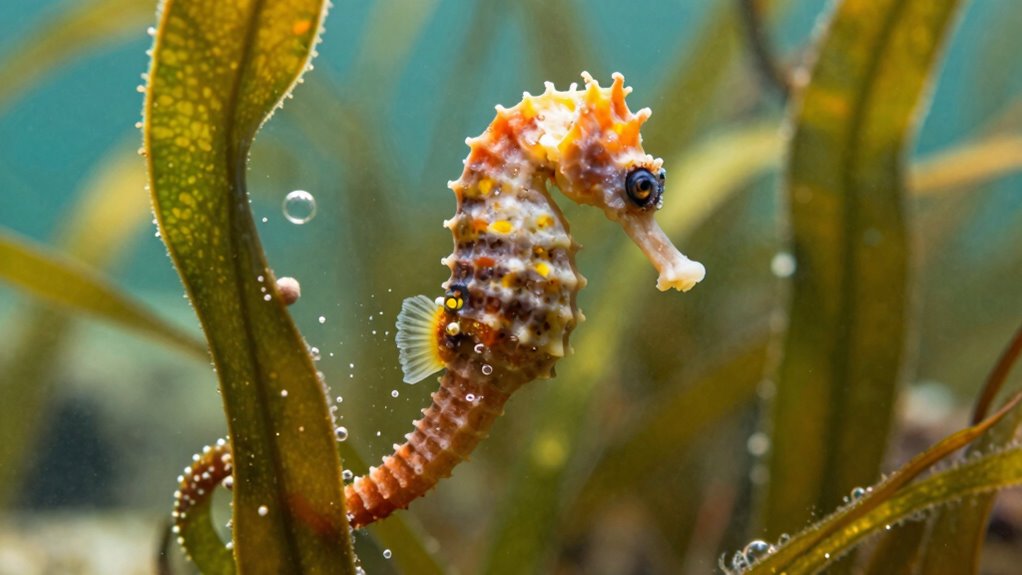

Seahorses give birth when the female deposits eggs into a special pouch on the male’s abdomen, where fertilization takes place. The male actively cares for the developing embryos, controlling the environment and protecting them from dangers. After 10 days to 6 weeks, depending on the species and conditions, the male contracts muscles to push out fully formed tiny seahorses. If you want to discover more about this fascinating process, keep exploring the details of their unique reproduction.

Get pet supplies delivered free with Prime
- Fast, free delivery on millions of items
- Prime Video, Amazon Music and more included
- Member-only deals all year
Key Takeaways
- Female seahorses deposit eggs into the male’s specialized pouch for fertilization and incubation.
- The male controls the pouch environment, providing oxygen and nutrients during embryo development.
- Development inside the pouch lasts from 10 days to 6 weeks, depending on species and water temperature.
- The male gives birth by muscular contractions, releasing fully formed tiny seahorses.
- Newly born seahorses are independent and immediately face survival challenges in their environment.
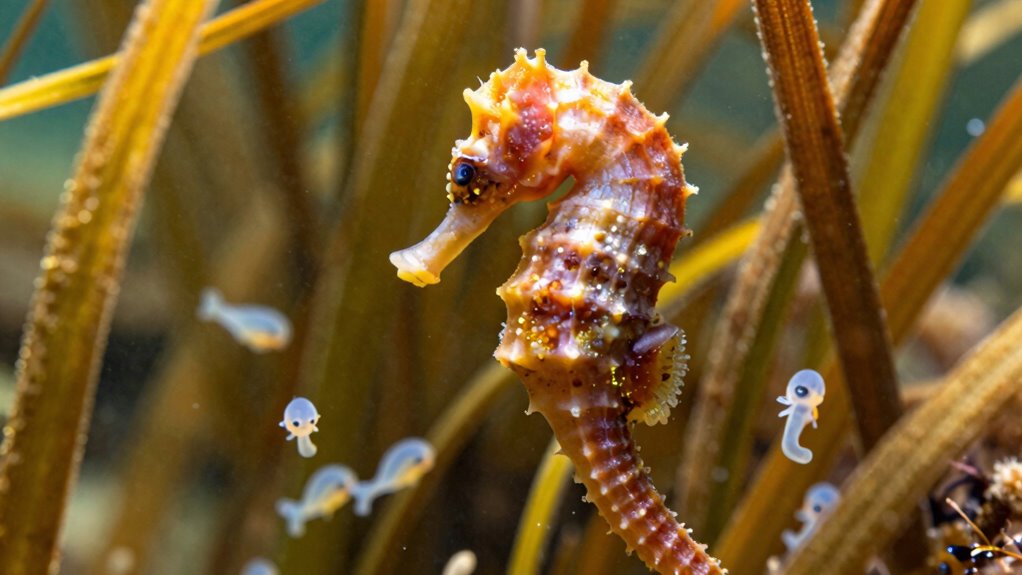
Unlike most animals, seahorses are remarkable because the males carry and give birth to their young. This unique reproductive process sets them apart and highlights the importance of understanding their biology and habitat. If you’re interested in marine conservation, learning how seahorses give birth can deepen your appreciation for their delicate lives and the threats they face. Their seahorse habitat, typically shallow coastal waters with plenty of seagrass and coral, is essential for their survival, and protecting these environments helps guarantee their continued existence.
Seahorses’ unique reproduction highlights the importance of protecting their shallow coastal habitats.
When it’s time to reproduce, the female seahorse deposits her eggs into a specialized pouch on the male’s abdomen. This pouch acts like a secure incubator, providing oxygen and nutrients to the developing embryos. You might think of it as a tiny underwater nursery. The male then fertilizes the eggs inside his pouch, where they develop for a period ranging from ten days to six weeks, depending on the species and water temperature. During this time, the male seahorse is actively involved, controlling the environment inside his pouch and making sure the eggs are safe from predators and environmental stresses. The process of reproductive success in seahorses is highly dependent on the stability of their environment.
As the young near maturity, the male begins to prepare for birth. In the final stage, he undergoes a series of muscular contractions that force the tiny, fully formed seahorses out of his pouch. You might imagine it as a challenging yet natural process, as dozens to hundreds of miniature seahorses emerge, ready to start their own lives. Once born, the tiny seahorses are independent and immediately face the challenges of finding food, avoiding predators, and establishing their own seahorse habitat. Their survival depends on the availability of nutrients and shelter in their environment, emphasizing the importance of healthy ecosystems.
The survival of these young seahorses depends heavily on the health of their environment. Marine conservation efforts focus on protecting seahorse habitat, such as seagrass beds and coral reefs, which are essential for their breeding and shelter. When these habitats are damaged by pollution, habitat destruction, or overfishing, the reproductive success of seahorses diminishes, threatening their populations. By understanding how seahorses give birth and supporting marine conservation initiatives, you contribute to safeguarding their future. Protecting their habitat not only guarantees successful reproduction but also preserves the entire ecosystem that sustains countless marine species. Maintaining healthy seahorse habitat is crucial for their survival and the overall health of marine ecosystems. Your awareness and actions can make a real difference in maintaining the fragile balance that allows seahorses to thrive in the wild.
As an affiliate, we earn on qualifying purchases.
Frequently Asked Questions
How Long Is a Seahorse’s Pregnancy?
A seahorse’s pregnancy lasts about 10 to 14 days. During seahorse mating, males become pregnant and carry the developing babies in their pouches, showcasing unique seahorse parenting. You’ll notice the male’s pouch swelling as the tiny seahorses grow. Once ready, the male goes into labor, releasing the tiny, fully formed seahorses into the water. This fascinating process highlights their extraordinary approach to reproductive roles.
Do All Seahorse Species Give Birth the Same Way?
Seahorse species surprisingly differ in their birthing behaviors. During seahorse mating, males carry and give birth to tiny, delicate offspring, often in a specialized pouch. While most seahorses share this unique process, some species show subtle variations in their reproductive routines. You’ll marvel as seahorses, masters of camouflage, perform their extraordinary roles—males as the miracle-makers, and females as the fabulous fertilization figures—making each species’ birth process uniquely enthralling.
Can Seahorses Give Birth More Than Once a Year?
Yes, seahorses can give birth more than once a year. During seahorse courtship, the male plays a vital reproductive role by carrying and nurturing the developing embryos in his pouch. After giving birth, the male readily becomes pregnant again, allowing for multiple reproductive cycles annually. This unique process highlights the significance of male involvement in seahorse reproduction, making their reproductive cycle quite different from many other species.
What Happens if a Seahorse’s Female Mate Is Unavailable?
If a seahorse’s female mate is unavailable, the male typically waits or seeks out a new partner to guarantee his reproductive strategies. Seahorses rely heavily on mate selection, often forming strong bonds with their chosen partner. When the original mate is absent, the male adapts by either remaining solitary until a new female appears or actively searching for a suitable mate to ensure his reproductive success.
How Do Seahorses Protect Their Babies After Birth?
You can help seahorses protect their babies by understanding their natural defenses. Seahorses use camouflage, blending into their surroundings to avoid predators, which benefits their offspring too. After birth, the tiny seahorses are vulnerable, so you should keep their habitat safe and undisturbed. Maintaining a proper seahorse diet guarantees their health, enabling them to produce strong, healthy young that are better equipped to survive in the wild.
Conclusion
Now that you know how seahorses give birth, you can see how remarkable they are. Their unique reproductive process, where the male carries and gives birth to babies, is like a secret dance of nature that surprises us at every turn. It’s a reminder that life is full of unexpected wonders, much like discovering a hidden treasure. So, next time you see a seahorse, remember, it’s a tiny marvel that defies expectations and redefines what’s possible.
Halloween Picks
halloween
As an affiliate, we earn on qualifying purchases.