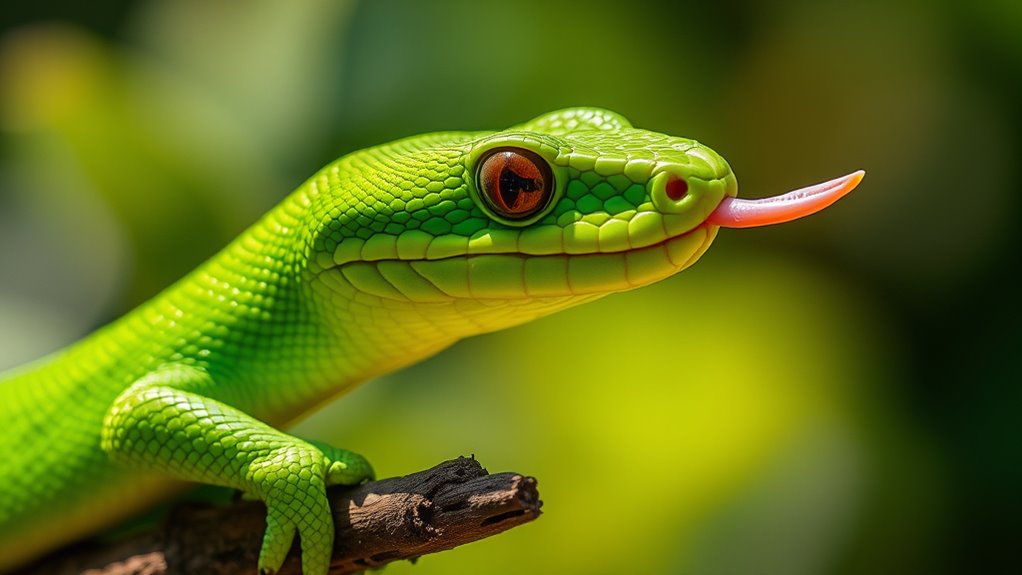

Snakes smell with their tongues by flicking them to collect chemical particles from the air. They then use a special organ called Jacobson’s organ in their mouths to analyze these scent molecules. This process allows them to detect prey, mates, and potential threats, making it essential for their survival. Each flick provides critical information about their environment. If you’re curious about how this skill impacts their hunting and social behaviors, there’s more to discover.
Key Takeaways
- Snakes flick their tongues in and out to collect chemical particles from the air, enhancing their sense of smell.
- The tongue delivers scent molecules to Jacobson’s organ, located in the roof of the mouth for chemical analysis.
- This process allows snakes to detect prey, mates, and threats effectively using chemical cues.
- The advanced smell system enables snakes to navigate their environment and make critical survival decisions.
- Tongue flicking also aids in social communication, helping snakes interpret reproductive signals and rival presence.

Have you ever wondered how snakes navigate their world? It’s fascinating how these creatures utilize their tongues not just for tasting, but also for smelling. When you see a snake flicking its tongue in and out, it’s actually gathering chemical particles from the air. This process is essential for their survival, as it helps them locate prey, find mates, and identify threats. You might be surprised to learn that their sense of smell is more advanced than that of many mammals, making it a critical tool in their daily lives.
Snakes have a specialized organ called the Jacobson’s organ, located in the roof of their mouth. When they flick their tongues, they collect scent molecules and deliver them directly to this organ. This allows snakes to analyze their environment and make informed decisions. Imagine walking through a forest; you’d want to know if there’s food nearby or if a predator is lurking around. Snakes do the same, using their keen sense of smell to assess their surroundings.
Snakes use their Jacobson’s organ to analyze scents, helping them navigate their environment for food and potential threats.
In terms of snake hunting strategies, this method of smelling plays a pivotal role. When a snake senses potential prey, it can track the scent trail left behind, allowing it to hone in on its target. Different snakes have varying venom compositions, which influences their hunting techniques. For instance, some snakes rely on quick strikes to inject venom and immobilize their prey, while others may use constriction. Regardless of the method, effective hunting heavily depends on their ability to identify and locate food through smell purification.
Additionally, the chemical cues picked up by their tongues can provide information about the reproductive status of potential mates or even signal the presence of rivals. This means that their tongue-flicking behavior isn’t just about finding food, but also about communication and social interaction within their species.
Understanding how snakes smell with their tongues gives you insight into their incredible adaptations. It’s a complex system that allows them to exploit their environment effectively. Next time you see a snake in the wild, remember that each flick of its tongue is a critical part of its survival strategy, revealing a world of information that’s often hidden from our view. Snakes may seem simple, but their methods of navigation are anything but straightforward.
Frequently Asked Questions
Can Snakes Taste With Their Tongues Too?
Yes, snakes can taste with their tongues! Their unique tongue anatomy allows them to pick up chemical particles from the air and surfaces. When you see a snake flicking its tongue, it’s not just smelling; it’s sampling its environment. This process serves dual purposes, acting as both a scent detection method and a way to taste potential food. So, in a way, their tongues do double duty!
Do All Snake Species Use Their Tongues to Smell?
Not all snake species use their tongues to smell in the same way. Most have specialized tongue anatomy that helps them pick up scent particles from the air or ground. When you see a snake flicking its tongue, it’s actually dispersing scents to its Jacobson’s organ for analysis. This method is vital for hunting and navigation, but some species rely more on other senses, making their reliance on tongue-based scent detection less pronounced.
How Often Do Snakes Flick Their Tongues?
You’ll notice that snakes flick their tongues constantly, often every few seconds. This tongue flicking behavior is vital for their sensory adaptation, as it helps them gather chemical particles from the air. By doing this, they can detect prey, predators, and mates. So, whenever you observe a snake, remember that its frequent tongue flicks are an essential part of how it interacts with its environment and navigates its world.
Can Snakes Detect Scents Underwater?
Yes, snakes can detect scents underwater, much like a detective following a trail. They rely on a process called aquatic sensing, utilizing their tongues to capture scent particles. Once they’ve collected these particles, they transfer them to their Jacobson’s organ, enhancing their scent detection. This ability allows them to hunt effectively in watery environments, making them versatile predators. So, whether on land or in water, they’re always tuned into their surroundings!
What Role Do Nostrils Play in a Snake’s Sense of Smell?
Nostrils play a crucial role in a snake’s sense of smell by allowing air to flow into their nasal cavities, where olfactory receptors are located. When you see a snake flick its tongue, it captures scent particles and brings them back to the roof of the mouth, enhancing the signals sent to the olfactory receptors. This combination helps the snake detect prey, predators, and mates, making their sense of smell incredibly effective.
Conclusion
In the dance of survival, snakes flick their tongues like delicate ribbons, tasting the air’s secrets. Each flick draws in scents, weaving a tapestry of their world, where prey and danger intertwine. With every subtle movement, they gather whispers of life, a mosaic of smells that guide their journey. So next time you see one, remember—each flick is more than instinct; it’s a vibrant connection to the pulse of nature, alive and ever-changing.