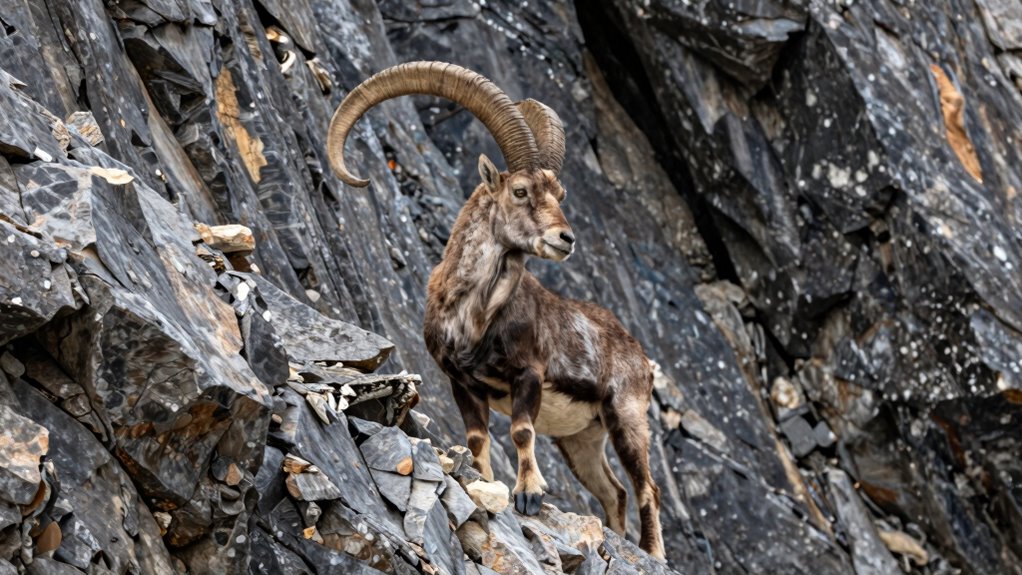

You’ll notice that Markhor goats look built for cliffs thanks to their spiraled, strong horns and textured hooves that provide grip on rocky surfaces. Their split hooves act like crampons, helping them hold onto cracks and ledges, while cautious, deliberate movements prevent slips. These physical features and behaviors have evolved over generations, making them expert climbers. To find out exactly how their adaptations work together, keep exploring—they’re truly remarkable survivors.

Get pet supplies delivered free with Prime
- Fast, free delivery on millions of items
- Prime Video, Amazon Music and more included
- Member-only deals all year
Key Takeaways
- Their spiraled horns provide stability and support for balancing on narrow ledges.
- Specialized split hooves with sharp edges enable gripping cracks and steep surfaces.
- Textured hooves increase traction on loose, rocky terrain for secure footing.
- Cautious, deliberate movements reduce slipping risks in rugged environments.
- Physical and behavioral adaptations collectively enhance their ability to navigate cliffs safely.
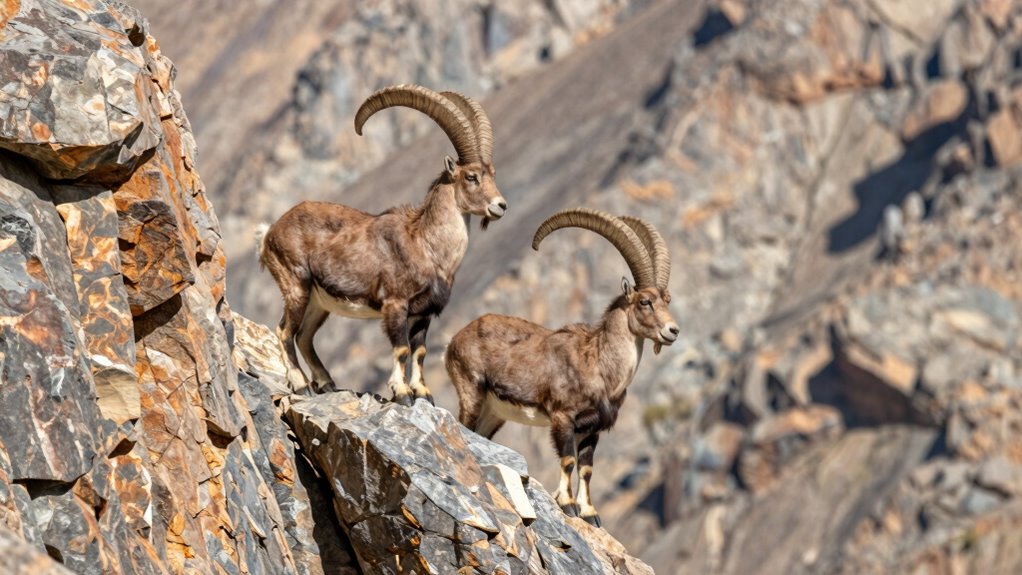
High on the rugged cliffs of Central Asia, the elusive markhor goat skillfully steering through the steep, rocky terrain that seems almost impossible to conquer. You might wonder how such a creature survives in these treacherous environments. The answer lies in its remarkable habitat adaptation and evolutionary traits, which have shaped it into a master of cliffside living. Over generations, the markhor has developed physical features and behaviors that make it uniquely suited for steep, rugged landscapes.
The markhor’s remarkable adaptations enable it to thrive on steep, rugged cliffs through specialized physical traits and cautious, agile behavior.
You’ll notice that its horns are a defining feature, spiraling elegantly but also serving practical purposes. These horns are not just for display—they’re a testament to its evolutionary traits. They help the goat establish dominance and defend itself from predators, but they also assist in climbing. The horns’ shape and strength enable the markhor to balance and anchor itself on narrow ledges, giving it an edge in traversing vertical terrain. This adaptation minimizes the risk of falling while moving across unstable surfaces.
The markhor’s hooves are another example of its habitat adaptation. You might think all goat hooves are similar, but these are specialized for gripping rocky surfaces. They have a rough, textured surface that provides traction on loose gravel and sharp rocks. The split hooves, with their sharp edges, act like natural crampons, allowing the goat to grip cracks and ledges with precision. This evolutionary trait is vital for managing the steep slopes and uneven terrain that define its habitat. Additionally, the shape and texture of its hooves are a result of physical adaptations that ensure stability on rugged surfaces. These adaptations have been shaped by evolutionary pressures, helping the markhor navigate complex terrains with agility. Moreover, their ability to navigate complex terrains has been crucial for survival in such challenging environments. Recognizing the importance of these features, scientists have studied the markhor’s anatomy to better understand evolutionary adaptations in mountain-dwelling animals.
Beyond physical features, the markhor has also evolved behavioral traits that enhance its survival on cliffs. You instinctively recognize that it’s a cautious creature, moving carefully and deliberately. This cautiousness is an adaptive trait, reducing the risk of slips or falls. Its agility and balance aren’t accidental—they’re the result of natural selection favoring those who can navigate their dangerous environment efficiently.
In essence, you see that the markhor looks built for cliffs because of a suite of evolutionary traits tailored for this rugged habitat. Its horns, hooves, and cautious behavior all work together to make it a formidable climber. Nature has fine-tuned the markhor over countless generations, transforming it into a symbol of resilience and adaptability in some of the world’s most challenging terrains. It’s a proof of how evolution shapes creatures to thrive exactly where others might falter.
Products Worth Considering

Shark Rotator Pet Pro Lift-Away Upright Vacuum, DuoClean PowerFins, LA555

Shark Navigator Robot Vacuum with Self-Empty Base, Dark Grey (RV2120AE)

Dyson V16 Piston Animal Cordless Vacuum
As an affiliate, we earn on qualifying purchases.
Frequently Asked Questions
How Long Do Markhor Goats Typically Live in the Wild?
You’ll find that Markhor goats typically live around 8 to 12 years in the wild. Their habitat, often steep cliffs and rugged mountains, helps protect them from predators. Their diet preferences include leaves, grasses, and shrubs they find in these rocky areas. Their agility and specialized hooves make it easier to navigate their challenging environment, helping them survive longer despite threats like predators and harsh weather conditions.
What Are the Main Predators of Markhor Goats?
Imagine predators like snow leopards and wolves lurking like shadows in the rugged mountains. You need to focus on habitat conservation and predator prevention to protect markhor goats. Their rocky habitats help them escape, but threats still exist. By preserving these environments and implementing predator management strategies, you can guarantee these skilled climbers continue to thrive, keeping their natural balance intact.
Can Markhor Goats Adapt to Different Terrains Besides Cliffs?
You might wonder if markhor goats can adapt to different terrains beyond cliffs. They demonstrate impressive mountain survival skills, allowing them to thrive on rocky slopes and rugged terrains. However, their terrain versatility is limited; they excel most in steep, inaccessible cliffs where predators struggle to reach them. While they can navigate some less steep areas, their unique adaptations make cliffs their ideal environment, ensuring their survival in challenging mountain landscapes.
How Do Markhor Goats Communicate With Each Other?
You hear the echo of Markhor vocalizations, a symphony carried on mountain winds, as they communicate through loud bleats and gentle whistles. These sounds forge social bonds, signaling territory or alerting others to danger. Their social bonding behaviors include head-butting and grooming, which strengthen their connections. Every call and gesture creates a rhythm that keeps the herd united, turning rocky cliffs into a communal chorus of survival and trust.
Are Markhor Goats Endangered or at Risk of Extinction?
You should know that markhor goats are endangered due to habitat conservation issues and a significant population decline. These impressive creatures face threats from hunting and habitat loss, putting their survival at risk. Conservation efforts are vital to protect their natural habitat and stabilize their numbers. If you want to help, supporting wildlife preservation programs can make a real difference in ensuring these remarkable goats continue to thrive in the wild.
Conclusion
Now, imagine standing atop those treacherous cliffs, watching the markhor effortlessly navigate the jagged edges. Their incredible adaptability isn’t just a coincidence—it’s a secret forged by evolution. But what other mysteries do these extraordinary goats hide? As you ponder their survival skills, one thing’s certain: the more you learn, the more you realize there’s still so much about these cliff-dwellers waiting to be uncovered. Are you ready to explore their hidden world?