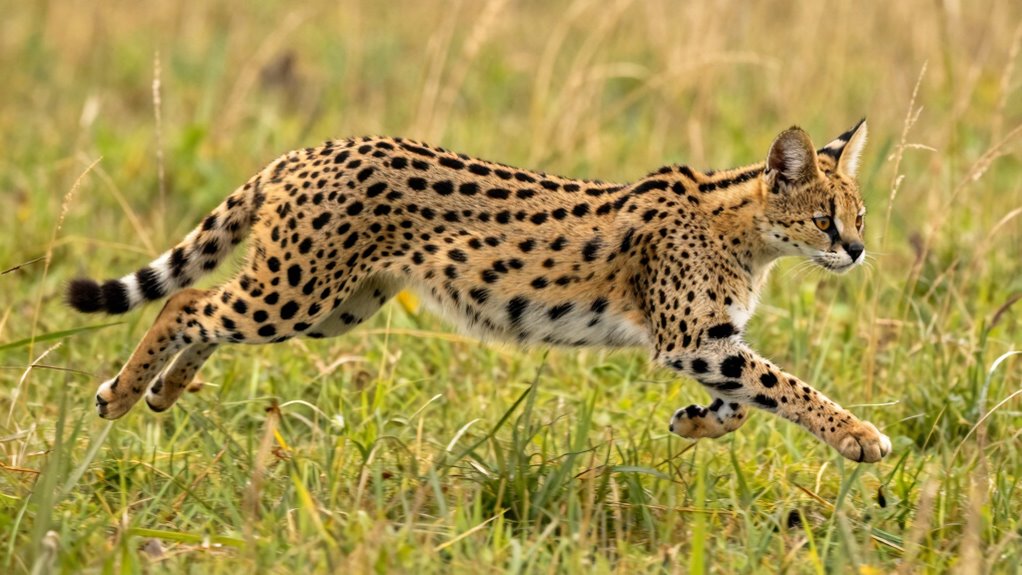

You can see that the serval’s long, muscular legs and flexible spine make it an exceptional high jumper, helping it reach prey hidden in tall grass or up low branches. Its slender frame keeps it lightweight, while its powerful legs act like springs, launching it into the air effortlessly. These physical features are the results of evolution, optimized for quick, surprise attacks. Keep exploring to learn more about how the serval’s anatomy makes it such a skilled hunter.

Get pet supplies delivered free with Prime
- Fast, free delivery on millions of items
- Prime Video, Amazon Music and more included
- Member-only deals all year
Key Takeaways
- Long, muscular hind legs provide the power needed for high and rapid jumps to catch prey.
- Flexible spine allows maximum reach and extension during vertical leaps.
- Anatomical features act as natural springs, facilitating efficient and minimal-effort launches.
- High jumps enable ambush attacks in tall grass and dense vegetation.
- Adaptations enhance hunting success by surprising prey from above or at elevated positions.
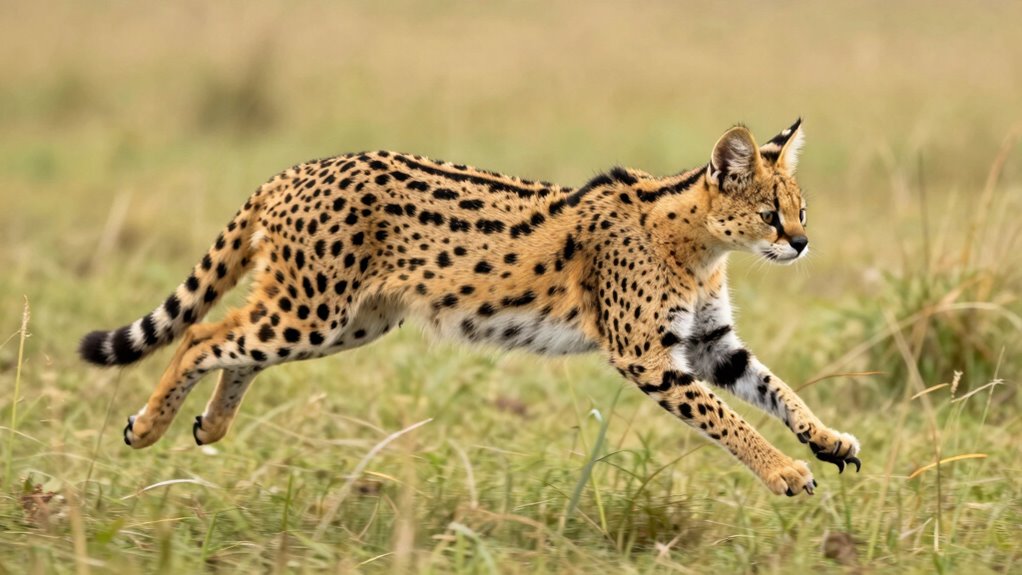
Ever wonder what makes the serval such an exceptional jumper? The secret lies in its distinctive anatomy that’s perfectly designed for high leaps and agile hunting. Unlike many other wild cats, the serval’s body is built for explosive power and precision. Its long legs, which are significantly longer than its body, give it a notable advantage when it comes to height and distance. These extended limbs are not just for show; they act like powerful springs, enabling the serval to launch itself into the air with minimal effort. Its slender frame reduces weight, making it easier to lift and propel itself upward. The serval’s flexible spine also contributes to this ability, allowing it to stretch and extend during jumps, maximizing reach and height. Its large, muscular hind legs work in tandem with its elongated limbs, providing the thrust needed for impressive vertical leaps. This anatomy isn’t just for show; it’s a vital component of its hunting strategies. Additionally, the serval’s anatomical adaptations are a prime example of how evolution shapes predator efficiency, optimizing its body for rapid, high-powered movements. These adaptations are complemented by its keen sensory capabilities, which help it detect prey even at great distances. When you consider how the serval hunts, it becomes clear why such a remarkable body is essential. The serval’s hunting techniques rely heavily on its ability to surprise prey from above or near the ground. It stalks quietly through tall grass, its keen eyesight and acute hearing helping it locate hidden prey like rodents, birds, or insects. Once it spots a target, it doesn’t need a long run to catch it. Instead, it relies on a quick, powerful jump to land directly on the prey or to reach it before it can escape. This sudden vertical leap often surprises prey, giving the serval the upper hand. Its ability to leap high and far means it can hunt in dense grasslands where prey often hides in tall vegetation. The serval’s high jumps also help it reach prey perched on low branches or in elevated spots, broadening its hunting scope. In essence, the serval’s extraordinary jumping ability is a combination of its unique anatomy and clever hunting strategies. Its long legs, flexible spine, and muscular hind limbs work seamlessly together, giving it the power and agility needed for high leaps. These adaptations allow it to hunt efficiently in its environment, ambushing prey with swift, vertical strikes. Its agility, which is a result of its specialized anatomy, further enhances its ability to make rapid movements and adjustments during a chase. These evolutionary designs have been finely tuned over generations to maximize hunting success. So, next time you see a serval leaping gracefully through the air, remember that it’s not just an impressive feat of agility—it’s a result of evolutionary design tailored perfectly for its survival and hunting success.
As an affiliate, we earn on qualifying purchases.
Frequently Asked Questions
How High Can a Serval Jump Compared to Other Cats?
You’ll find that a serval can jump up to 10 feet in the air, which is higher than most domestic cats. This impressive feat is due to their exceptional serval agility and feline balance, allowing them to leap great distances and heights effortlessly. Compared to other cats, their high-jumping ability stands out, making them outstanding hunters and agile predators in their natural habitat.
What Specific Muscles Enable the Serval’s Impressive Leaps?
The serval’s stunning leaps stem from its powerful, perfectly coordinated muscles. Your focus should be on the hind limb muscles, especially the quadriceps and gastrocnemius, which generate incredible leg strength. These muscles work in harmony, harnessing high muscle coordination to propel the serval skyward. This combination of strong, synchronized muscles grants the serval the remarkable ability to leap great heights, catching prey with precision and agility.
Do Servals Use Their Jumping Ability for Hunting or Escaping Predators?
You’ll find that servals use their incredible jumping ability primarily for hunting, much like domestic cats do, to catch prey high in trees or on the ground. Their high jumps help them surprise and overpower prey efficiently. While they can escape predators with quick leaps, their primary use of this skill is predator deterrence and hunting success, allowing them to navigate their environment and stay safe from threats.
How Does a Serval’s Jumping Skill Affect Its Hunting Success Rate?
Your serval’s impressive jumping skill considerably boosts its hunting success rate, allowing it to catch prey like birds and rodents more efficiently. Its agility helps it ambush within dense vegetation, aligning with its habitat preferences. During hunts, serval communication, such as vocalizations and body language, also plays a role in coordinating these high jumps and stalking behaviors, making it a highly effective predator in its environment.
Are Servals Capable of Jumping Horizontally as Well as Vertically?
You’ll find that servals excel in aerial agility, allowing them to jump both vertically and horizontally with remarkable skill. Their vertical prowess helps them leap high to catch birds mid-flight, while their horizontal jumping ability enables swift pursuit of prey across open spaces. This combination of skills makes them exceptional hunters, as they can quickly close in on prey from various angles, increasing their hunting success rate considerably.
Conclusion
You might think a small cat like the serval can’t be a fierce hunter, but its incredible jumping ability proves otherwise. Don’t dismiss it as just cute or ordinary—this feline’s agility and determination make it a true predator. Imagine witnessing its swift, precise leaps, realizing that even the smallest creatures can possess extraordinary strength and skill. The serval reminds us that sometimes, the most remarkable talents are hidden in the most unexpected places.
Halloween Picks
halloween
As an affiliate, we earn on qualifying purchases.