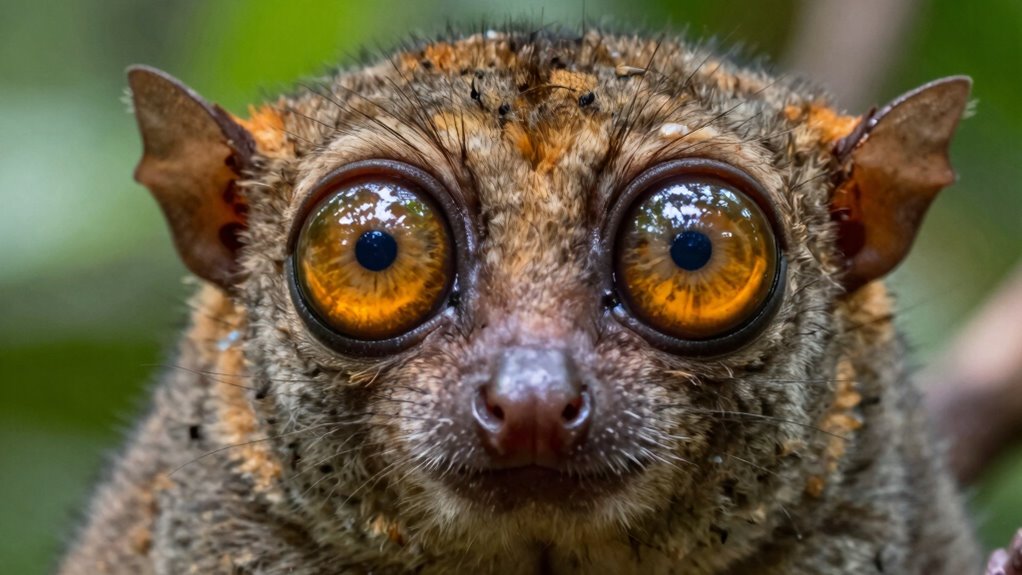

You’ll see that tarsiers have huge eyes because they’re specially adapted for nighttime hunting in dark forests. Their large eyes, packed with sensitive rod cells, help them see in low light, spotting tiny prey and avoiding predators. This incredible adaptation gives them a hunting edge and helps them navigate complex, shadowy environments. If you want to understand more about how their eyes work and their evolution, keep exploring this fascinating creature.

Get pet supplies delivered free with Prime
- Fast, free delivery on millions of items
- Prime Video, Amazon Music and more included
- Member-only deals all year
Key Takeaways
- Their large eyes are an adaptation for enhanced night vision, enabling effective hunting in low-light environments.
- Bigger eyes increase sensitivity to dim light, helping tarsiers detect small prey and avoid predators.
- The enlarged eyes provide a predatory advantage by improving depth perception and tracking fast-moving objects.
- Natural selection favored large eyes to improve survival during their nocturnal activities in dense forests.
- The evolution of big eyes reflects the importance of visual acuity for hunting and navigating dark habitats.
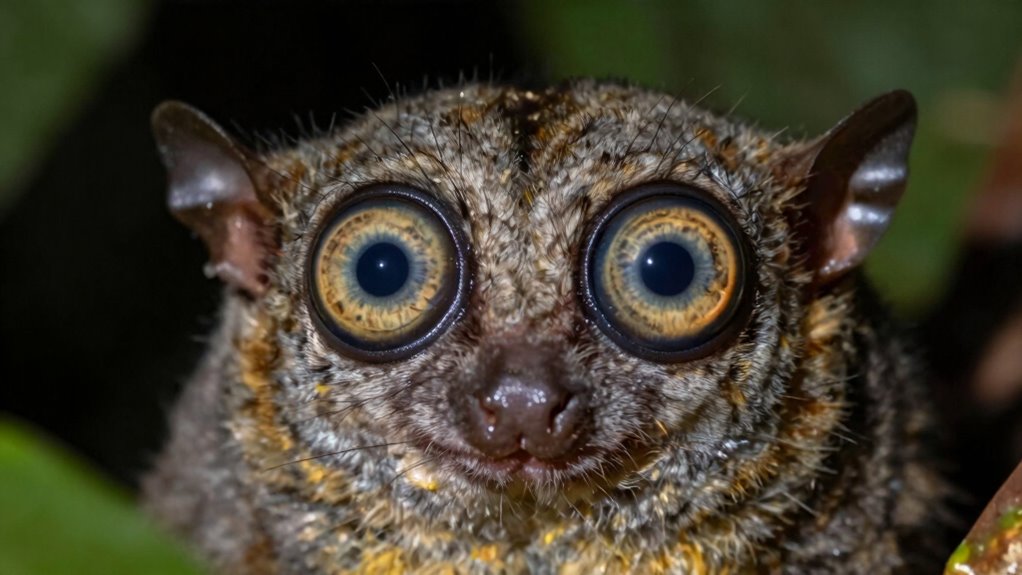
Tarsiers are remarkable primates best known for their enormous eyes, which are among the largest relative to their body size in the animal kingdom. These striking features aren’t just for show; they’re the result of evolutionary adaptation that gives you a distinct advantage when hunting in the dark. Their huge eyes are perfectly suited for their nocturnal lifestyle, allowing them to see in low-light conditions that would leave other predators or prey in the dark. This adaptation makes them exceptional night hunters, giving you a clear view of tiny insects and small creatures that slip past the vision of many other predators. The large size of their eyes isn’t random; it’s a direct response to their need for better night vision, which vital for their survival and success as hunters. The development of such large eyes has been driven by predatory advantages, allowing early tarsiers to better detect prey and avoid larger predators lurking in the shadows. When early tarsiers began their nocturnal journeys, those with bigger eyes could spot prey more easily and avoid larger predators lurking in the shadows. Over time, natural selection favored individuals with larger eyes, leading to the specialized anatomy you see today. Their eyes contain more rod cells, which are sensitive to dim light, making them excellent at detecting movement and detail in darkness. This adaptation guarantees you can identify even the smallest insects or movement on the forest floor, giving you a significant edge over competitors or predators that rely on less sensitive vision. Furthermore, the size of their eyes influences their ability to judge distances and track fast-moving objects. This predatory advantage isn’t just about seeing better; it’s about reacting quickly and accurately in a complex environment. Their enormous eyes enable you to scan your surroundings with precision, making swift decisions on where to leap or hunt next. The evolution of such specialized visual systems highlights how crucial visual acuity is for survival in the dense, dark forests of Southeast Asia. The evolutionary adaptation of large eyes has turned these tiny primates into stealthy, efficient nocturnal predators, giving them a survival edge that’s hard to match, especially considering their specialized visual system. An understanding of this visual adaptation provides insight into how primitive traits can evolve into highly specialized features for survival.
As an affiliate, we earn on qualifying purchases.
Frequently Asked Questions
Do Tarsiers Use Their Eyes to Communicate?
Yes, tarsiers use their eyes for communication, especially through visual signaling. Their eye adaptation allows them to see well in low light, helping them spot prey and communicate with others. When they widen or focus their eyes, it signals alertness or curiosity. You’ll notice their huge eyes are instrumental not just for hunting but also for social cues, making visual signaling a key part of their interaction and survival strategies.
Can Tarsiers See in Complete Darkness?
Yes, tarsiers can see in near-complete darkness thanks to their exceptional night vision. Their eye anatomy, with large, tubular eyes packed with numerous rod cells, enhances their ability to detect movement and see in low light conditions. These adaptations allow you to hunt insects effectively at night. While they can’t see in total darkness, their specialized eyes give them a significant advantage in dim environments.
How Do Tarsiers’ Eyes Compare to Other Primates?
You might be surprised to learn that tarsiers’ eyes are much larger relative to their body size compared to other primates. Their eye anatomy grants them incredible visual acuity, especially in low light, making their night vision exceptional. Unlike most primates, whose eyes are smaller and less specialized, tarsiers’ huge, forward-facing eyes help them hunt in darkness and enhance their depth perception. It’s a fascinating adaptation that sets them apart.
Are Tarsiers’ Large Eyes Prone to Health Issues?
Yes, tarsiers’ large eyes can be prone to health issues, especially if their eye anatomy is compromised or if they experience injury. Their huge eyes are an adaptation for keen night vision, but this makes them vulnerable. You should be cautious of infections or trauma, as their specialized vision adaptation relies on healthy eyes. Regular check-ups and a safe environment help protect their delicate eye health.
Do Tarsiers’ Eyes Change Size With Age?
You might think tarsiers’ eyes change size with age, but they actually don’t—those enormous eyes are a permanent feature, designed for exceptional visual acuity in low light. Eye development in tarsiers stabilizes early, so their big eyes stay consistent, giving them a constant advantage in hunting at night. Their huge eyes aren’t just a quirky trait; they’re a lifelong investment in nocturnal survival, not a growing problem.
Conclusion
So, now you know the truth—those massive eyes aren’t just for dramatic flair. They’re a clever survival tool, turning the tarsier into a nocturnal superstar, silently stalking the night for bugs. Next time you’re tempted to judge someone for their oversized gaze, remember, they’re just trying to see in the dark—literally. It’s a perfect example of nature’s way of saying, “Why settle for average when you can have eyes that could spot a fly from a mile away?”
Halloween Picks
halloween
As an affiliate, we earn on qualifying purchases.