TL;DR
Automatic pet feeders dispense food on a schedule or in measured portions, which can help you keep a regular routine when life gets busy. Their portion settings may not match a standard weight, and jams, outages, or food incompatibility can disrupt meals, so measure actual servings, test the device, and arrange human check-ins when you’re away.
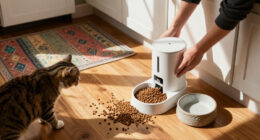
Your cat’s breakfast can arrive with a cheerful whirr at 6 a.m. even when your alarm is still an hour away. Automatic pet feeders can dispense food on a schedule or in measured portions, making them useful for households that want more regular meal times.

Get pet supplies delivered free with Prime
- Fast, free delivery on millions of items
- Prime Video, Amazon Music and more included
- Member-only deals all year
But a machine can’t notice that your dog didn’t eat, refill its own hopper, or provide fresh water and company. Before you rely on one, you’ll want to match it to your pet’s food and feeding plan, find out how its portions work, and test what happens if power or Wi-Fi drops.
This guide walks you through the feeder types, the checks that matter at home, and a practical way to introduce one. You’ll also see where a feeder can help—and when a person still needs to step in.
A feeder can support regular meal timing, but your pet still needs fresh water and human check-ins.
Test several servings with your pet’s actual food; a displayed “portion” is not a universal weight or calorie amount.
Check the model’s approved food types and kibble-size limits before filling it.
Supervise early meals and test schedules, alerts, and backup power while you’re home.
Plan for cleaning, feeder faults, and meal access in multi-pet homes.
Choose a feeder that matches the way your pet eats
An automatic pet feeder releases food at set times or gives you control over meal portions, but different designs suit different routines. Timer models offer basic scheduling, while smart models can add app controls or meal logs; gravity feeders refill a bowl continuously and offer less control over timing. The right fit depends on your pet’s food and how closely you need to manage access.
For example, a healthy adult cat who eats dry kibble at predictable times may do well with a programmable model. A dog who tends to gulp down every crumb might need supervised meals even if a feeder can release them on schedule. Convenience doesn’t equal supervision.
| Feeder type | May suit | Check before buying |
|---|---|---|
| Basic timer | Simple dry-food schedules | How many meals and portion settings it supports |
| Programmable or app-connected | Flexible meal times and logs | Offline operation, internet needs, fees, and software support |
| Gravity feeder | Pets with suitable free-access feeding routines | Continuous access offers little portion control |
| Wet-food feeder | Meals that need covered compartments or cooling | Approved food types, cooling method, and cleaning instructions |
Smart features vary by model, and an app notification can tell you what the device recorded without proving your pet ate the meal. Treat alerts and camera views as useful clues, not a substitute for checking on your animal.
Products Worth Considering

Whisker Feeder-Robot Automatic Pet Feeder, White with Smoke-Grey Hopper

Roborock Qrevo Curv 2 Flow Robot Vacuum and Mop, 20,000 Pa, Self-Cleaning Roller Mop, AI Obstacle Avoidance

Roborock Q7 M5+ Robot Vacuum and Mop with Self-Emptying Dock
As an affiliate, we earn on qualifying purchases.
Make sure the food and portions work before you rely on the feeder
Automatic pet feeders work best when the food fits the device and you’ve checked what each serving actually weighs. A setting called one “portion” doesn’t promise a standard amount: round kibble, flat kibble, and larger pieces can flow differently through the same chute. Measure the food the feeder releases and follow your veterinarian’s feeding guidance for your pet.
Say the schedule calls for a morning meal and an evening meal. Set the device to release each meal, then collect several dispenses in a measuring cup or on a kitchen scale. If the amounts vary or the serving doesn’t line up with your pet’s plan, adjust the setting or choose a feeder that better matches the food. This check matters because a small difference repeated at every meal can add up over time. A consistent schedule can still deliver too much or too little if the device’s unit doesn’t match the prescribed amount.
- Check the label and manual: confirm that your pet’s food type and kibble size are supported. A feeder that struggles with the food can dispense unevenly or jam, so compatibility affects both portion accuracy and whether the meal arrives at all.
- Run repeated test portions: use the actual food, not an empty-hopper demonstration. Several trials show whether portions are consistent as the food settles and the mechanism cycles.
- Compare the result: check the dispensed amount against the feeding plan you received from your veterinarian. If the amount is off, changing the schedule alone may not correct it; you may need to adjust the portion setting or use a different feeder.
- Watch a meal: make sure your pet can comfortably reach the bowl and eat the food. A technically accurate serving won’t help if your pet avoids the bowl or has difficulty using it.
Food compatibility matters just as much as timing. Many standard units are made for dry kibble; some accept particular semi-moist foods, while wet-food models may use sealed compartments and cooling features. Don’t put food into a hopper unless the manufacturer says the device can handle it: unsuitable food can spoil, clog the mechanism, or make cleaning harder. If your pet has a medical condition, weight concern, or special diet, ask your veterinarian about the feeding plan and device fit. In those cases, portion errors can have consequences beyond an inconvenient missed meal.
Test the feeder at home before trusting it on a busy day
To introduce an automatic pet feeder safely, let your pet investigate it and supervise early meals before you depend on its schedule. A feeder’s motor can buzz, food can rattle down a chute, and a cautious pet may need time to approach the new bowl. A calm trial at home gives you a chance to spot a jam, missed meal, or startled reaction while you’re there. Without that trial, a device that looks fine while idle could fail at mealtime, when you may be unable to respond quickly.
For instance, place the feeder beside your cat’s usual bowl and let her sniff it while it’s switched off. Then run a supervised meal. If she backs away from the click and clatter, keep offering familiar meals nearby while she gets used to the machine, rather than leaving her to work it out alone. The gradual introduction helps separate a sound-related worry from a problem with the food or bowl, so you can make one change at a time.
- Set the schedule while you’re home, using the feeding times in your pet’s current plan. This lets you compare the programmed time with the actual release.
- Observe several meals to see that food drops into the bowl and your pet can eat without difficulty. One successful cycle may not reveal an intermittent jam or a pet that approaches only when you’re nearby.
- Try the alerts or logs if you use app features, and check what they show after a real meal. A record of a dispense confirms what the device reports, not that your pet consumed the food.
- Test the backup plan according to the manual, including battery status and how the feeder behaves without Wi-Fi if that applies. Knowing which functions continue helps you decide whether you need another way to deliver meals during an outage.
Some feeders keep scheduled functions running offline; others depend on an internet connection for certain controls or notifications. Read the model’s instructions instead of assuming its app will keep working during an outage. If remote alerts stop, a person nearby may be the only way to learn that a meal was missed. Repeat checks regularly, especially after changing the schedule, food, or batteries, because those changes can affect how reliably food moves through the device.
Plan for jams, empty hoppers, and pets who share a home
An automatic feeder can keep a routine on track, but it can’t guarantee that food will reach the right pet. Jams, an empty hopper, low batteries, power loss, or a mechanical fault can interrupt meals, and one animal can steal another’s serving if they share access. Think about those everyday failure points before you leave the bowl to the machine. Each has a different remedy: refilling prevents an empty hopper, backup power may help during an outage, and only checking the mechanism or arranging human oversight can catch a jam.
Imagine you have two cats: Milo eats slowly, while Juniper treats any unattended meal like a prize. One shared feeder could release Milo’s food and let Juniper finish it before he arrives. A multi-pet model with identification access may help, but features differ; a separate feeding space or a person supervising meals may be a better fit for some homes. The practical question is whether the device controls access reliably enough for both pets’ needs, not simply whether it can dispense two bowls.
- Check capacity and location: make sure the hopper suits your routine and the feeder can sit on a stable surface. A larger hopper can reduce refill frequency, but it still needs monitoring and may make stale food harder to notice.
- Consider curious pets: look for a design you can secure if an animal might tip it or pry at the lid. If food can spill or be reached inside the hopper, the schedule and portions lose their value.
- Think about bowl access: bowl height and the feeding area should work for your pet’s size and comfort. A cramped or awkward spot can discourage eating, even when the feeder operates correctly.
- Keep a person in the loop: ask someone to check the pet and equipment during longer absences. A person can respond to problems the machine can’t diagnose or repair.
A battery backup can help some models operate through a power outage, but it doesn’t fix a jam or make an empty hopper full again. A camera or meal log may help you spot a problem if connectivity holds, yet a notification alone doesn’t put food in the bowl. These features reduce some uncertainty but don’t remove the need for a response plan. For a weekend away, arrange a responsible person to check in and provide the care your pet needs.
Keep food-contact parts clean and dry
Cleaning an automatic pet feeder helps keep old food residue from building up where fresh meals pass through. Oils and crumbs can collect in the hopper, chute, bowl, and seals, especially when food sits in a warm kitchen. Follow the manufacturer’s cleaning instructions; some parts may not be washable or dishwasher-safe.
Suppose you refill a hopper and notice a greasy film along the bottom, or a few stale crumbs wedged in the chute. Don’t just pour fresh kibble over them. Empty the feeder, clean the removable food-contact parts as directed, and let them dry fully before refilling. Moisture trapped under fresh kibble can spoil the food or make it clump.
Wet-food feeders need particular attention because food can sit in covered compartments between meals. If your model has cooling features, check how the manufacturer says to maintain them and how long food can safely stay in the device. A compartment lid and cooling feature don’t cancel out the need for proper cleaning.
Make cleaning part of your refill routine, and check the device whenever you change foods. That makes it easier to notice worn seals, residue, or a chute that no longer moves food smoothly. A clean, dry feeder is easier to inspect and more pleasant for your pet to eat from.
Use the schedule as support, not as a substitute for care
Automatic pet feeders are most useful as routine tools, not as replacements for a caregiver. They can make feeding times more consistent when your workday runs late or you want meals divided across the day, but they don’t supply fresh water, notice a sick pet, or give your animal a check-in. Longer absences still call for human care.
For example, if a meeting keeps you at the office through your cat’s usual dinner time, a tested feeder may help deliver the scheduled meal. If you’re away for a weekend, the same feeder doesn’t cover everything your cat needs; arrange for someone to check food, water, and wellbeing in person. A dog who needs help reaching a bowl or close meal supervision needs a plan built around that need.
Young animals and pets taking medication can have feeding needs that differ from a healthy adult pet’s routine. Don’t use a device to change meal timing around medication or to decide how much food your pet needs without veterinary guidance. Ask your veterinarian whether the schedule and feeder suit your pet, especially if your animal has a health condition, trouble eating, or a special diet.
Also check what the product’s app and connected features actually do. Feeding notifications, cameras, and smart-home integrations vary by model and may need internet, a subscription, or continued software support. Know which features still work offline, and keep ordinary home-network privacy in mind if you choose a camera.
Frequently Asked Questions
Are automatic pet feeders worth it?
They can help you keep meal times consistent or divide a daily ration into scheduled meals. Their usefulness depends on your pet’s needs, the food you use, and whether the feeder works reliably in your home.
Can an automatic feeder dispense wet food?
Some models are designed for wet food and may include sealed compartments or cooling features. Many standard feeders handle dry kibble only, so check the manufacturer’s approved food types and care instructions before using wet food.
How accurate are automatic feeder portions?
Accuracy varies by device and food: kibble shape and size can change how much the feeder drops. Weigh or measure several servings using your own food and compare them with your pet’s feeding plan.
Can I use one feeder for multiple pets?
Some models offer multiple bowls or pet-identification features, but those options vary. In a shared setup, one animal may eat another’s meal, so watch how your pets use the feeder and arrange separate access if needed.
Will the feeder work during a power or Wi-Fi outage?
It depends on the model. Check whether scheduled meals continue offline and whether the device has battery backup; app notifications and remote controls may still stop without power or internet.
Can I leave my pet alone for a weekend with an automatic feeder?
A feeder doesn’t provide supervision, fresh water, or a check on your pet’s wellbeing. Arrange for a responsible person to visit during longer absences, even if the device is tested and working.
Are automatic feeders suitable for kittens, puppies, or pets on medication?
Feeding needs vary with age and health, and medication timing can require specific guidance. Ask your veterinarian whether a feeder and schedule are suitable for your animal before relying on one.
Conclusion
Choose a feeder for your pet’s food and real feeding routine, then measure its servings and watch your pet use it before relying on the schedule. A machine can keep time; a caring person still checks the bowl, the water, and the animal beside it.