TL;DR
Automatic pet feeders dispense scheduled portions, but portion sizes vary by model and food, so test what yours releases against your pet’s feeding plan. Match the feeder to the food, your pet’s behavior, and your household, then keep a backup feeding plan and arrange human care when you are away.
Your cat’s dinner can land in the bowl at 6 p.m. even if your train is late—but the feeder can’t tell you whether your cat ate it, whether the power went out, or whether the dog stole it. That distinction is the key to choosing an automatic pet feeder that actually helps.

Get pet supplies delivered free with Prime
- Fast, free delivery on millions of items
- Prime Video, Amazon Music and more included
- Member-only deals all year
These devices dispense premeasured portions on a schedule, which can make a routine more predictable and reduce the need to be home at every mealtime. But “one portion” means different things across models, and a kibble hopper is not a safe place to store wet food. The details matter.
Here’s how to compare food compatibility, portion accuracy, capacity, power, and smart features. You’ll also see how to introduce a feeder, what to watch for in a multi-pet home, and why a scheduled meal still doesn’t replace a person checking on your pet.
Match the feeder to your pet’s food; ordinary dry-food hoppers are not suitable for wet food.
Measure several servings because a labeled portion may vary with kibble size and density.
Introduce the feeder while you’re home, and test the clock, schedule, and backup behavior.
In multi-pet homes, observe meals; separate or pet-activated feeders may help control access.
Arrange human check-ins when you’re away because a feeder cannot provide full care or respond to emergencies.
What an automatic feeder can—and can’t—do for your routine
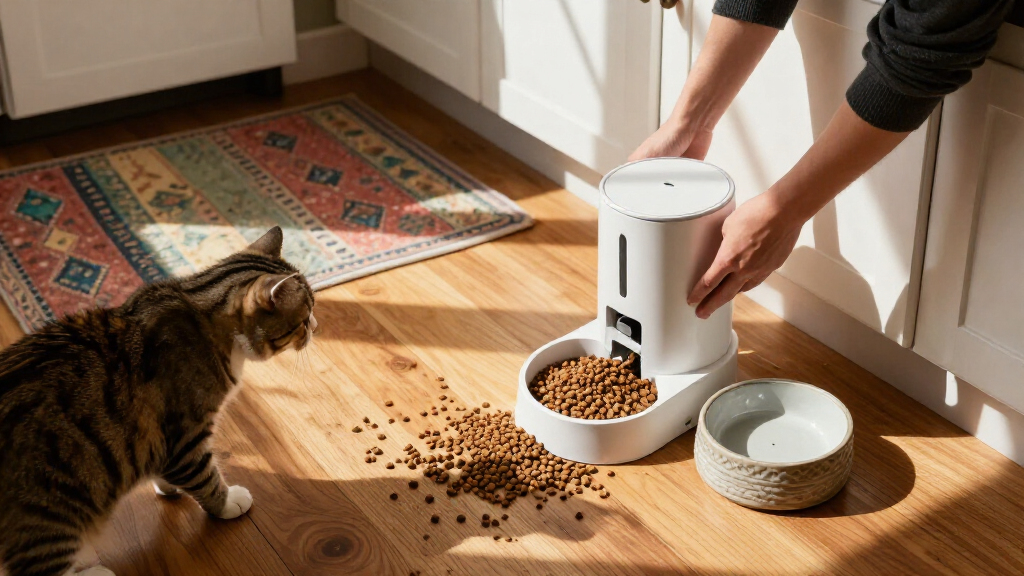
An automatic pet feeder releases food at scheduled times, usually from a hopper or tray, so you don’t have to be beside the bowl for every meal. Depending on the model, it may handle dry kibble, chilled wet food, or both. That can make feeding times more consistent, which is useful when your workday shifts or your pet expects an early breakfast. But a release is only one step: the device cannot tell whether the food reached the bowl, whether your pet ate it, or whether another animal took it.
Think of a feeder as a kitchen timer with a bowl attached. It can help when a meeting runs late or you want breakfast served before sunrise. If you’re stuck on a delayed train and your cat’s usual meal is at 6 p.m., a tested feeder can dispense food on schedule. The benefit is predictable timing; the tradeoff is that you may not notice a missed meal unless you check in. For an extended absence, arrange for someone to see your cat and confirm they are eating and behaving normally.
Features vary widely. A basic unit may use buttons and a clock; a connected model may offer app scheduling, feeding logs, alerts, a camera, or a voice recording. These can help you check whether a programmed release occurred or change a schedule when plans shift. They provide clues, not certainty: a log may record a dispense even if the chute jammed, and a camera might show a bowl while missing the dog that wandered off with the food moments later. More features can also mean more setup and another connection to troubleshoot.
Keep the boundary simple: feeders support a care routine; they don’t provide water checks, companionship, litter care, exercise, or help in an emergency. If you’re away overnight, arrange a person to check on your pet. The machine can keep time. A person can notice when something is wrong.
Products Worth Considering

PetSafe Guardian GPS 2.0 Dog Fence and Tracking Collar

Roborock Q7 L5 Robot Vacuum and Mop Combo with 8,000 Pa Suction

Roborock Robot Vacuum and Mop with LiDAR Navigation and Self-Empty Dock
As an affiliate, we earn on qualifying purchases.
Match the feeder to the food in your pet’s bowl
Choose a feeder built for the food you serve: many hopper models are designed for dry kibble, while wet-food models often rely on chilled compartments, ice packs, or sealed trays. This matters because food needs different storage conditions. Dry kibble can usually sit in a hopper as directed by its maker; wet food can spoil if left warm for too long. A dry-food hopper should not be treated as a wet-food container.
For example, if you feed kibble before work, a hopper may hold enough for several scheduled meals. If your older cat eats wet food at midday, look for a model specifically designed to keep those meals cool or covered, and check its safe holding time. Chilling may make a wet-food feeder suitable for a particular window, but it doesn’t mean food can be left indefinitely. Capacity and cooling performance vary by product, so read the manufacturer’s current instructions rather than guessing from a product photo.
Food shape matters, too. A feeder opening that handles small, round kibble may jam with larger pieces or an unusual shape. A jam can turn a useful schedule into a missed meal, so check the maker’s guidance for approved food type and kibble size, then test your own food before relying on the device. A handful of test meals can reveal whether pieces bridge across the opening or fall unevenly.
Cleaning is part of food compatibility. Crumbs and oily residue can build up around the chute and bowl, affecting hygiene and sometimes how food moves through the mechanism. Removable, washable food-contact parts make routine cleaning easier, which makes it more likely you’ll keep up with it. If your usual routine includes wiping the bowl after dinner, choose a design that doesn’t turn that small task into a teardown involving a screwdriver and a sink full of parts.
Measure portions before you trust the serving label
A feeder’s portion setting does not guarantee a particular weight of food. The amount released can change with kibble shape, size, and density, so “one portion” on the screen may not match the amount in your pet’s feeding plan. This difference matters over time: a small excess at every meal can add up, while repeated short servings can leave a pet underfed. Measure what your model actually dispenses before setting it and walking away.
Here’s a practical check: set the feeder to release the portion you expect, collect what falls into the bowl, and weigh or measure it. Repeat the test several times. An average gives you a better estimate than one serving, while variation between servings can reveal inconsistent flow. For instance, if the first serving looks modest but the next is a heaped bowl, the mechanism may be releasing inconsistently or your kibble may not flow evenly.
Use the amount your pet should eat as the starting point, not a vague “small” or “large” setting. Then compare the test servings with that plan and adjust the number of releases or settings accordingly. Portion control may help limit unsupervised access to food, but only if the scheduled amount is right and your pet cannot reach into the outlet or break into the hopper. A feeder that dispenses accurately can still provide too much if its schedule or portion count is wrong.
Ask your veterinarian about feeding amounts if your pet has a medical condition, a special diet, or specific feeding instructions. Don’t use a feeder’s controls to make medication or diet changes on your own. For a pet with a prescribed meal schedule, take the device’s actual measured output to your veterinary team and confirm that the schedule fits.
Use this five-step setup before the first unsupervised meal
Set up and test an automatic pet feeder while you’re home so you can catch jams, confusing controls, or a pet that refuses to eat from it. A little practice makes the change less startling. The motor’s click and the sudden tumble of kibble can sound like a tiny machine taking over the kitchen. Testing also lets you see whether the schedule, output, and backup behavior match what you expect before a missed meal depends on them.
- Read the food and size guidance. Confirm that the feeder accepts your pet’s food. A mismatch can lead to jams or food that is stored under unsuitable conditions.
- Measure a test portion. Compare several releases with the feeding plan you follow. This checks both the amount and whether it comes out consistently.
- Set the clock and schedule. Check each meal time, especially after a power interruption. A clock that resets can shift every meal, not just the next one.
- Watch your pet use it. Make sure they can reach the food and another animal cannot easily steal it. A successful release does not help if your pet avoids the machine or a housemate eats the serving.
- Test the backup plan. Learn what the feeder does during an outage, jam, or lost connection, and know how you’ll provide the next meal. That turns an alert or failure into a clear next step.
Imagine bringing home a feeder on Sunday and leaving for work early Monday. The cat hears the motor, backs away, and skips breakfast. If you introduce it over several meals while you’re there, you can see that reaction and adjust the transition before it becomes a missed-meal problem.
Keep checking the settings after interruptions. Some models have battery backup; others may need attention to restore the clock or schedule. Backup power may keep a unit running, but it does not necessarily preserve app access or every programmed setting. The exact behavior depends on the device. Test it using the manual, and keep an easy backup meal plan instead of assuming every model remembers every setting.
Pick power and smart features that solve a real problem
Choose power and connectivity based on how you’ll use the feeder. Some units plug into an outlet, some use batteries, and some offer both. A plug-in model avoids routine battery changes but depends on household power; batteries can provide flexibility or backup, but need monitoring and replacement. Connected models may let you adjust schedules remotely or receive alerts, but they can depend on Wi-Fi and an app. Those features add convenience only when the connection and setup work for your household.
If you’re choosing between a simple timer and an app model, start with the need: do you mainly want breakfast dispensed on time, or do you want remote schedule changes and feeding-history notifications? If you leave for work at the same hour every day, a straightforward timer may do the job with fewer settings to manage. If your schedule changes often, remote controls may be useful, provided you understand what happens when the network drops and can still feed your pet if the app is unavailable.
Recent models may add cameras, voice recordings, smart-home links, or notifications. Picture checking a feeding log during a long workday: it may help you spot that a scheduled release happened. It still cannot confirm that your pet ate the food or notice every health problem. An alert is a clue, not a person at the door. Consider whether a feature will change what you do; if you would not act on a camera feed or notification, it may add complexity without much practical value.
Before buying, check the current specifications and support information for the exact model. Find out whether schedules persist without Wi-Fi, whether battery backup is included, and how alerts work. A bright app screen can make a feeder look reassuring; a brief power-and-connection test tells you more about its real behavior.
Plan carefully for pets that share a kitchen
A shared feeder does not guarantee that each pet eats only its own food. One animal may finish its meal and then nose into the other bowl, while a determined pet may tip a lightweight feeder or reach into the food outlet. This matters especially when pets have different diets or one needs a carefully controlled portion: the scheduled release can be accurate while the wrong animal eats it. In homes with pets on different diets, the feeding setup needs to match their behavior as well as their number.
For example, a fast-eating dog might clear a shared bowl before a shy cat reaches it. Separate feeding areas and separate feeders can help, but watch a few meals to see whether the arrangement works. A closed door during mealtimes or a higher surface the dog cannot reach may solve the problem more simply than adding another app. The best arrangement is the one your animals will use consistently, not the one with the most features.
Microchip- or tag-activated feeders can restrict access to a specific pet, depending on the model. They can help in some multi-pet households, but they don’t watch the animals eat and may not suit every pet or feeding setup. Check how the lid opens and closes, and supervise the first uses so a cautious animal has time to learn. Also consider whether the pet can approach the feeder without being crowded; controlled access is useful only if the intended animal feels comfortable using it.
Stability and access matter even in a one-pet home. If your cat has a habit of prying open cupboards, a loose hopper lid deserves attention. Choose a solid base and a secure lid suited to your pet’s size and habits. A feeder that stays upright and closed is more useful than one with a long feature list and a lid your dog can flip open.
Use a feeder for short gaps, not a weekend of unattended care
An automatic pet feeder does not make it safe to leave a pet without a person checking in. It can dispense a scheduled meal, but it cannot refill water, clean litter, provide company, exercise your pet, or respond if your pet becomes ill. Feeding is one part of care, not the whole job. The longer you are away, the more chances there are for a small problem—such as a spill or a jam—to go unnoticed and affect your pet.
If you’re planning a weekend away, arrange for someone to visit and follow local guidance on care for unattended pets. A neighbor who sees that the food is gone can also notice a tipped water bowl, an unusual mess, or a pet hiding under the bed. Those observations matter in ways a feeding log cannot capture, because a person can respond when the situation does not look normal.
Even for a short absence, prepare for the ordinary things that go wrong: the feeder can jam, the power can fail, or settings can change. Keep contact details and a clear backup feeding plan for whoever checks in. If your pet needs frequent monitoring, has special feeding instructions, or is very young, ask your veterinarian what level of care fits. The right check-in schedule depends on the pet’s needs, not just on how much food the hopper holds.
The feeder may still be useful during a brief workday or while your schedule shifts. For instance, a sitter can check the pet in the evening while the feeder covers a midday meal. That pairing lets the machine handle timing while a person handles the parts of care that require eyes, hands, and judgment.
Frequently Asked Questions
Are automatic pet feeders reliable?
They can be reliable when you test and maintain them, but jams, power loss, and incorrect settings can happen. Run several test meals and keep a backup plan for the next feeding.
Can I put wet food in an automatic feeder?
Only use a model designed for wet food, often with chilled or sealed compartments. Check the manufacturer’s safe holding time and cleaning instructions; a standard dry-food hopper is not suitable.
How much food does one feeder portion contain?
It depends on the model and the food, including kibble size and density. Collect and measure several test portions rather than relying on a portion label alone.
Will a feeder stop my pet from overeating?
Scheduled portions can limit access to food if the settings match your pet’s feeding plan and the pet cannot reach extra food. Ask your veterinarian about an appropriate daily amount, especially if your pet has a medical condition or special diet.
Can one feeder feed multiple pets?
It can release food in a shared space, but it cannot guarantee each pet gets only its own portion. Separate units or pet-activated feeders may help; watch the animals eat to see whether your arrangement works.
What happens if the power or Wi-Fi goes out?
It depends on the feeder: some use battery backup or retain schedules, while app features may lose remote access. Check the manual and test what happens after a brief interruption before you rely on it.
Can I leave my pet alone for a weekend if the feeder is full?
No feeder provides water checks, companionship, litter care, or help if a pet becomes ill. Arrange for a person to check on your pet and follow local guidance on unattended care.
Conclusion
Choose an automatic feeder for the job your pet actually needs: the right food, a measured portion, a reliable schedule, and a design that fits your home. Test it while you’re there, then keep checking the settings and the animal eating from it.
Let the feeder keep time, and let a person keep watch. That’s how a quiet click in the kitchen becomes useful support rather than a promise the machine can’t keep.