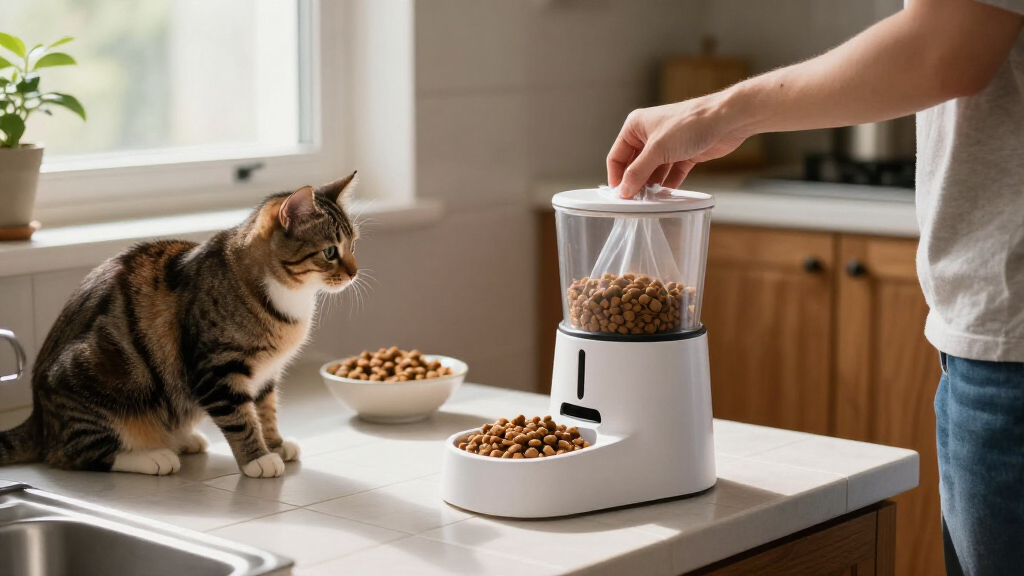

Automatic pet feeders solve one problem — reliable, on-time meals whether you’re home or not — but they differ widely in scheduling precision, capacity, power backup, and smart features. After comparing 15 popular models, the PETLIBRO Automatic Cat Feeder with Smart Scale and WiFi stands out as the best overall pick thanks to its precise portion tracking and app control, while the PETLIBRO AI Recognition model with camera is the smarter choice for multi-pet homes where one pet steals food. For budget-minded buyers, the SARPAWS 3L timed feeder covers the basics without app complexity. The main tradeoff in this category is simple: smart features like cameras, WiFi, and AI recognition add cost and setup friction, while basic timers are cheaper and more dependable but far less flexible. Keep reading for the full breakdown, including which models handle large dogs, which ones prevent food theft, and which to skip entirely.

Get pet supplies delivered free with Prime
- Fast, free delivery on millions of items
- Prime Video, Amazon Music and more included
- Member-only deals all year
Complete the kit


Key Takeaways
- PETLIBRO dominates the smart segment of this roundup, with four entries spanning WiFi scheduling, AI pet recognition, camera monitoring, and smart-scale portion tracking — its consistency in build quality and app design separated it from generic-brand alternatives.
- Feeders designed for two cats (the oneisall 5G WiFi and PETLIBRO AI Recognition models) solve portion theft between pets, a problem single-bowl feeders ignore entirely; if you have multiple pets, this feature matters more than capacity.
- Basic LCD-timer feeders like the SARPAWS and the 3L anti-jam model delivered the same core feeding reliability as smart models at a fraction of the complexity — the tradeoff is losing remote scheduling and monitoring.
- Dual power (adapter plus battery backup) appeared on most top-ranked models because a power outage at mealtime defeats the entire purpose of an automatic feeder; models lacking it ranked lower.
- Large-capacity 8L-class feeders only make sense for large dogs or long absences — for a single cat, that extra capacity means food sits longer and loses freshness, which is why smaller sealed hoppers ranked higher for typical cat owners.


| automatic pet feeder | Capacity |
|---|---|
| Automatic Cat and Dog Food and | — |
| PAPIFEED Automatic Cat Feeder | 6L (25 cups) |
| PETLIBRO Automatic Cat and Dog | 5L |
| SARPAWS Automatic Cat Feeder | 3L |
| oneisall 5G WiFi Automatic Cat | 5L / 20 cups |
| PETLIBRO Automatic Cat Feeder | 5L |
| Oneisall Automatic Cat Feeder | 20 cups / 5 liters |
| Automatic Cat Feeder | 3L (12 cups) |
| VOLUAS Automatic Cat Feeder | 4L / 16.9 cups |
| PETLIBRO Automatic Cat Feeder | — |
| ANDOLL HOME Automatic Cat Feed | 4L |
| Automatic Dog and Cat Feeder | 8L / 34 cups |
| FEELNEEDY Automatic Cat Feeder | 5.5L |
| iPettie FW54 5G/2.4GHz WiFi Au | — |
| PETLIBRO Automatic Cat Feeder | 5L |
More Details on Our Top Picks
Automatic Cat and Dog Food and Water Dispenser Set (3.3L, Black)
Food and water in one gravity-fed set make this the simplest choice for households that want fewer refills without adding an electrical device. Its siphon water design helps limit spills, while the 3.3L capacity and easy-clean parts suit everyday use with cats or dogs. Compared with the app-controlled PAPIFEED Automatic Cat Feeder, this set cannot schedule meals or manage portions, so it offers less control over a pet’s intake. Its advantage is that it needs no power and dispenses both essentials. That convenience depends on gravity: pets can access the food as it flows, which may not work for animals that overeat or need timed meals. I’d choose it for uncomplicated access, not dietary routines.
Pros:- Provides food and water in one set
- Gravity operation needs no electricity
- 3.3L capacity reduces frequent refilling
- Food-grade, BPA-free materials are easy to assemble and clean
Cons:- Cannot schedule meals or control portions
- Gravity access may not suit pets that overeat
- 3.3L capacity may need frequent refills for very large pets
Best for: Households with cats or dogs that need a basic, power-free supply of food and water
Not ideal for: Owners managing portions or feeding times, since gravity dispensing provides no schedule or intake control
- Food capacity:3.3L
- Material:PP+PET
- Color:Black
- Suitable for:Small to large dogs and cats
- Dispensing:Gravity-fed food and water
- Power:No electricity needed
Our verdict“Choose this set for simple, power-free food and water access; pick the PAPIFEED if scheduled portions matter more.”
PAPIFEED Automatic Cat Feeder with App, WiFi, 6L Capacity, Dual Power, Timed Dispenser for Small Dogs and Cats
App scheduling and a 6L hopper make the PAPIFEED a practical fit for owners who want to plan meals remotely and refill less often. It supports up to 10 meals per day, with portion settings that give more routine control than the gravity-fed Automatic Cat and Dog Food and Water Dispenser Set. The removable, dishwasher-safe stainless steel bowl also makes cleanup easier than a fixed feeding surface. Dual power adds a backup option during outages, although the required AA batteries are not included. This feeder is limited to dry food, and reported app connectivity problems could undermine its main convenience. Compared with the PETLIBRO 5L feeder, PAPIFEED has a larger stated capacity and bowl-cleaning details, but the PETLIBRO adds freshness features and jam notifications.
Pros:- 6L hopper holds food for multiple days
- App schedules up to 10 meals daily
- Removable stainless steel bowl is dishwasher-safe
- AC adapter and battery backup provide dual power
Cons:- Four AA backup batteries are not included
- App connectivity issues may disrupt remote control
- Dispenses dry food only
Best for: Small-dog and cat owners who want app-based schedules, a larger dry-food hopper, and a washable bowl
Not ideal for: Owners who need wet-food dispensing or do not want to rely on WiFi and app connectivity
- Capacity:6L (25 cups)
- Power supply:AC adapter and 4 AA batteries (not included)
- Meals per day:Up to 10
- Portions per meal:12
- Materials:Food-grade plastic and stainless steel
- Food type:Dry food
- Dimensions:Not specified
Our verdict“Pick the PAPIFEED for a larger app-scheduled dry-food supply, while the PETLIBRO suits buyers who prioritize freshness alerts.”
PETLIBRO Automatic Cat and Dog Feeder with WiFi, 5L Capacity, Freshness Preservation, and Up to 10 Meals Per Day
The sealed tank, desiccant, and smart alerts give this PETLIBRO a stronger focus on keeping dry food protected and flagging low-food or jam problems. Owners can schedule up to 10 meals per day through WiFi, set portions in 1/12-cup increments, and record a voice call. That combination offers more monitoring than the simpler SARPAWS timed feeder, which relies on local scheduling and backup batteries. The tradeoff is dependence on WiFi for full app control, plus no stated battery backup if power fails. Its 5L capacity is also smaller than the PAPIFEED’s 6L hopper. I’d favor this model when alerts and food freshness are higher priorities than maximizing storage or maintaining operation through an outage.
Pros:- App schedules up to 10 meals per day
- Sealed tank and desiccant help preserve food freshness
- Notifications flag low food and jams
- Voice meal calls and adjustable portions add feeding control
Cons:- Full app functionality requires WiFi
- No battery backup is specified
- 5L capacity is smaller than the PAPIFEED’s 6L hopper
Best for: Cat and small- or medium-dog owners who want app scheduling plus alerts for food levels and dispensing jams
Not ideal for: Buyers seeking a power-outage backup or a larger hopper than the PAPIFEED’s 6L capacity
- Capacity:5L
- WiFi:2.4GHz and 5GHz
- Meal scheduling:Up to 10 meals per day
- Portion size:1/12 cup per portion
- Material:Food-grade stainless steel
- Power source:Charger included
- Target species:Cats, dogs, and small animals
- Warranty:24 months
Our verdict“Choose this PETLIBRO for freshness features and alerts; choose the SARPAWS if outage backup and simpler timed feeding matter more.”
SARPAWS Automatic Cat Feeder, 3L Timed Pet Food Dispenser with Stainless Steel Bowl, 10s Voice Recorder, Dual Power, Auto Pet Feeder for Small Cats and Dogs
Timed portions with battery backup make the SARPAWS a straightforward choice for owners who want regular dry-food meals to continue through a power outage. Its 3L hopper, four-meal schedule, and 10-second voice recorder cover the basics without requiring the app-based setup of the PETLIBRO 5L feeder. The backup battery life is listed as 180 days, and the anti-clogging design aims to keep meals moving. This simpler approach also means fewer controls: it offers only four meals, and the listed portion size is tied to kibble weight rather than a cup measurement. It accepts dry kibble sized 5–12mm, so larger pieces are out. Compared with the WiFi-enabled oneisall, SARPAWS gives up remote family access for direct timed operation and stated outage support.
Pros:- Backup batteries keep feeding during power outages
- Four scheduled meals with portion control
- Stainless steel bowl is easy to clean
- Anti-clogging design and a visual food window aid routine use
Cons:- Limited to four meals per day
- Kibble must measure 5–12mm
- Dimensions are not specified
Best for: Owners of small cats or dogs who want scheduled dry-food portions and backup power without app controls
Not ideal for: Pets eating kibble outside the 5–12mm size range or owners who need remote scheduling and more than four meals
- Capacity:3L
- Portion size:8g ± 2g
- Meals:4
- Voice recording:10 seconds
- Power:5V DC and backup batteries
- Listed battery life:180 days
- Material:304 stainless steel
- Kibble size:5–12mm
Our verdict“Choose SARPAWS for basic timed meals with outage backup; choose the oneisall for app access and shared control.”
oneisall 5G WiFi Automatic Cat Feeder for 2 Cats, App Control, 20 Cups/5L
Shared app access and two stainless steel bowls give the oneisall a clear role for households where more than one person manages two cats’ feeding. Its 5L hopper, scheduled or manual feeds, voice recording, and support for both 5G and 2.4G WiFi offer remote control without the larger 6L capacity of the PAPIFEED. The second bowl helps split access, but the feeder’s stated portion size is about 10 grams, so owners should check whether that suits their cats’ meal needs. Kibble must be under half an inch, and operation depends on WiFi. Unlike the SARPAWS, this model emphasizes family app control rather than specified battery backup. I’d pick it for connected two-cat routines, not for larger pets or a fully offline feeding plan.
Pros:- Shared app access lets family members manage feeding
- Supports 5G and 2.4G WiFi
- Includes two stainless steel bowls
- Scheduled and manual feeds with voice recording
Cons:- Kibble must be less than 0.5 inch
- WiFi is required for operation
- 5L capacity may be limiting for larger pets or extended use with multiple pets
Best for: Two-cat households where multiple family members want app access to scheduled and manual feeding
Not ideal for: Owners using kibble at least half an inch wide or those who need feeding to continue without WiFi
- Connectivity:5G/2.4G WiFi
- Capacity:5L / 20 cups
- Portion size:Approximately 10 grams
- Kibble size limit:Less than 0.5 inch
- Voice recorder:10 seconds
- Target species:Cats
- Included components:2 stainless steel bowls, anti-chew cord, desiccant, power plug
- Warranty:2 years
Our verdict“Choose the oneisall for shared app management of two cats, while SARPAWS is a better fit for backup-powered timed feeding.”
PETLIBRO Automatic Cat Feeder for 2 Cats with AI Recognition and Camera
This model stands out as the most data-driven feeder in this lineup, pairing AI recognition with gram-level dual scales so each cat gets its own portion and intake log. Compared with the VOLUAS 4L dispenser, which simply fires food on a timer, this PETLIBRO tells you which cat ate and how much — a meaningful difference for multi-cat households managing weight or prescription diets. The 1080P camera adds peace of mind during travel, something the Oneisall timed feeder cannot match. The tradeoff is real, though: full functionality depends on WiFi, the setup curve is steeper than a basic programmable dispenser, and the 5L capacity is modest given the advanced hardware.
Pros:- AI recognition distinguishes individual cats and logs each pet’s intake separately
- Gram-level dual scales deliver precise, personalized portion control
- 1080P HD camera enables live monitoring while away from home
- Scheduled feeding and remote operation through the app
Cons:- Requires a stable WiFi connection for core smart features to work
- Setup and app pairing are more complex than simple programmable feeders
- Advanced features push it to a higher price tier than comparable capacity
Best for: Multi-cat owners who need per-pet portion tracking, intake logs, and camera check-ins for weight management or remote monitoring
Not ideal for: Buyers who want a plug-and-play timer feeder — it needs WiFi, app setup, and a steeper learning curve than basic models
- Target Species:Cats
- Model Number:PLAF205
- Capacity:5L
- Recognition:AI pet recognition
- Camera:1080P HD
- Tracking:Dual gram-level scales
- Connectivity:WiFi
- Warranty:24 months
Our verdict“This pick makes the most sense for tech-comfortable multi-cat households that genuinely need per-pet tracking and camera oversight, not just timed dispensing.”
Oneisall Automatic Cat Feeder for 2 Cats, Timed Food Dispenser
Where the PETLIBRO smart feeder leans on AI, this Oneisall wins on hygiene and simplicity. Its two separate stainless steel, dishwasher-safe bowls solve the core two-cat problem — food theft and bowl contamination — without any app or camera overhead. Compared with the VOLUAS 4L single-bowl dispenser, the dedicated dual-bowl layout is simply better suited to feeding two cats fairly. The multi-layer sealing with desiccants keeps kibble fresh between meals, and up to six daily feedings beat the VOLUAS’s four. Limitations are worth weighing: kibble must stay under 0.5 inches, there’s no battery backup (the 3L anti-jam feeder offers one), and 5L won’t cover long absences for hungry pairs.
Pros:- Two separate stainless steel bowls prevent food stealing between cats
- Dishwasher-safe bowls make cleanup genuinely easy
- Multi-layer sealing with desiccant keeps food fresh
- Simple setup with up to 6 meals per day and a 10-second voice recorder
Cons:- No battery backup — power interruption stops feeding entirely
- Only compatible with kibble smaller than 0.5 inch
- 5L capacity may fall short for multi-day absences with two cats
Best for: Two-cat households that want separate hygienic bowls and reliable scheduling without smart-feeder complexity
Not ideal for: Homes in areas with power outages or owners feeding large kibble — it requires constant wall power and kibble under 0.5 inches
- Capacity:20 cups / 5 liters
- Bowls:2 stainless steel
- Meals per Day:Up to 6
- Portion Size:Approx. 10 grams
- Voice Recorder:10 seconds
- Power Source:Wall plug (included)
- Freshness:Multi-layer sealing with desiccants
Our verdict“The most sensible choice for two-cat homes that prioritize clean, separate feeding over smart features.”
Automatic Cat Feeder, 3L Dispenser with Anti-Jam Design and Stainless Steel Bowl
This 3L feeder earns its spot by solving the problem most rivals ignore: power failure. Running up to 180+ days on three D batteries, with wall power as an option, it keeps feeding when the Oneisall dual-bowl model would go dark. The anti-jam dispensing design handles a wide 2–15mm kibble range, so irregular kibble shapes that frustrate other feeders dispense cleanly. It matches the Oneisall’s six-meal scheduling flexibility in a smaller footprint. The compromises are predictable at this size: 3L capacity means more frequent refills than the VOLUAS 4L or PAPIFEED 6L models, batteries are sold separately, and there’s no voice recorder to call pets at mealtime — a feature both the Oneisall and VOLUAS include.
Pros:- Up to 180+ days of battery life, plus optional wall power
- Anti-jam design handles a wide 2-15mm kibble range
- Flexible 1-6 meal scheduling with customizable portions
- Removable, washable stainless steel components
Cons:- D batteries sold separately, adding to the true cost
- 3L capacity requires frequent refills for larger appetites
- No voice recorder or smart features found on similarly priced rivals
Best for: Owners in outage-prone areas or anyone who wants set-and-forget battery operation without WiFi dependency
Not ideal for: Owners who travel for a week at a stretch — the 3L hopper needs frequent refills compared with 4L and 6L rivals
- Capacity:3L (12 cups)
- Meal Schedule:1-6 meals per day
- Kibble Size Range:2-15mm
- Power:3 D batteries (not included) or wall supply
- Battery Life:Over 180 days
- Material:Food-grade plastic and stainless steel
- Bowl:Stainless steel
Our verdict“A smart pick if uninterrupted battery-powered feeding matters more than capacity or smart features.”
VOLUAS Automatic Cat Feeder, 4L Timed Dry Food Dispenser for Cats & Dogs
The VOLUAS delivers the core automatic-feeding experience at the simplest price of entry: four daily meals, 6–7g portions, a 4L hopper, and a 10-second voice recorder to call your pet. Its dual power options — wired adapter with D-cell battery backup — put it ahead of the Oneisall, which dies with the grid. It also works for cats and small dogs, widening its use beyond cat-only rivals. The cuts show in the details: a plastic build rather than stainless bowls, only four meals per day versus six on the Oneisall and the 3L anti-jam feeder, and no WiFi or app control like the PAPIFEED or PETLIBRO smart models. Batteries are, again, a separate purchase.
Pros:- Dual power with battery backup keeps meals on schedule during outages
- 4L capacity covers several days for small pets
- 10-second voice recording calls pets at mealtime
- Removable parts simplify cleaning
Cons:- Only 4 meals per day, fewer than the 6-meal Oneisall and 3L models
- All-plastic construction is less hygienic than stainless steel rivals
- D batteries not included
Best for: Budget-conscious owners of cats or small dogs who want dependable scheduled feeding with battery backup
Not ideal for: Owners needing fine-grained portion control or app monitoring — portions are coarse and there’s no connectivity
- Capacity:4L / 16.9 cups
- Portion Size:6-7g per portion
- Meals per Day:Up to 4
- Power Options:5V wired adapter or 3 D-cell batteries (not included)
- Voice Recording:Up to 10 seconds
- Material:Plastic
- Suitable For:Cats, small dogs, and small animals
Our verdict“The value play here — dependable scheduled feeding for small pets if you can live without smart features and stainless bowls.”
PETLIBRO Automatic Cat Feeder with AI Recognition and HD Camera
Compared with its sibling, the PETLIBRO PLAF205, this model targets a sharper use case: prescription diets and strict weight control. Its Smart Refill mode tops each cat’s bowl to a target weight and stops when one pet has eaten enough — the closest thing in this roundup to automated diet enforcement. Like the PLAF205, it offers AI recognition, dual chutes, 1080P video, and gram-level dual scales, but the two-way audio here lets you actually speak to a cat mid-meal to break up food guarding. Set against simpler feeders like the VOLUAS, the difference is stark: precise, per-pet accountability versus blind timed dispensing. The cost is complexity and a hard WiFi dependency — no network, no smart features.
Pros:- Smart Refill mode enforces per-pet target portions automatically
- Two-way audio lets owners intervene during meals remotely
- AI recognition keeps separate feeding logs for each cat
- Dual gram-level scales provide precise portion accountability
Cons:- Smart features are inoperable without a WiFi connection
- App and recognition setup may overwhelm users new to smart feeders
- Premium feature set commands a premium price
Best for: Owners managing strict veterinary diets or weight-loss plans for two cats who need per-pet enforcement and accountability
Not ideal for: Casual feeders or non-technical owners — the price and app complexity are wasted on basic scheduled feeding
- Recognition:AI recognition camera
- Camera:1080P HD with two-way audio
- Feeding Setup:Dual chutes for 2 cats
- Tracking:Built-in dual gram-level scales
- Connectivity:WiFi
- Feeding Modes:Scheduled, Smart Refill
- Monitoring:Live video and two-way audio
Our verdict“Buy this if a vet-directed diet for two cats demands per-pet portion enforcement — skip it if you just need timed meals.”
ANDOLL HOME Automatic Cat Feeder, 4L Food Dispenser with Voice Recorder
This model stands out for covering the fundamentals — scheduling, portioning, and freshness — without demanding a WiFi network or a steep learning curve. The 10-second voice recorder is the feature that separates it from similarly priced rivals like the VOLUAS 4L dispenser, because it lets the feeder call your cat at mealtime, which matters for pets who hesitate to approach a machine. The sealed ring and desiccant keep kibble from going stale between meals, a nice touch at this price. Compared with the FEELNEEDY camera feeder later in this list, you give up remote monitoring entirely — this is a set-it-and-forget-it device. The tradeoffs are real: batteries ship separately, it only handles dry food, and the 4L tank means more frequent refills than the 8L model below.
Pros:- Voice recorder calls pets to meals, reducing feeding anxiety
- Sealed ring and desiccant keep kibble fresh between meals
- Dual power options (adapter plus AA batteries) protect against outages
- Simple controls that don’t require WiFi or an account
Cons:- Batteries not included, so backup power costs extra
- 4L capacity requires more frequent refills than larger models
- Dry food only — no option for wet or semi-moist diets
Best for: Budget-conscious cat owners who want reliable scheduled feeding without app setup or subscription costs
Not ideal for: Owners who travel often and want to check on their pet remotely — there’s no camera or connectivity here
- Capacity:4L
- Meals per Day:Up to 8
- Voice Recorder:10 seconds
- Power Options:5V DC adapter, 3 AA batteries
- Food Type:Dry food only
- Bowl Design:Tilted bowl with smooth-flow swinging dispenser
- Freshness Features:Sealed ring and desiccant
Our verdict“A sensible no-frills choice for single-cat households that value simplicity and a familiar voice at dinner time over smart features.”
Automatic Dog and Cat Feeder – 8L/34 Cups Large Capacity
Capacity is the whole story here, and it’s a story smaller feeders can’t tell. At 8L / 34 cups, this unit holds roughly double what the ANDOLL HOME 4L model stores, which translates directly into fewer refills — the difference between loading it weekly versus every few days. The up-to-50-portion control also allows bigger single meals than typical cat-focused feeders, making it viable for medium-sized dogs, and the 6.7-inch stainless steel bowl is easier to sanitize than plastic alternatives found on the SARPAWS 3L. Anti-jamming hardware and a locking lid protect against the messier failures of gravity feeders. The compromises: setup is reportedly fiddlier than average, neither the adapter nor batteries are included, and like everything else in this roundup, it’s dry kibble only.
Pros:- 8L capacity cuts refill frequency roughly in half versus 4L models
- Up to 50 portions per meal supports larger dogs
- Fully removable parts and stainless steel bowl simplify cleaning
- Locking lid and anti-jam mechanism prevent spills and blockages
Cons:- First-time setup is more involved than simpler feeders
- Power adapter and batteries both sold separately
- Kibble limited to 18mm or smaller; no wet food support
Best for: Owners of medium-sized dogs or multi-pet households who refill standard feeders too often
Not ideal for: Small-apartment dwellers or single-cat owners — the 8L footprint is oversized for light eaters
- Capacity:8L / 34 cups
- Portions per Meal:Up to 50
- Meals per Day:6
- Bowl:Stainless steel, 6.7-inch diameter
- Power:Type-C adapter and 4 AA batteries (not included)
- Food Compatibility:Dry kibble up to 18mm
- Display:LCD screen
Our verdict“The clear choice when volume matters most — big dogs and multiple pets justify its bulk where cat-sized feeders fall short.”
FEELNEEDY Automatic Cat Feeder with Camera, 360° HD Video
This is the option for buyers whose priority isn’t just feeding — it’s knowing their pet is okay. The 360° pan and 120° tilt 2K camera with night vision goes well beyond the fixed-lens cameras on the PETLIBRO AI Recognition feeder, letting you scan an entire room rather than a single angle. Two-way audio means you can talk to an anxious pet from the office. Compared with the PETLIBRO Smart Scale model below, the FEELNEEDY trades precise gram-level measurement for surveillance depth; the reverse tradeoff applies too. The costs aren’t trivial: cloud storage may require a subscription, the battery backup is a separate purchase, and even auto-reverse anti-jam logic can’t guarantee jam-free operation with oddly shaped kibble. For frequent travelers, though, that camera changes the calculus entirely.
Pros:- 360° 2K camera with night vision outperforms fixed-angle feeder cameras
- Two-way audio enables real-time interaction with pets
- AI pet tracking and AI-generated feeding plans reduce manual setup
- 5.5L capacity means fewer refills than compact 3-4L models
Cons:- Cloud video storage likely requires a paid subscription
- Battery backup sold separately
- Anti-jam auto-reverse doesn’t eliminate jams entirely
Best for: Frequent travelers and anxious pet parents who want to see, hear, and talk to their pet remotely
Not ideal for: Buyers avoiding subscriptions or ongoing costs — cloud features may carry recurring fees
- Camera:2K HD, 360° pan, 120° tilt, night vision
- Connectivity:WiFi 2.4G/5G
- Capacity:5.5L
- Smart Features:AI pet tracking, cloud recording, two-way audio
- Anti-Jam:Auto-reverse mechanism
- Power:AC with battery backup (battery sold separately)
Our verdict“Buy it if remote peace of mind justifies the price and potential subscription; skip it if you only need scheduled meals.”
iPettie FW54 5G/2.4GHz WiFi Automatic Pet Feeder and Waterer 2-in-1 Set
The FW54 is the only product in this batch that solves two problems at once: with a 123 oz water reservoir alongside 176 oz of food storage, it covers hydration as well as feeding. That matters most for owners leaving pets alone overnight or over a weekend, where a standalone feeder like the 8L model above still leaves a water bowl to run dry. App features go beyond scheduling — clog detection and voice reminders add a layer of oversight that basic WiFi feeders like the PAPIFEED lack, and dual-band WiFi means fewer router compatibility headaches. The tradeoffs are structural: the electronic base can’t be submerged, which makes deep cleaning more fiddly than a plain stainless bowl, and the whole package is sized for small-to-medium pets, so large-breed owners are out of luck.
Pros:- 2-in-1 design handles feeding and hydration in one footprint
- 123 oz water reservoir supports overnight and weekend absences
- Clog detection and alerts add reliability most feeders lack
- Dual-band 5G/2.4GHz WiFi works with most modern routers
Cons:- Electronic base cannot be immersed, complicating cleaning
- App-centric design frustrates users who prefer simple controls
- Not sized for large dogs
Best for: Owners of cats or small-to-medium dogs who want food and water covered in one weekend-ready system
Not ideal for: Large-breed dog owners and anyone who dislikes app-based control — capacity and setup both fall short
- Food Capacity:176 oz
- Water Capacity:123 oz
- Connectivity:WiFi 5G/2.4GHz
- Power:AC adapter with battery backup
- Food Compatibility:Dry food, 3-14 mm kibble
- App Features:Remote feeding, clog detection, voice reminders, alerts
- Pet Size:Cats and small to medium dogs
Our verdict“The most sensible single purchase for short trips away, as long as your pet is cat- or small-dog-sized.”
PETLIBRO Automatic Cat Feeder with Smart Scale and WiFi
Where every other feeder in this roundup portions food by volume — an imprecise proxy that varies with kibble shape — this PETLIBRO’s built-in scale measures in actual grams. For cats on veterinary weight-loss plans or diabetic pets needing exact meal timing and quantity, that difference is the entire purchase rationale. The up-to-10-meal schedule matches the flexibility of the PETLIBRO 5L WiFi feeder elsewhere in this guide, and the low-food sensor removes the guesswork of wondering whether the tank is running empty. Compared with the FEELNEEDY, you get precision instead of a camera — you’ll know exactly how much your cat ate, but not see them eat it. Full functionality depends on a stable WiFi connection, and setup can challenge less tech-comfortable owners. Dry kibble only, as expected.
Pros:- Gram-level scale provides true portion accuracy, not volume estimates
- Up to 10 meals daily supports grazing and medical feeding schedules
- Low-food sensor and activity monitoring flag problems early
- Dual-band WiFi plus battery and AC power options add flexibility
Cons:- WiFi required for remote features to function
- Initial setup has a learning curve
- Dry kibble only
Best for: Owners managing pet weight loss, diabetes, or strict diets where gram-level accuracy is non-negotiable
Not ideal for: Households without reliable WiFi or owners who want a plug-in-and-go device without app setup
- Capacity:5L
- Meals per Day:Up to 10
- Measurement:Built-in smart scale, gram-level
- WiFi:2.4 GHz & 5 GHz
- Power:AC and battery modes
- Sensors:Low food sensor, activity monitoring
- Food Type:Dry kibble
Our verdict“The right tool when feeding is medical management rather than convenience — precision here beats every camera and capacity spec in this roundup.”

How We Picked
I evaluated each feeder against the factors that actually determine whether it works in daily life: scheduling flexibility (how many meals, how precise the portions), power reliability (battery backup versus adapter-only), build and food freshness (sealed hoppers, stainless bowls versus plastic), and smart-feature usefulness (does the app add real value or just complexity?). For multi-pet and camera models, I also weighed how well AI recognition and split feeding actually address food theft between pets — a feature that sounds impressive but only matters if it works consistently.
The ranking logic favors models that match features to realistic use cases rather than raw spec counts. A feeder with fewer meals but reliable jam-proof dispensing outranked one with ten-meal scheduling and a reputation for clogging. Camera and AI models ranked highly only when the monitoring genuinely complements feeding, not when it inflates the price. Finally, capacity was judged relative to need: an 8L hopper is an advantage for a large dog but a freshness liability for a single cat, so the same spec helped some picks and hurt others.
Factors to Consider When Choosing Automatic Pet Feeders
Before choosing a feeder, it helps to understand where buyers most often go wrong. These are the factors that shaped the rankings above — and the tradeoffs worth thinking through before you spend more on features you may never use.Meal Count and Portion Precision
The advertised meal count matters less than portion granularity. A feeder offering ten meals in coarse increments may feed your cat less accurately than one offering four meals with fine portion control, and for pets on restricted diets or weight-loss plans, that difference adds up over weeks. Look for models where the minimum portion size suits your pet — small cats need tiny increments, while large dogs need generous maximums. Also check whether portions are adjustable per meal or fixed across all meals; per-meal control is what lets you feed a light breakfast and a larger dinner. The PETLIBRO smart-scale model in this roundup goes further by weighing what’s actually dispensed, which catches the drift that plagues purely volume-based dispensers over time.
Power Backup and Reliability
The single most common failure point in this category isn’t the timer — it’s power loss. An adapter-only feeder stops dead during an outage, which means missed meals precisely when you’re away and can’t intervene. Dual-power models that run on batteries as a fallback ranked higher in this comparison for exactly this reason. A related mistake buyers make is assuming batteries alone are sufficient; they drain faster than expected with WiFi models constantly connected. The best configuration is an adapter for primary power with batteries as backup, and ideally an app notification when power drops. If you travel frequently, treat power redundancy as non-negotiable rather than a premium nicety.
Smart Features: When They’re Worth It
WiFi, cameras, and app control are the biggest price differentiators here, and they’re worth paying for only in specific situations. Remote schedule changes genuinely help if your routine shifts often or you travel, and camera models let you confirm your pet actually ate — useful for sick or anxious pets. AI pet recognition is the most expensive feature and only pays off in multi-pet homes where one animal blocks or steals food; in a single-pet home it’s money spent on a problem you don’t have. A common mistake is buying a camera feeder for surveillance value alone, then discovering the app requires a stable 2.4GHz network and ongoing engagement. Match the feature to the actual problem, not the spec sheet.
Capacity Versus Freshness
Bigger hoppers aren’t automatically better. A large 8L reservoir makes sense for a big dog or a week-long absence, but for a single cat that eats a small daily amount, food sitting in a hopper for weeks loses freshness and can go stale or clump, which also causes jams. Sealed hoppers with desiccant pockets — like the freshness-focused PETLIBRO models — extend food life meaningfully compared with open-lid designs. Also consider kibble shape and size relative to the dispenser mechanism; irregular or large kibble is the top cause of clogging in cheap feeders, regardless of capacity. Buy the capacity your pet will realistically consume within one to two weeks.
Cleaning and Bowl Material
Feeder hygiene is underrated until you’re scrubbing a plastic bowl that’s developed scratches holding bacteria and odor. Stainless steel bowls, like those on the SARPAWS and anti-jam models in this roundup, are easier to sanitize and more durable long-term than plastic, and they matter more for pets prone to chin acne or allergies. Check how many parts disassemble for cleaning — hoppers with awkward internal corners turn a five-minute rinse into a frustrating chore, and a feeder that’s hard to clean simply won’t get cleaned. Dishwasher-safe removable parts are a genuine quality-of-life feature, not a luxury. If two feeders are otherwise similar, the one that’s easier to disassemble is the better long-term buy.
Two-Pet Feeding Setups
Households with two cats face a problem single-pet owners never think about: dominant pets monopolizing the bowl. Simply buying two cheap feeders side by side often fails because cats don’t respect territory the way you’d hope. Dedicated dual-cat feeders with split bowls or AI recognition — like the oneisall and PETLIBRO two-cat models in this roundup — are engineered specifically for this, either separating portions physically or opening only for the recognized pet. The tradeoff is cost and, with AI versions, dependence on recognition accuracy, which can falter with look-alike pets or poor lighting. If your pets have wildly different dietary needs, physical separation beats recognition every time.
Frequently Asked Questions
Do I really need WiFi and app control, or is a basic timer feeder enough?
For most pets on a fixed schedule, a basic timer feeder does the job — the meals happen whether or not your phone is involved. App control earns its price when your schedule changes often, when you travel and want to adjust feeding remotely, or when you want confirmation that meals were actually dispensed. It’s also useful for pets whose portion needs shift, like post-surgery diets, since changing a smart schedule takes seconds versus reprogramming a physical interface. The downsides are real, though: WiFi models need a stable 2.4GHz network, batteries drain faster, and a buggy app can be more frustrating than no app at all. If your routine is steady and you’re mostly home, save the money.
Are automatic feeders safe to leave running while I’m on vacation for a week?
Yes, provided you choose the right model and prepare properly. Look for dual power so a power outage doesn’t stop meals, and do a full test run for several days before you leave so you know the portion sizes and schedule are correct. Capacity is the other constraint: calculate your pet’s daily consumption and confirm the hopper plus any backup food covers your absence with margin. Camera-equipped models add peace of mind by letting you verify your pet is eating, which matters for older or ill pets. One caution — feeders jam occasionally with certain kibble shapes, so use the kibble brand you tested with and avoid switching right before a trip.
Can an automatic feeder help a overweight cat lose weight?
It can, but only if the feeder offers fine portion control. Many cheap models dispense in coarse increments that are too large for a cat needing precise calorie restriction — the smart-scale models that weigh actual dispensed food are far better here than volume-based dispensers, which drift as kibble settles. Scheduling also helps by splitting daily intake into more, smaller meals, which reduces begging and mimics natural grazing without free-feeding. That said, a feeder is a tool, not a plan: you still need a vet-approved calorie target translated into portion settings. If weight management is the primary reason you’re buying, prioritize portion granularity over cameras or capacity.
How do I stop one pet from eating the other’s food?
This is one of the hardest problems in multi-pet homes, and there are two workable approaches. Physical separation — a dual-bowl feeder placed far apart, or feeding pets in different rooms on synchronized timers — is simple and reliable, and the split-bowl two-cat feeders in this roundup are built for it. AI recognition feeders go further by identifying each pet and only dispensing or opening for the right one, which helps when separate rooms aren’t practical. Recognition isn’t perfect, though: similar-looking pets or dim lighting can cause misidentification, so read carefully about how each system handles failure. For pets with different medical diets, physical separation remains the safer choice because a recognition error has real health consequences.
What causes automatic feeders to jam, and how can I prevent it?
Jams almost always come down to kibble shape and size interacting with the dispensing mechanism. Large, irregular, flat, or freeze-dried pieces are the worst offenders, while uniform round or star-shaped kibble flows smoothly. When you first set up a feeder, run several dispensing cycles with your actual kibble and watch for hesitation or partial portions before you depend on it. Regular cleaning matters too, because kibble dust and oil residue build up in the chute and slow the mechanism over time. Some models advertise anti-jam designs with wider chutes or flexible paddles, which genuinely reduce the problem but don’t eliminate it — no feeder handles every kibble type, so match your food to the mechanism rather than assuming compatibility.
Conclusion
Choosing the right automatic pet feeder comes down to matching features to your household rather than buying the most capable model. For best overall, the PETLIBRO Automatic Cat Feeder with Smart Scale and WiFi balances precise portion control, app flexibility, and dependable build — the features that matter most across the widest range of owners. For best value, the SARPAWS 3L timed feeder delivers reliable scheduled feeding with a stainless bowl and dual power at a basic-feeder price. For best premium, the PETLIBRO AI Recognition model with camera justifies its cost in multi-pet homes where food theft or monitoring a sick pet is a daily concern.
For beginners who want feeding automation without apps or WiFi setup, the VOLUAS 4L or the 3L anti-jam model keep things simple with straightforward LCD programming. For specific needs: large-dog owners should look at the 8L large-capacity feeder, two-cat households get the best fit from the oneisall 5G WiFi dual feeder, and owners who want feeding plus fresh water in one setup should consider the iPettie 2-in-1 feeder and waterer set. Whatever you choose, prioritize dual power, portion precision that matches your pet’s size, and a hopper capacity you’ll empty within two weeks — those three factors predict satisfaction more than any smart feature.
Columbus Day / Indigenous Peoples' Day Picks
long weekend sales
As an affiliate, we earn on qualifying purchases.