
The best smart bird feeder for most buyers is the NETVUE Birdfy Smart Bird Feeder with 2K AI Camera, which balances detailed footage with automated bird identification. For a higher-resolution option, the Kiwibit 4K Smart Bird Feeder stands out, while the Bird Buddy Pro Solar is a strong choice for shoppers who value a polished birdwatching experience. The main tradeoffs are camera detail versus battery upkeep, identification features versus app or subscription limits, and a larger feeder versus a simpler setup. I compared 15 models across those practical differences, along with cleaning and mounting needs. Read on for the full breakdown and help matching a feeder to your yard.
Complete the kit


Key Takeaways
- The NETVUE Birdfy 2K models are the most balanced picks: they pair sharper-than-HD footage with AI identification without making 4K resolution the main selling point.
- Kiwibit offers the clearest resolution split: its 4K model targets detail-focused viewers, while its solar models suit buyers who would rather reduce charging chores.
- Solar power is a convenience, not a guarantee: shade, feeder placement, and seasonal daylight affect charging, so a solar model may still need occasional manual charging.
- AI species identification varies in practical value: it can help sort visits, but it should not replace checking uncertain identifications or researching local birds.
- The lineup favors choice over one universal design: wood, compact, solar, and multiple 2K options mean feeder placement, cleaning, and app preferences can matter as much as camera resolution.
| Cadrali 3K Smart Bird Feeder with Camera |  | Best for Broad Species Identification | Video resolution: 3K; product details also list 1440p | AI identification: Over 10,000 bird species | Wi-Fi: 2.4 GHz | VIEW LATEST PRICE | See Our Full Breakdown |
| Kiwibit Solar-Powered Smart Bird Feeder with Camera 2 Mini |  | Best for High-Detail Video | Video: 4K UHD; 1080p playback at 60fps | Photo capture: 8MP | Field of view: 132° | VIEW LATEST PRICE | See Our Full Breakdown |
| NETVUE Birdfy Smart Bird Feeder with 2K AI Camera |  | Best for Color Night Vision | Model: Birdfy AI N12 | Camera resolution: 2K | AI identification: Over 11,000 species; advanced features require a subscription | VIEW LATEST PRICE | See Our Full Breakdown |
| Birdfy Smart Bird Feeder with Camera – Solar Powered, AI Bird Identification, 1080P Video, Night Vision, Natural Fir Wood |  | Best for Subscription-Free AI | Camera resolution: 1080P | Frame rate: 60FPS | AI features: Over 6,000 species, gender and age detection, and activity tracking | VIEW LATEST PRICE | See Our Full Breakdown |
| NETVUE by Birdfy Smart Bird Feeder with 2K AI Camera |  | Best for Fewer Seed Refills | Model: N12 | Camera resolution: 2K (1080P HD) | Seed capacity: 50 oz (1.5L) | VIEW LATEST PRICE | See Our Full Breakdown |
| Birdfy Smart Solar-Powered Bird Feeder with Camera |  | Best for All-Weather Metal Construction | Camera resolution: 1080p HD | Night vision: Full-color | Bird identification: AI species identification with phone alerts | VIEW LATEST PRICE | See Our Full Breakdown |
| HARYMOR Smart Bird Feeder with 2K Camera and Solar Panels | 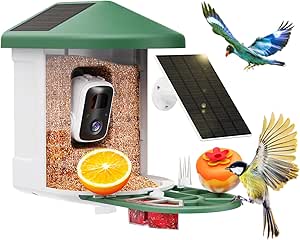 | Best for Flexible Video Storage | Model: Q8 | Camera: 2K resolution; 120° lens; 3× magnification | Seed capacity: 2L | VIEW LATEST PRICE | See Our Full Breakdown |
| HARYMOR Smart Bird Feeder with 2K Camera and AI Bird Identification |  | Best for Attracting Hummingbirds | Model: Q8 | Camera resolution: 2K | Zoom: 3× | VIEW LATEST PRICE | See Our Full Breakdown |
| Kiwibit 4K Smart Bird Feeder with Camera |  | Best for High-Detail Video | Video: 4K livestream with HDR | Photo resolution: 8 MP | Field of view: 132° | VIEW LATEST PRICE | See Our Full Breakdown |
| Birdfy Smart Bird Feeder with Camera and Solar Panel |  | Best for Seed and Suet Variety | Model: AMZ-Q10-ASG | Construction: All-metal | Seed capacity: 1.7L | VIEW LATEST PRICE | See Our Full Breakdown |
| Bird Buddy Pro Solar Smart Bird Feeder with Camera |  | Best for App-Based Bird Discovery | Camera: 2K video, 5MP photos, HDR | Connectivity: Bluetooth pairing and 2.4 GHz Wi-Fi | Power: Rechargeable battery; USB-C charging or solar panel | VIEW LATEST PRICE | See Our Full Breakdown |
| HARYMOR Smart Bird Feeder with Camera, Solar Powered, 2K HD Live Video, AI Identification of 10,000+ Bird Species |  | Best for High-Capacity, Shared Viewing | Model: Q8 | Seed capacity: 1.5 L | Camera: 2K HD | VIEW LATEST PRICE | See Our Full Breakdown |
| Birdfy Rookie Smart Bird Feeder with Camera |  | Best for Beginners | Video resolution: 1080p FHD | Night vision: Full-color | Playback: Slow-motion | VIEW LATEST PRICE | See Our Full Breakdown |
| HEAPETS Solar-Powered Smart Bird Feeder with 2K Camera |  | Best for Flexible Placement | Video resolution: 2K HD | Power: Solar-powered; wired power also possible | AI identification: Over 10,000 bird species | VIEW LATEST PRICE | See Our Full Breakdown |
| Kiwibit Solar Smart Bird Feeder with Camera |  | Best Premium Camera | Camera: 8MP photos, 4K Ultra HD video, HDR | Lens: 132° ultra-wide | Night vision: Infrared, black-and-white footage | VIEW LATEST PRICE | See Our Full Breakdown |
More Details on Our Top Picks
Cadrali 3K Smart Bird Feeder with Camera
The Cadrali stands out for pairing 3K video with AI coverage of more than 10,000 bird species, making it a strong fit for birders who want both detailed footage and a wide identification catalog. Its 3 W solar panel and 5000 mAh battery support outdoor placement, while IP65 protection and chew-resistant construction address common backyard wear. Compared with the Birdfy 1080P Natural Fir Wood model, Cadrali offers higher listed video resolution and broader species coverage, but Birdfy includes free AI identification and a wood finish. Cadrali’s tradeoffs are its 2.4 GHz-only Wi-Fi and possible subscription costs for AI and cloud storage after the trial. Local microSD recording avoids relying solely on cloud storage, though the card must be bought separately.
Pros:- AI identification covers more than 10,000 bird species.
- 3 W solar panel and 5000 mAh battery support outdoor operation.
- Offers microSD storage up to 128 GB as an alternative to cloud storage.
- IP65 and chew-resistant construction suits exposed outdoor placement.
Cons:- Connects only to 2.4 GHz Wi-Fi.
- MicroSD card is not included.
- AI identification and cloud storage may require a subscription after the 30-day trial.
Best for: Backyard birders who want broad AI species coverage, solar-assisted power, and the option to save clips locally.
Not ideal for: People with only a 5 GHz Wi-Fi network or buyers who want AI features without a possible ongoing subscription.
- Video resolution:3K; product details also list 1440p
- AI identification:Over 10,000 bird species
- Wi-Fi:2.4 GHz
- Power:3 W solar panel; 5000 mAh battery
- Weather protection:IP65; chew-resistant construction
- Storage:MicroSD up to 128 GB (not included) or cloud storage
- Mounting:Wall, tree, or pole
- Special features:Two-way audio and app alerts
Our verdict“Choose the Cadrali if wide-ranging species identification and local storage matter more than subscription-free AI or 5 GHz connectivity.”
Kiwibit Solar-Powered Smart Bird Feeder with Camera 2 Mini
For buyers who put footage quality first, the Kiwibit 2 Mini offers a distinctive combination of 4K video, 8MP photos, and 1080p playback at 60fps. Its 132° view captures a broad area around the perch, and infrared night vision extends monitoring beyond daylight. That makes it a more camera-focused pick than the NETVUE Birdfy 2K AI Camera with 1.5L capacity, which emphasizes a larger seed supply rather than 4K capture. Kiwibit also has a 1L container, a solar roof, and a removable camera and seed container that make cleaning less awkward. The main compromise is that AI identification needs a paid Premium subscription after the trial. It also depends on 2.4 GHz Wi-Fi, and local recording requires a separately purchased microSD card.
Pros:- Captures 4K UHD video and 8MP photos, with 1080p playback at 60fps.
- 132° field of view and infrared night vision cover a broad range of activity.
- Solar roof helps support outdoor use.
- Removable camera and seed container simplify cleaning and refilling.
Cons:- AI bird identification requires a paid Premium subscription after the 30-day trial.
- The 1L seed container is smaller than the 1.5L NETVUE N12’s.
- Requires 2.4 GHz Wi-Fi and a separate microSD card for local storage.
Best for: Birdwatchers who prioritize sharp video, wide scene coverage, and convenient access for camera and feeder cleaning.
Not ideal for: Buyers seeking subscription-free AI, a larger seed container, or compatibility with 5 GHz Wi-Fi.
- Video:4K UHD; 1080p playback at 60fps
- Photo capture:8MP
- Field of view:132°
- Night vision:Infrared
- Seed capacity:1L
- Weather resistance:IP65
- Connectivity:2.4 GHz Wi-Fi
- Local storage:MicroSD up to 512 GB (not included)
Our verdict“Pick the Kiwibit 2 Mini for detailed, wide-angle bird footage if you are comfortable paying separately for AI identification.”
NETVUE Birdfy Smart Bird Feeder with 2K AI Camera
The NETVUE Birdfy N12 is a balanced choice for birders who want automatic visit recordings and color night vision without making 4K resolution the priority. Its 2K camera, app notifications, and solar panel with a 5200 mAh battery cover the essentials for ongoing backyard monitoring. Compared with the Kiwibit 2 Mini, it gives up 4K capture, 8MP photos, and a stated wide-angle view, but its listed AI catalog spans more than 11,000 species. That broad coverage is appealing, though the product notes that advanced AI features require a subscription. Weather- and UV-resistant construction also suits outdoor mounting. One uncertainty is the inconsistent battery-runtime information in the product text, so buyers should avoid relying on a specific runtime expectation. This pick is strongest when dependable alerts and night color matter more than fine video detail.
Pros:- 2K camera includes color night vision and live app viewing.
- Automatically records visits and sends notifications.
- Solar panel and built-in 5200 mAh battery support outdoor use.
- AI identification covers more than 11,000 species.
Cons:- Advanced AI features require a subscription.
- Battery-runtime claims are inconsistent in the product information.
- Offers 2K video rather than the Kiwibit 2 Mini’s 4K capture.
Best for: Backyard watchers who want automatic recording, phone alerts, solar-assisted power, and color night viewing.
Not ideal for: Buyers who need a clearly stated battery runtime, subscription-free advanced AI, or 4K footage.
- Model:Birdfy AI N12
- Camera resolution:2K
- AI identification:Over 11,000 species; advanced features require a subscription
- Battery:5200 mAh
- Power:Solar panel and built-in battery
- Night vision:Color
- Construction:Weather- and UV-resistant
- App features:Automatic recording, notifications, and live viewing
Our verdict“Choose this Birdfy model for solar-assisted recording and color night vision if you can accept subscription limits and unclear runtime claims.”
Birdfy Smart Bird Feeder with Camera – Solar Powered, AI Bird Identification, 1080P Video, Night Vision, Natural Fir Wood
This Birdfy model is the clearest pick for buyers who want free AI identification rather than another trial that may lead to recurring costs. It recognizes more than 6,000 species and adds gender and age detection, activity tracking, and free cloud storage with 30-day video retention. The natural fir wood body gives it a more traditional garden appearance than the plastic-bodied NETVUE Birdfy N12, while its 5200 mAh battery, solar charging, and IP66 rating support outdoor placement. Its 1080P camera is a step down in resolution from that NETVUE’s 2K camera and the Cadrali’s listed 3K, but 60FPS capture can make movement easier to review in slow motion. The key limitation is its 2.4 GHz Wi-Fi requirement; cloud clips also do not provide indefinite retention.
Pros:- Free AI identifies over 6,000 species, with gender and age detection and activity tracking.
- Solar charging and a 5200 mAh battery support outdoor operation.
- 60FPS capture supports slow-motion review of bird movement.
- Natural fir wood and IP66 weather resistance suit garden use.
Cons:- 1080P resolution is lower than the 2K NETVUE and 3K Cadrali options.
- Requires a stable 2.4 GHz Wi-Fi connection.
- Free cloud video retention is limited to 30 days.
Best for: Bird enthusiasts who want detailed, free AI identification and prefer a natural wood feeder for a garden setting.
Not ideal for: Buyers who want 2K or higher resolution, long-term cloud archives, or access to a 5 GHz Wi-Fi network.
- Camera resolution:1080P
- Frame rate:60FPS
- AI features:Over 6,000 species, gender and age detection, and activity tracking
- Battery:5200 mAh
- Connectivity:2.4 GHz Wi-Fi
- Weather resistance:IP66
- Material:Natural fir wood
- Storage:Free cloud storage with 30-day retention
Our verdict“Choose this Birdfy if free, detailed AI identification and a natural wood design matter more than higher-resolution video or longer clip retention.”
NETVUE by Birdfy Smart Bird Feeder with 2K AI Camera
The standout reason to choose this NETVUE N12 is its 1.5L seed capacity: it holds more than the Kiwibit 2 Mini’s 1L container, which can mean fewer trips to refill when birds visit often. It also pairs a 2K camera with automatic photo and video capture, real-time phone alerts, IP65 protection, and a snap-lock roof designed to ease cleaning. The product information lists AI identification for more than 6,000 species, while also noting that advanced AI requires a subscription after the free trial. Compared with the NETVUE Birdfy 2K AI Camera with color night vision, this listing makes capacity and easy-clean construction its clearest advantages, but does not specify solar power or battery capacity. Its 2.4 GHz-only Wi-Fi also rules it out for homes with only a 5 GHz network.
Pros:- 1.5L (50 oz) capacity reduces how often the feeder needs refilling.
- 2K camera captures visiting birds and supports real-time phone alerts.
- IP65 weatherproof rating suits outdoor installation.
- Snap-lock roof supports easier cleaning.
Cons:- Does not support 5 GHz Wi-Fi.
- Advanced AI features require a subscription after the free trial.
- Product details do not specify solar power or battery capacity.
Best for: Frequent backyard visitors and birders who want a larger feeder capacity to reduce refills, plus app alerts and 2K capture.
Not ideal for: Buyers who need 5 GHz connectivity, clearly specified solar or battery power, or advanced AI without a subscription.
- Model:N12
- Camera resolution:2K (1080P HD)
- Seed capacity:50 oz (1.5L)
- Connectivity:2.4 GHz Wi-Fi; 5 GHz not supported
- AI identification:Over 6,000 species; advanced features require a subscription after the free trial
- Weather resistance:IP65
- Cleaning feature:Snap-lock roof
- Warranty:1 year
Our verdict“Choose this NETVUE N12 if larger seed capacity and easier cleaning outweigh the lack of 5 GHz support and unspecified power details.”
Birdfy Smart Solar-Powered Bird Feeder with Camera
The Birdfy’s case for a place in this roundup is its metal body paired with solar-assisted power, a practical combination for buyers who want an outdoor feeder built for exposure rather than a lightweight setup. Its 1080p camera adds full-color night vision, while AI identification and phone alerts help make visits easier to follow. Compared with the Kiwibit 4K Smart Bird Feeder, this model gives up higher-resolution video and a wider field of view, but keeps the choice simpler if sturdy metal construction matters more than detailed footage. The 9,000 mAh battery offers a substantial reserve, though solar charging still depends on placement and available light. One firm limitation: it connects only to 2.4 GHz Wi-Fi, so buyers with a 5 GHz-only network will need another option.
Pros:- Metal construction is rainproof, drop-resistant, and corrosion-resistant.
- Full-color night vision adds detail after daylight.
- AI species identification can send bird-arrival alerts to a phone.
- Solar panel supports the built-in 9,000 mAh battery.
Cons:- Requires 2.4 GHz Wi-Fi and does not list 5 GHz support.
- 1080p video provides less detail than the Kiwibit 4K model.
- Solar charging performance depends on sunlight and feeder placement.
Best for: Bird watchers seeking a weather-resistant metal feeder with color night viewing and a high-capacity battery.
Not ideal for: Households whose Wi-Fi network does not offer 2.4 GHz, or buyers prioritizing 4K detail over outdoor construction.
- Camera resolution:1080p HD
- Night vision:Full-color
- Bird identification:AI species identification with phone alerts
- Battery:9,000 mAh
- Connectivity:2.4 GHz Wi-Fi
- Material:Metal
- Weather resistance:Rainproof, drop-resistant, and corrosion-resistant
- Included components:Mounting kit, retractable perch, seed guard, and solar panel
Our verdict“Choose this Birdfy if durable metal construction and color night vision matter more to you than 4K footage or broader Wi-Fi compatibility.”
HARYMOR Smart Bird Feeder with 2K Camera and Solar Panels
This HARYMOR stands out for pairing a 2K wide-angle camera with a choice of cloud or local recording. The 120° lens helps capture more of the feeder area, while 3× magnification makes distant details easier to inspect. Its 2L hopper and IP65-rated design also suit people who want a generous seed supply with protection from weather. Compared with the closely related HARYMOR Q8 that includes a detachable hummingbird feeder, this version’s distinguishing appeal is its specified 3W built-in and 3W external solar panels, plus storage flexibility. That flexibility has limits: the memory card is not included, and detailed AI identification requires an app subscription. It also supports only 2.4 GHz Wi-Fi, so the Kiwibit 4K may suit buyers seeking higher-resolution footage, while this HARYMOR makes more sense for those who value 2K framing and storage options.
Pros:- 2K camera combines a 120° field of view with 3× magnification.
- 2L capacity reduces how often the feeder needs refilling.
- Cloud and memory-card recording provide storage choices.
- Built-in and external solar panels support ongoing power.
Cons:- AI identification details require an app subscription.
- Memory card is not included.
- Supports 2.4 GHz Wi-Fi only.
Best for: Bird watchers who want a roomy feeder, wide-angle 2K video, and a choice between cloud and memory-card storage.
Not ideal for: Buyers who want subscription-free AI identification, included local storage, or 5 GHz Wi-Fi support.
- Model:Q8
- Camera:2K resolution; 120° lens; 3× magnification
- Seed capacity:2L
- Water resistance:IP65
- Solar panels:3W built-in and 3W external
- Wi-Fi:2.4 GHz; 5 GHz not supported
- Storage:Cloud recording or memory card up to 128GB; card not included
- AI identification:More than 10,000 bird species
Our verdict“Pick this HARYMOR if you want a large, weather-protected feeder with flexible recording, and can accept subscription-based AI and a separate memory card.”
HARYMOR Smart Bird Feeder with 2K Camera and AI Bird Identification
The standout reason to choose this HARYMOR over the other models here is its detachable mini hummingbird feeder, which adds a second way to bring birds within camera range. The main feeder still covers the everyday basics with 2L capacity, IP65 protection, and 2K video with 3× zoom. Its built-in solar panel can reduce charging interruptions, while the included three-day cloud loop gives buyers a way to review recent visits; a memory card is optional and not supplied. Compared with the HARYMOR Q8 with two solar panels, this version lists a built-in panel and puts the hummingbird attachment front and center. Both share the 2.4 GHz Wi-Fi restriction and subscription-based AI identification, so this is a better fit for variety at the feeder than for buyers seeking the most flexible power setup or no-fee species recognition.
Pros:- Detachable mini hummingbird feeder adds another bird-attracting option.
- 2K video and 3× zoom help reveal more viewing detail.
- 2L food capacity and IP65 protection suit outdoor use.
- Built-in solar panel supports operation without frequent manual charging.
Cons:- AI identification of more than 10,000 species requires a subscription.
- Memory card is not included.
- Wi-Fi is limited to 2.4 GHz.
Best for: Bird enthusiasts who want to attract both seed-eating birds and hummingbirds to one camera-equipped station.
Not ideal for: Buyers who need 5 GHz Wi-Fi, subscription-free AI identification, or a memory card included in the box.
- Model:Q8
- Camera resolution:2K
- Zoom:3×
- Food capacity:2L
- Weather protection:IP65
- Power:Built-in solar panel
- Storage:Three-day cloud video loop for two years; supports memory cards up to 128GB
- Included feature:Detachable mini hummingbird feeder
Our verdict“Choose this HARYMOR if the detachable hummingbird feeder is a priority; choose its Q8 sibling if you prefer specified dual solar panels.”
Kiwibit 4K Smart Bird Feeder with Camera
For buyers who care most about footage clarity, the Kiwibit is the strongest video pick in this group: it offers 4K livestreaming, HDR, and a 132° field of view. That combination can capture a broad scene while preserving more detail than the 1080p Birdfy models or the 2K HARYMOR feeders. Its adjustable 3W solar panel, 5,200 mAh battery, and MicroSD support add useful flexibility for an outdoor camera. The tradeoff is that premium imaging does not mean every feature is included or unrestricted: local storage needs a separate card, cloud history is limited to a one-day rolling window, and AI features require a subscription after the 30-day trial. Its 1.5L hopper is also smaller than HARYMOR’s 2L feeders. Pick the Kiwibit for image detail, not for maximum seed capacity or subscription-free identification.
Pros:- 4K livestreaming with HDR captures more detail than the 2K HARYMOR models.
- 132° field of view covers a broad area around the feeder.
- Adjustable solar panel and rechargeable battery support outdoor placement.
- MicroSD storage supports cards up to 512GB.
Cons:- AI features require a subscription after the 30-day premium trial.
- MicroSD card is not included, and free cloud history is limited to one day.
- 1.5L hopper holds less seed than the HARYMOR 2L models.
- Does not support 5 GHz Wi-Fi.
Best for: Bird watchers who prioritize sharp livestream footage, a broad viewing angle, and local recording options.
Not ideal for: Buyers who want a larger seed hopper, included MicroSD storage, or ongoing AI identification without a subscription.
- Video:4K livestream with HDR
- Photo resolution:8 MP
- Field of view:132°
- Night vision:Yes
- Seed hopper:1.5L, dual compartment
- Power:3W adjustable solar panel and 5,200 mAh rechargeable battery
- Local storage:MicroSD up to 512GB; card not included
- Weather resistance:IP65
- Wi-Fi:2.4 GHz; 5 GHz not supported
Our verdict“Choose the Kiwibit if video detail is your priority and you are comfortable supplying a MicroSD card and paying for AI features after the trial.”
Birdfy Smart Bird Feeder with Camera and Solar Panel
This Birdfy earns a distinct place for combining a 1.7L seed container with side suet cages, giving buyers more than one way to attract birds at a single station. Its all-metal construction is another clear point of difference from the HARYMOR Q8 models, which emphasize larger 2L hoppers and 2K video. Here, the camera records 1080p video with 60FPS slow-motion playback, a useful feature for reviewing quick visits, while species recognition and phone alerts bring the smart-feeder basics. Solar support and a 5,200 mAh battery reduce the need for frequent manual charging, though performance still depends on light and setup. Buyers focused on sharper video should look to the Kiwibit 4K instead. This Birdfy’s listed connectivity is limited to 2.4 GHz Wi-Fi, and the provided component list mentions only a manual, so check the package contents before planning installation.
Pros:- All-metal construction is suited to outdoor use.
- Seed container and side suet cages offer more than one food option.
- 60FPS slow-motion playback can make quick bird visits easier to review.
- 3W solar panel and 5,200 mAh battery support extended operation.
Cons:- 1080p resolution is lower than the HARYMOR 2K and Kiwibit 4K options.
- Supports 2.4 GHz Wi-Fi only.
- Included components list only a manual, leaving mounting accessories unspecified.
Best for: Backyard bird watchers who want to offer both seed and suet while capturing slow-motion clips of visits.
Not ideal for: Buyers who prioritize 2K or 4K footage, need 5 GHz Wi-Fi, or want clearly specified mounting accessories included.
- Model:AMZ-Q10-ASG
- Construction:All-metal
- Seed capacity:1.7L
- Video:1080p with 60FPS slow-motion playback
- Camera features:Bird species recognition and phone alerts
- Power:3W solar panel and 5,200 mAh rechargeable battery
- Wi-Fi:2.4 GHz only
- Feeding features:Side suet cages
Our verdict“Choose this Birdfy if attracting birds with both seed and suet matters more than higher-resolution video or broader network compatibility.”
Bird Buddy Pro Solar Smart Bird Feeder with Camera
The Bird Buddy Pro makes the most sense for birders who want the feeder’s app to do more than send a motion alert. Its AI identification and visit notifications make it easier to follow backyard activity, while 2K HDR video and 5MP photos offer more image detail than the Birdfy Rookie’s 1080p camera. Solar charging can reduce manual charging, and the included hanger and universal mount give buyers more than one installation route. The tradeoff is that key app features require a premium subscription, so the ongoing service commitment matters as much as the hardware. Its 0.9-liter capacity is also smaller than the HARYMOR and Kiwibit feeders’ 1.5-liter hoppers, meaning more frequent refills for busy yards. I’d choose it for app-led identification, not maximum seed storage.
Pros:- 2K HDR video and 5MP photos provide more detail than the Birdfy Rookie’s 1080p footage.
- AI bird identification and visit alerts make backyard activity easier to follow in the app.
- Solar and USB-C charging offer two ways to manage battery power.
- Includes a metal hanger and universal mount for flexible installation.
Cons:- App features require a premium subscription.
- The 0.9-liter capacity means more frequent refills than the 1.5-liter HARYMOR or Kiwibit models.
- A pole is not included, and a wall mount is not included.
Best for: Birders who value app-based species identification and visit alerts, and have a convenient place to mount a compact feeder.
Not ideal for: People who want a large seed hopper or full smart features without a paid subscription; the 0.9-liter capacity is modest and app features require a premium plan.
- Camera:2K video, 5MP photos, HDR
- Connectivity:Bluetooth pairing and 2.4 GHz Wi-Fi
- Power:Rechargeable battery; USB-C charging or solar panel
- Capacity:0.9 liters
- Dimensions:6.89 x 6.3 x 9 inches
- Weight:1.63 kg
- Material:ABS plastic
- Mounting:Hanger or included universal pole mount; wall mount not included
Our verdict“Choose the Bird Buddy Pro for app-centered bird identification and flexible charging, but skip it if you want a large hopper or subscription-free smart features.”
HARYMOR Smart Bird Feeder with Camera, Solar Powered, 2K HD Live Video, AI Identification of 10,000+ Bird Species
The HARYMOR is the practical pick here for households that want a generous seed supply and a wide view of the feeding area. Its 1.5-liter container holds more than the Bird Buddy Pro’s 0.9-liter feeder, so it can mean fewer refills when visits are frequent. The 120° 2K camera covers a broad scene, while shared live streaming suits families watching from separate devices. Two built-in solar panels support ongoing power, though the product notes that an optional external panel may help in low light. The mesh barrier and siren add squirrel deterrence that the HEAPETS listing does not specify. The compromise is added setup and service cost: AI identification requires a subscription, and neither the memory card nor cloud storage is included. I’d favor it over the more compact Birdfy Rookie when capacity and group viewing matter most.
Pros:- The 1.5-liter seed container holds more than the Bird Buddy Pro’s 0.9-liter hopper.
- A 120° field of view captures a broad area around the feeder.
- Two built-in solar panels support solar operation, with an optional external panel available.
- Squirrel-proof mesh and a built-in siren add seed-protection features.
Cons:- AI species identification requires a paid subscription.
- Memory card and cloud storage are sold separately.
- An external solar panel may be needed for better power in low-light locations.
Best for: Families and frequent backyard visitors who want a larger seed supply, broad camera coverage, and shared live viewing.
Not ideal for: Buyers seeking a simple, low-extra-cost setup; AI requires a subscription, and local memory card or cloud storage must be arranged separately.
- Model:Q8
- Seed capacity:1.5 L
- Camera:2K HD
- Field of view:120°
- Storage support:Up to 128GB memory card; card sold separately
- Solar panels:Two built-in panels; optional external panel
- AI identification:Over 10,000 species; subscription required
- Protection:Squirrel-proof mesh barrier and built-in siren
Our verdict“Pick the HARYMOR if you want a roomy, family-friendly feeder with a wide camera view, and accept separate storage and subscription costs.”
Birdfy Rookie Smart Bird Feeder with Camera
The Birdfy Rookie is the least complicated entry point in this group: tool-free installation, beginner tips, and a modular design reduce the work of getting started and cleaning up. Its 1080p video is less detailed than the 2K feeds from the Bird Buddy Pro and HEAPETS, but full-color night vision and slow-motion playback add useful viewing options beyond resolution alone. The listed battery life—up to four months—depends on a specific usage pattern of ten 20-second clips per day, so heavier activity may shorten the interval between charges. Its Wi-Fi and app requirements also make it a poor fit for a yard without a reliable connection. Unlike the HARYMOR, the supplied details do not give a seed capacity or solar charging option. I’d pick it for approachable setup rather than advanced image quality or low-maintenance power.
Pros:- Tool-free installation lowers the barrier for first-time smart-feeder owners.
- Full-color night vision and slow-motion playback add viewing options to 1080p video.
- Modular construction is designed for easier cleaning.
- App supports live video, visit notifications, and sharing with more than 20 people.
Cons:- 1080p resolution is below the 2K cameras in the Bird Buddy Pro and HEAPETS feeders.
- Battery life of up to four months is tied to the stated clip-use conditions.
- Smart features require Wi-Fi and the Birdfy app.
Best for: First-time smart-feeder owners who want guided setup, simple cleaning, and app notifications without starting with a higher-resolution camera.
Not ideal for: Birders who prioritize 2K or 4K footage, solar charging, or a clearly specified large seed hopper.
- Video resolution:1080p FHD
- Night vision:Full-color
- Playback:Slow-motion
- Battery life:Up to 4 months at 10 clips of 20 seconds per day
- Connectivity:Wi-Fi
- Smart features:Bird recognition, live video, and visit notifications through the Birdfy app
- Installation:Tool-free installation
- Included components:Feeder, camera, installation accessories, manual, and beginner tips
Our verdict“Choose the Birdfy Rookie for straightforward setup and approachable features, not for the highest-resolution footage or solar-powered operation.”
HEAPETS Solar-Powered Smart Bird Feeder with 2K Camera
HEAPETS earns its place for buyers whose mounting location matters as much as the camera. It supports tree, pole, or wall mounting, giving it more explicitly listed placement choices than the Bird Buddy Pro, which offers a hanger or universal pole mount but no wall mount. The 2K stream and motion alerts cover the core smart-feeder experience, while solar power or wired operation lets buyers adapt to the available setup. AI can identify more than 10,000 species, but the included service is a one-month trial; ongoing identification can require a subscription. There is also a firm sharing limit: only two users can watch live at once, unlike the Birdfy Rookie, which supports sharing with more than 20 people. With no capacity figure provided, I wouldn’t rank it ahead of HARYMOR for refill planning. It’s a useful fit when mounting flexibility is the deciding factor.
Pros:- Tree, pole, and wall mounting options suit a wider range of yard layouts than the Bird Buddy Pro’s listed mounts.
- 2K video and motion alerts provide the main connected-feeder functions.
- Solar or wired power supports more than one installation approach.
- Weather-resistant construction is described as rainproof, snow-resistant, and heat-tolerant.
Cons:- AI identification moves to optional paid subscriptions after the one-month trial.
- Live viewing is limited to two users at the same time, fewer than the Birdfy Rookie’s stated sharing group.
- Seed container capacity is not specified in the supplied product details.
Best for: Birders who need to choose among tree, pole, and wall mounting and want solar or wired power options.
Not ideal for: Large households that want several people watching live together, or buyers who need a stated seed capacity before choosing.
- Video resolution:2K HD
- Power:Solar-powered; wired power also possible
- AI identification:Over 10,000 bird species
- AI service:One-month free trial; optional monthly or yearly subscription afterward
- Mounting options:Tree, pole, or wall
- Weather resistance:Rainproof, snow-resistant, and heat-tolerant
- Simultaneous live viewers:2 users
- Seed container:Spill-proof; capacity not specified
Our verdict“Choose HEAPETS when mounting flexibility and solar-or-wired power matter more than large-group viewing or a documented hopper capacity.”
Kiwibit Solar Smart Bird Feeder with Camera
The Kiwibit is the image-quality pick in this set: 4K HDR video and 8MP photos exceed the Bird Buddy Pro’s 2K video and 5MP stills, making it the stronger choice for close inspection of plumage and behavior. Its 132° lens captures a wide view, and the 1.5-liter dual-seed hopper offers substantially more room than the Bird Buddy Pro’s 0.9-liter capacity. Dual solar panels work alongside a 5,200mAh battery, while detachable parts can make refilling and cleaning less of a chore. That premium camera package comes with tradeoffs: AI features require a paid subscription after a 30-day trial, and the 2.4GHz-only Wi-Fi rules out 5GHz networks. Infrared night vision is black-and-white, not the Birdfy Rookie’s full-color night footage. I’d choose Kiwibit for detail and hopper capacity, not for the broadest network compatibility.
Pros:- 4K HDR video and 8MP photos offer more detail than the Bird Buddy Pro’s 2K video and 5MP photos.
- The 132° lens provides a wide viewing angle.
- A 1.5-liter dual-seed hopper holds more than the Bird Buddy Pro’s 0.9-liter feeder.
- Dual solar panels, a 5,200mAh battery, and detachable parts support outdoor use and easier handling.
Cons:- AI features require a paid subscription after the 30-day trial.
- Wi-Fi connectivity is limited to 2.4GHz.
- Infrared night vision produces black-and-white footage rather than the Birdfy Rookie’s full-color night view.
Best for: Birders who want the sharpest listed footage and photos in this group, plus a large dual-seed hopper and solar charging.
Not ideal for: Households with only 5GHz Wi-Fi or buyers who want full-color night footage and AI features without a paid plan.
- Camera:8MP photos, 4K Ultra HD video, HDR
- Lens:132° ultra-wide
- Night vision:Infrared, black-and-white footage
- AI identification:Over 10,000 species; subscription required after a 30-day trial
- Battery:5,200mAh rechargeable
- Solar charging:Dual solar panels
- Wi-Fi:2.4GHz
- Seed capacity:1.5L dual-seed hopper
- Weather resistance:IP65
Our verdict“Choose Kiwibit for the strongest listed camera specifications and a roomy dual-seed hopper, provided 2.4GHz Wi-Fi and subscription-based AI suit your setup.”

How We Picked
I compared the 15 feeders on the factors that change everyday use: camera resolution and live-view usefulness, bird-identification features, solar and battery arrangements, app functions, feeder capacity and access for cleaning, and the demands of mounting and outdoor placement. A higher resolution can show more detail, but it does not automatically make a feeder easier to maintain or more useful for casual watching. I also treated claims about species recognition as a feature to compare, not a promise that every visit will be identified correctly.
The ranking favors a well-rounded experience over a single standout specification. Models with a useful balance of camera capability, power convenience, and approachable setup place ahead of options whose appeal centers on a narrower need, such as 4K footage or a particular feeder style. I also account for overlap among models: when several feeders offer similar 2K cameras, differences in power setup, design, and intended buyer carry more weight than the resolution label alone.
Factors to Consider When Choosing Best Smart Bird Feeders
Choosing a smart feeder is less about finding the biggest feature list and more about deciding what will make you keep using it. I would start with the yard and the daily upkeep you are willing to handle, then compare camera and app features against that reality.
Match Camera Resolution to How You Watch
Resolution matters most when you plan to crop footage, inspect markings, or save clips for close viewing. For casual alerts and sharing visits, a capable 2K camera may offer a better balance than paying extra attention to 4K. Image quality also depends on lighting, lens angle, motion, and where the feeder is mounted, so a higher number alone cannot promise clear footage. Place the feeder where birds can approach naturally and the camera has an unobstructed view. Avoid mounting it directly into harsh backlight if you want useful daytime images. Choose the resolution that fits your viewing habits, not the most prominent number on the box.
Treat Solar as Backup Power, Not Set-and-Forget
Solar panels can cut down on charging, but their output depends on direct sunlight and the panel’s angle. A feeder tucked under a porch or beneath dense tree cover may not receive enough light to keep pace with frequent camera activity. Before choosing a solar model, check whether the panel is built into the feeder or can be positioned for better exposure. Think about winter daylight and long stretches of cloudy weather in your area, too. A reachable charging port matters if you may need to bring the unit indoors or connect a cable. Buyers who cannot place a panel in a sunny spot should favor easy manual charging over assuming solar will cover every season.
Check the App and Identification Features
AI identification can make a stream of visits easier to browse, but recognition should be treated as a helpful suggestion rather than a definitive field guide. Species lists and app features can differ, so check which functions come with the feeder and which may depend on a paid plan. Consider how alerts, saved clips, sharing, and live viewing fit your routine; frequent notifications can become noise if the app offers limited controls. If several household members want access, look into account sharing before buying. A buyer who mainly wants reliable footage may prefer a simpler app over a long list of identification features. Keep a local bird guide or trusted identification source handy when a result looks uncertain.
Plan for Cleaning and Refill Access
Feeders need regular cleaning and refilling, and camera housings can make those chores less straightforward. Look for a design that lets you reach the seed compartment without struggling around the electronics. A wide opening can make scrubbing easier, while a removable tray may collect debris that would otherwise fall to the ground. Consider where rain, hulls, and spilled seed will go, since damp seed can spoil and attract pests. Check the expected seed type and capacity against the birds you hope to attract and how often you want to refill. A feeder that is easy to maintain is more likely to stay stocked and hygienic through the season.
Choose a Mounting Spot Before Choosing a Feeder
Mounting options shape both video quality and bird activity. A window, post, or tree placement can change the camera angle, access for cleaning, exposure to sunlight, and how safely birds can approach. Confirm what mounting hardware is included and whether the feeder needs a nearby Wi-Fi signal; a strong connection indoors does not guarantee coverage at the far end of a yard. Keep the feeder away from places where cats can ambush visitors, and consider nearby glass that could pose a collision hazard. If you rent or have limited outdoor space, a compact design may be easier to position than a larger feeder. Measure the intended spot before ordering instead of treating mounting as an afterthought.
Pay More Only for Features You Will Use
Premium features make sense when they solve a recurring problem: 4K for close inspection, solar for a sunny location, or richer app tools for someone who actively catalogs visits. They offer less value when your main goal is occasional clips or a straightforward view of backyard birds. Add potential subscription costs to the decision if cloud storage or advanced identification may require ongoing payment. A lower-cost or simpler model can be the better fit when it still covers your mounting, camera, and maintenance needs. Compare the full ownership routine, including charging and cleaning, rather than shopping by feature count alone. Choose a premium feeder for a specific benefit, not simply because it has more specifications.
Frequently Asked Questions
Is a 4K smart bird feeder worth choosing over a 2K model?
Choose 4K if you expect to crop clips, study small markings, or save detailed footage; that is the clearest reason to pick the Kiwibit 4K over a 2K option in this lineup. For general live viewing and visit alerts, 2K models such as the NETVUE Birdfy may already fit the job. Actual footage also depends on light, motion, camera position, and connection quality. Higher resolution can create larger files and may place more demand on storage or data use. If detail is not a regular priority, compare power setup and app features before paying for extra resolution.
Will a solar-powered feeder keep running without manual charging?
Not in every yard or season. Solar charging depends on sunlight reaching the panel, and a shaded mounting spot, cloudy weather, or short winter days can reduce its contribution. Camera use and frequent activity alerts may also draw power faster than a poorly placed panel can replenish it. Before buying, check whether the panel can be angled or placed separately, and whether the feeder remains easy to charge by cable. Solar is most useful when the mounting location gets dependable sun and you can still reach the device for maintenance.
Do I need a subscription to use bird identification or save video?
It depends on the model and on which app functions you want, so check the current plan details for the exact feeder before purchase. A product’s AI identification claim does not by itself explain whether all identification tools, cloud storage, or extended clip history are included. Decide whether you need ongoing access to saved footage or mainly want live viewing and occasional alerts. If a subscription is required for a feature you expect to use, include that recurring commitment in your comparison. Buyers who prefer fewer ongoing costs should confirm what works without a paid plan.
How can I tell whether a smart feeder will work at my planned location?
Check three things at the actual mounting spot: Wi-Fi coverage, access to sunlight if using solar, and room for a clear camera view. A signal that works indoors may weaken across a yard or through exterior walls, so test connectivity near the feeder location if possible. Make sure you can reach the feeder for refilling, cleaning, and charging without unsafe climbing. Observe whether nearby branches, walls, or glass obstruct the lens or create hazards for birds. If the spot fails one of these checks, changing the location may help more than choosing a model with a higher-resolution camera.
Which smart feeder is a better fit for a beginner?
A beginner should favor a feeder that is straightforward to mount, refill, clean, and charge, rather than buying chiefly for the longest species list or the highest resolution. The Birdfy Rookie is the lineup’s entry-level-oriented option, while the broader Birdfy models offer a different balance of camera and identification features. Before deciding, review setup requirements, app sharing, and any ongoing plan needed for the features you want. Think about what seed you will use and whether local birds are likely to visit the planned location. A simpler routine can be more rewarding than a feature-rich feeder that is difficult to maintain.
Conclusion
For most buyers, I recommend the NETVUE Birdfy Smart Bird Feeder with 2K AI Camera as the best overall balance of footage and identification features. The best value depends on your priorities: choose a straightforward 2K model if you want everyday clips, and avoid paying for 4K unless added detail matters to you. For a best premium experience, the Bird Buddy Pro Solar is a standout for buyers drawn to its camera-and-app approach; check its feature and plan details before choosing. Beginners should look at the Birdfy Rookie and prioritize easy upkeep over advanced specifications. For specific needs, the Kiwibit 4K suits detail-focused viewing, while a solar model makes more sense in a reliably sunny spot. The right pick is the one that fits your mounting location and maintenance routine as well as your interest in bird footage.