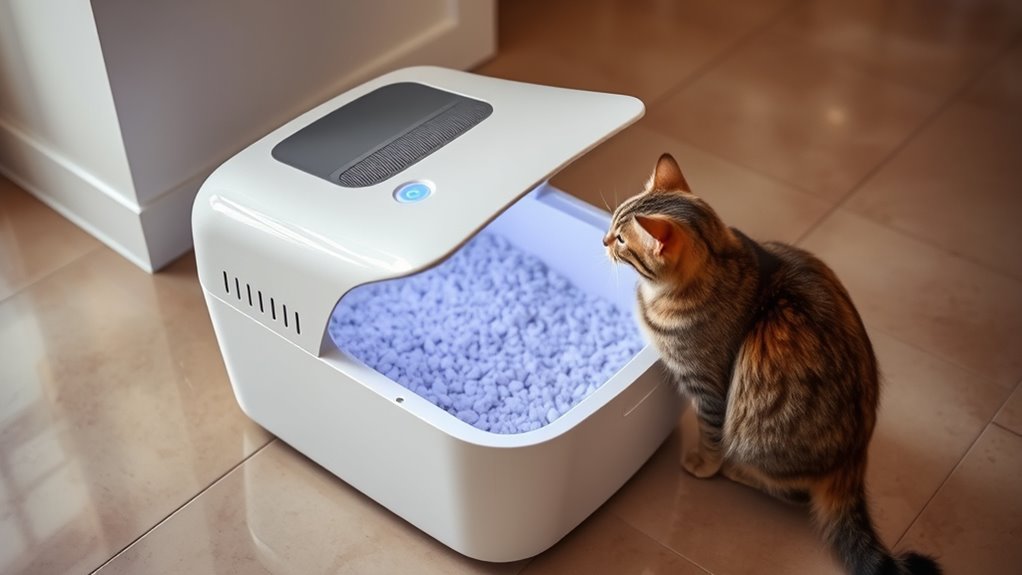

Among these self-cleaning cat litter boxes, the PETKIT PuraMax 2 is my best overall pick for shoppers who want a more established feature set, while the Cumrige stands out for its stated 95L capacity and the Mimfam for its four pairs of infrared sensors and included mat and liner bags. The main tradeoffs are open access versus a more enclosed design, larger capacity versus the room a unit takes up, and app features versus simpler setup. Sensor details, litter compatibility, and how waste is handled can matter as much as automation. Read on for the full breakdown of which design suits each household and what to check before choosing.

Get pet supplies delivered free with Prime
- Fast, free delivery on millions of items
- Prime Video, Amazon Music and more included
- Member-only deals all year
Complete the kit


Key Takeaways
- PETKIT PuraMax 2 is the strongest all-around choice in this lineup for shoppers who prefer a named, feature-rich model; buyers should still check its dimensions and litter requirements for their setup.
- Cumrige’s stated 95L capacity makes it the clearest option to investigate for larger cats or multi-cat homes, though a high-capacity unit can claim more floor space.
- Mimfam’s four pairs of infrared sensors and included litter mat and liner bags give it a more safety- and setup-focused package than the basic open-top listings.
- Several picks, including the unnamed automatic box, Mimfam, otoging, and WARCAT, use an open-top design; that can feel more accessible to some cats but may offer less litter scatter control.
- App control appears across multiple models, so it is not enough by itself to distinguish a pick; compare the safety details, cleaning routine, footprint, and replacement supplies before deciding.


| cat litter boxes self cleaning | Connectivity | Dimensions | Weight |
|---|---|---|---|
| Automatic Cat Litter Box | 2.4 GHz Wi-Fi | — | — |
| Fumoi Automatic Self-Cleaning | 2.4 GHz Wi-Fi | 23 × 22.99 × 20 in | 35 lb |
| Mimfam Automatic Self-Cleaning | — | 21.25 × 16.32 × 24 in | 22 lb |
| otoging Self-Cleaning Open-Top | — | 21.25 × 20.21 × 24.1 in | 21.3 lb |
| Cumrige Automatic Litter Box w | 2.4 GHz Wi-Fi | — | — |
| PETKIT PuraMax 2 Automatic Sel | 2.4 GHz Wi-Fi | — | — |
| WARCAT Automatic Litter Box | No app or Wi-Fi required | 21.7 × 21.7 × 20 inches | 22.3 pounds |
More Details on Our Top Picks
Automatic Cat Litter Box, Self Cleaning Litter Box for Multiple Cats with Open Top Design, App Control, Safety Protection, Ultra-Quiet, Easy Setup, White
This pick pairs an open 16.5-by-16.5-inch entrance with app controls, making it a fit for households whose cats may avoid enclosed boxes but whose people still want remote cleaning and usage alerts. Its seven sensors are more numerous than the safety details listed for the Fumoi M4, while the Fumoi publishes a larger 86-liter drum capacity; this model’s drum size is not provided, so I can’t compare how often either needs litter replenished. The 15-liter sealed waste bin and washable liner are intended to reduce odor and simplify cleanup. App features require 2.4 GHz Wi-Fi, and the open top offers less physical coverage than the Fumoi’s enclosed design. It suits cats that prefer an unobstructed entry, but buyers should confirm the footprint and setup fit their home.
Pros:- Wide, unobstructed 16.5-by-16.5-inch entrance
- Four weight sensors and three infrared detectors
- App supports cleaning controls, schedules, usage trends, and bin alerts
- Sealed 15-liter waste compartment and washable liner
Cons:- App functions require 2.4 GHz Wi-Fi
- Open-top layout provides less containment than the enclosed Fumoi M4
- Drum capacity and overall dimensions are not supplied
Best for: Multi-cat households with cats that prefer an open entrance and caregivers who want app alerts and scheduled cleaning.
Not ideal for: People who need an enclosed box to contain litter scatter or who cannot use a 2.4 GHz Wi-Fi network.
- Entrance:16.5 × 16.5 in
- Waste bin:15 L, sealed
- Safety sensors:4 weight-activated sensors and 3 infrared detectors
- Connectivity:2.4 GHz Wi-Fi
- Controls:App control, scheduled cleaning, and one-tap waste disposal
- Liner:Removable washable liner
Our verdict“Choose this model if your cats favor open access and you want app-based routines, provided 2.4 GHz Wi-Fi is available.”
Fumoi Automatic Self-Cleaning Litter Box with App Control
The Fumoi M4 is the enclosed choice in this group, with an 86-liter drum and 15-liter waste compartment aimed at households that want less frequent litter and waste handling. Its enclosed form gives more coverage than the open-top Mimfam AS11, though cats wary of covered spaces may take time to adjust. The app records usage and sends bin reminders, but it depends on 2.4 GHz Wi-Fi; the otoging avoids network setup entirely, at the cost of having no listed app controls. Infrared sensors pause operation when a cat approaches, and the removable washable tray supports cleanup. At 35 pounds and roughly 23 inches in each listed horizontal dimension, it is a substantial fixture, so it makes more sense for a settled litter area than frequent repositioning.
Pros:- 86-liter drum and 15-liter waste compartment
- App provides cleaning controls, usage records, and bin reminders
- Infrared sensors pause operation when a cat approaches
- Removable washable tray supports cleanup
Cons:- App features require 2.4 GHz Wi-Fi
- Enclosed design may take adjustment for nervous or older cats
- 35-pound weight makes relocation less convenient
Best for: Multi-cat households that want an enclosed, high-capacity box with app records and waste-bin reminders.
Not ideal for: Cats that avoid enclosed spaces, people without 2.4 GHz Wi-Fi, or households that need to move the box often.
- Brand and model:Fumoi M4
- Litter drum:86 L
- Waste compartment:15 L
- Connectivity:2.4 GHz Wi-Fi
- Safety:Infrared sensors pause operation when a cat approaches
- Dimensions:23 × 22.99 × 20 in
- Weight:35 lb
- Material:ABS
Our verdict“Pick the Fumoi M4 for an enclosed, high-capacity setup with app tracking, if your cats accept covered boxes.”
Mimfam Automatic Self-Cleaning Litter Box with 4 Pairs Infrared Sensors, Open-Top Design for Multi-Cat Homes, Includes Liner Bags and Cat Litter Mat – Grey
The Mimfam AS11 stands out for its stated 32 dB operation and layered detection: four pairs of infrared sensors plus three hall sensors. That combination makes it the quiet-focused open-top option, while the similarly open otoging is also listed at about 32 dB but relies on a power button without app control. Mimfam adds a 10-liter waste container, liner bags, and a litter mat, so it comes with useful cleanup accessories; the Cumrige offers a larger 15-liter waste bin for buyers prioritizing less frequent emptying. The open entry gives cats more visibility and room, though it leaves less coverage around the litter area than the enclosed Fumoi M4. At 22 pounds and 24 inches tall, it needs a dedicated spot, and its listed waste capacity is smaller than some alternatives.
Pros:- Stated operating noise level of 32 dB
- Four pairs of infrared sensors and three hall sensors
- Open-top entry with a 10-liter waste container
- Liner bags and cat litter mat are included
Cons:- 22-pound body and 24-inch height require a dedicated space
- Open design contains less scatter than the enclosed Fumoi M4
- 10-liter waste capacity is smaller than the 15-liter Cumrige bin
Best for: Noise-sensitive households with multiple cats that prefer an open entry and want multiple proximity sensors.
Not ideal for: People seeking a compact unit, enclosed litter containment, or the longest interval between waste-bin emptying.
- Brand and model:Mimfam AS11
- Design:Open top with top entry
- Waste capacity:10 L
- Noise level:32 dB
- Sensors:4 pairs infrared and 3 hall sensors
- Dimensions:21.25 × 16.32 × 24 in
- Weight:22 lb
- Material and color:Polypropylene (PP), grey
- Warranty:1 year
Our verdict“Choose the Mimfam if quiet operation and open access matter more than an enclosed design or a larger waste bin.”
otoging Self-Cleaning Open-Top Cat Litter Box
The otoging is the straightforward choice for buyers who want an open-top self-cleaning box without app or Wi-Fi setup: operation starts with a power button. That keeps it simpler to configure than the app-connected Mimfam, but it also means no listed remote controls, usage records, or bin alerts. Its 10-liter waste container matches the Mimfam’s stated capacity, and its noise level is listed at about 32 dB. The 6 kg litter capacity gives buyers a concrete loading limit, while the open design offers visibility and room for cats that dislike covered boxes. Compared with the enclosed Fumoi M4, it provides less coverage for scatter and odors. At just over 21 pounds and more than 24 inches tall, it still needs floor space, and its plug-in power requirement limits placement.
Pros:- Starts by power button without app or Wi-Fi setup
- Open-top design gives cats visibility and room
- 10-liter waste container
- Stated operating noise of about 32 dB
Cons:- No listed app controls, usage records, or remote alerts
- Open top offers less coverage than the enclosed Fumoi M4
- Plug-in power and large footprint constrain placement
Best for: Cat owners who want an open-top automatic box with simple button operation and no app connection.
Not ideal for: People who want remote monitoring, an enclosed litter area, or flexible placement away from a power outlet.
- Brand and model:otoging AS11-SLB13
- Design:Open top
- Litter capacity:6 kg
- Waste container:10 L
- Noise level:About 32 dB
- Dimensions:21.25 × 20.21 × 24.1 in
- Weight:21.3 lb
- Material and color:Polypropylene (PP), white
- Power and warranty:Plug-in; 1 year
Our verdict“Choose otoging if you want open access and basic button operation without managing app connectivity.”
Cumrige Automatic Litter Box with Safety Sensor, App Control, 95L Large Capacity
For buyers whose main goal is reducing how often they handle litter and waste, the Cumrige pairs a 95-liter drum with a 15-liter waste bin that the product data says can last up to 15 days. That is the largest stated drum in this lineup, ahead of the Fumoi M4’s 86 liters, while both have 15-liter waste compartments. The app runs through Tuya Smart on 2.4 GHz Wi-Fi and offers remote monitoring and control; the otoging is simpler to connect because it has no app, but it cannot offer the same remote oversight. A safety sensor pauses cleaning when a cat is present, and the unit is specified for clumping litter and cats weighing 2.2 to 33 pounds. Its bulk may be difficult to accommodate in a small home, and its Wi-Fi requirement rules out 5 GHz-only setups.
Pros:- 95-liter drum is the largest stated capacity among these five options
- 15-liter waste bin is listed for up to 15 days of use
- Safety sensor pauses cleaning when a cat is present
- Tuya Smart app supports remote monitoring and control
Cons:- Requires 2.4 GHz Wi-Fi for app features
- Bulky size may be difficult to place in a small home
- Specified for clumping litter and cats weighing 2.2–33 lb
Best for: Multi-cat households with enough floor space that want a large drum, a sizable waste bin, and remote app control.
Not ideal for: Small homes, users on 5 GHz-only Wi-Fi, or households using litter other than clumping types.
- Drum capacity:95 L
- Waste bin:15 L; listed for up to 15 days
- Cat weight range:2.2–33 lb
- Litter compatibility:Clumping litter
- Connectivity:2.4 GHz Wi-Fi
- App:Tuya Smart
- Safety:Sensor pauses cleaning when a cat is present
Our verdict“Choose Cumrige if you have space for a large unit and want the biggest stated drum capacity with app control.”
PETKIT PuraMax 2 Automatic Self-Cleaning Cat Litter Box
The PETKIT PuraMax 2 suits cat owners who want cleaning controls and usage tracking on their phone, along with a roomy 76L interior. Its auto, manual, timer, and empty modes give more control than the app-free WARCAT Automatic Litter Box, though that model’s open top may feel more inviting to cats wary of enclosed spaces. Here, seven infrared and four weight sensors pause cleaning when a cat approaches, while the sealed 7L bin and included odor remover target mess and smells between emptying. The 7.87-inch entry may help some older cats get in, but it could still be a hurdle for cats with significant mobility limits. It requires clumping litter, a flat floor, and cats at least six months old; carpet and mats are unsuitable, and K3 Smart Spray is incompatible.
Pros:- App control and usage tracking provide remote access to cleaning information
- Multiple cleaning modes offer flexibility in how the unit runs
- Seven infrared and four weight sensors pause cleaning when a cat approaches
- Sealed 7L bin and included odor remover support odor management
Cons:- Requires a flat floor and cannot be placed on carpet or mats
- Supports clumping litter only and is not intended for cats under six months
- Not compatible with PETKIT K3 Smart Spray
Best for: Owners of adult cats who want app-based cleaning controls, usage tracking, and a sealed waste bin
Not ideal for: Homes with kittens under six months, non-clumping litter users, or cats that need a very low step-in
- Interior capacity:76 L
- Waste bin capacity:7 L
- Supported cat weight:3.3–22 lbs
- Minimum pet age:6 months
- Entry height:7.87 inches
- Connectivity:2.4 GHz Wi-Fi
- Safety sensors:7 infrared sensors and 4 weight sensors
- Cleaning modes:Auto, manual, timer, and empty
- Litter compatibility:Clumping litter
Our verdict“Choose the PuraMax 2 if you want app controls and a large interior, and can meet its floor and litter requirements.”
WARCAT Automatic Litter Box – Open Top, Child Lock, Gray & White
The WARCAT Automatic Litter Box is a straightforward pick for cats that may resist enclosed designs and for households that prefer not to manage an app or Wi-Fi connection. Its open top gives cats a less confined entry than the PETKIT PuraMax 2, which pairs its larger interior with phone-based controls. WARCAT adds a child lock and ten sensors that stop cleaning when a cat is inside; the 10L sealed drawer is described as holding about ten days of waste, although the drawer still needs to be emptied by hand. Standard clumping litter is supported, with a particle-size limit under 15 mm, so litter choice is narrower than the broad plug-and-play pitch might suggest. At 21.7 inches square and 22.3 pounds, it also takes up substantial floor space and is not an easy unit to move.
Pros:- Open-top design may suit cats uncomfortable with enclosed boxes
- Ten sensors stop cleaning when a cat is inside
- Child lock helps prevent accidental operation
- 10L sealed waste drawer offers substantial holding capacity
Cons:- Large footprint and 22.3-pound weight make it difficult to reposition
- Waste drawer requires manual emptying
- Only supports clumping litter under 15 mm
Best for: Owners of shy or senior cats who want an open-top automatic box without app or Wi-Fi setup
Not ideal for: People with limited floor space, non-clumping litter users, or anyone seeking app-based monitoring
- Dimensions:21.7 × 21.7 × 20 inches
- Weight:22.3 pounds
- Waste drawer capacity:10 L
- Safety sensors:10 sensors
- Litter compatibility:Standard clumping litter under 15 mm
- Connectivity:No app or Wi-Fi required
- Material:Plastic
- Color:Gray and white
- Warranty:1 year
Our verdict“Pick WARCAT if your cat prefers an open top and you want app-free operation, provided you have room for its large footprint.”

How We Picked
I ranked these seven boxes by how clearly their listed features address the daily work of litter care: cleaning automation, access, safety provisions, capacity, and ongoing maintenance. I gave more weight to a specific buyer benefit than to broad claims such as easy setup or quiet operation, since those claims do not explain the cleaning cycle, waste capacity, or compatibility needs. The lineup offers limited comparable detail, so I avoid treating unlisted specifications as proven advantages.
The PETKIT PuraMax 2 leads as the most recognizable feature-led option in this particular group, while the Cumrige and Mimfam rank close behind for their more explicit capacity and sensor details. Open-top alternatives earn consideration for shoppers who favor accessible entry or a simpler design, but their listings provide less differentiation. The order reflects how useful and specific the stated features are for choosing a self-cleaning box, alongside the tradeoffs a buyer should check before purchase.
Factors to Consider When Choosing Cat Litter Boxes Self Cleaning
Choosing an automatic box means matching its cleaning routine and physical design to your cat and home. Before comparing app features, I would check the practical details that determine whether automation will fit into daily life.
Check Your Cat’s Entry and Turning Space
Measure the space where the box will sit, then compare it with the unit’s full footprint and entry height. A roomy interior on paper does not help if your cat has to squeeze through a narrow opening or cannot turn comfortably. Open-top models may suit cats that dislike enclosed spaces, but they can allow more litter to scatter. For a large or older cat, prioritize an easy step-in and enough interior room over a compact exterior. Leave clearance for access panels, waste drawers, and any parts that need to move during a cleaning cycle. If the manufacturer does not provide dimensions, get them before buying rather than estimating from product photos.
Understand the Cleaning Cycle and Safety Stops
Automatic cleaning depends on a delay or sensing system that should give a cat time to leave the unit. Look for clear information about how sensors work, when the cycle starts, and what stops it if a cat approaches or enters. Sensor count alone does not explain placement, coverage, or how the unit responds to a fault. In a home with kittens, multiple cats, or curious children, a child lock and plainly described safety behavior can matter more than app alerts. Ask whether the box can be paused or operated manually if a sensor misreads activity. Avoid assuming that every product labeled self-cleaning has the same safeguards.
Match Capacity to Your Household
Capacity affects how often you need to empty waste, but the stated number can refer to different parts of a litter box. Check whether a listed volume describes the interior, waste container, or total product, and look for guidance about cat count and emptying frequency. A large waste compartment may reduce routine trips to the bin, while a larger overall unit can be harder to place. Multi-cat households should also consider whether one box is enough for their cats’ habits rather than relying on automation to settle every access issue. Track how much space you can give the unit before choosing a high-capacity model. Treat broad claims about days between cleanouts cautiously when they do not specify the number or size of cats.
Confirm Litter and Waste-Supply Compatibility
Some automatic boxes work only with particular litter textures or clumping behavior, which can affect both cleaning and upkeep. Check the manufacturer guidance before switching from your cat’s current litter; a sudden change can lead to rejection even when the machine is compatible. Find out whether the unit uses standard bags or proprietary liners, and whether accessories such as mats are included or sold separately. A supplied starter set helps with setup but does not show how easy replacements will be to find. Consider where waste is stored and how the drawer or compartment is removed without spilling. These details shape the long-term routine more than a headline app feature.
Decide Whether App Control Adds Real Value
An app can make it easier to check activity or adjust settings, but only if the functions answer questions you actually have. Before paying more for connected features, find out whether core cleaning works without a phone and whether the unit needs a stable Wi-Fi connection. Notifications may help when you are away, yet they cannot replace checking the waste compartment or cleaning parts that collect residue. Consider who will manage the box if the primary user is unavailable or the app stops connecting. If your household prefers straightforward controls, a simpler interface may be easier to live with. Compare the stated app functions rather than treating the words app control as a complete feature description.
Plan for Cleaning Beyond the Automatic Cycle
Self-cleaning usually automates removal of clumps; it does not remove the need to wash components, refill litter, or handle waste. Check which parts can be removed, how they are cleaned, and whether any surfaces or electrical components need special care. Odor control also depends on the waste compartment, seals, litter, and how promptly waste is emptied. A unit that is difficult to open may turn occasional maintenance into an unpleasant chore. Think about where you will store liners and cleaning supplies near the box. Paying more makes sense only when the design solves a recurring problem, such as reducing manual scooping or making waste handling easier for your household.
Frequently Asked Questions
Will a self-cleaning litter box work for a cat that is wary of new equipment?
Possibly, but the transition depends on your cat’s comfort with the unit’s shape, movement, and sounds. Keep the old box available while your cat explores the new one, and follow the maker’s setup guidance before enabling automatic cleaning. An open-top design may feel less enclosed to some cats, though each cat responds differently. Give your cat time to use the unit without pressure, and watch for signs that it is avoiding the box. If your cat does not adapt, automation is not worth a change in litter habits.
Can one automatic box handle a home with multiple cats?
A larger capacity or multi-cat label does not guarantee that one box will suit every household. Cats may prefer separate places to eliminate, and a busy unit can fill its waste compartment faster than expected. Check whether the product guidance specifies a cat count, and plan to monitor the waste level more often at first. A second box may still be needed if cats avoid sharing or if their routines overlap. Choose capacity based on your cats’ actual use, not only the largest volume claim.
Do open-top automatic boxes control litter scatter and odor?
An open top can make entry less restrictive, but it generally gives kicked litter fewer barriers to stay inside the unit. A mat at the entrance may catch some granules, though its effectiveness depends on the cat and the surrounding floor. Odor control depends more on the waste compartment, seals, litter choice, and emptying routine than on whether the top is open. If scatter is a concern, check for a high-sided entry area and leave room for a mat. If odor is your main concern, look for specific details about waste containment rather than relying on a general claim.
What should I verify before buying an app-controlled litter box?
Check which settings and alerts the app actually provides, whether the box needs Wi-Fi, and what happens if the connection drops. Confirm that the basic cleaning cycle can still run from the unit itself, since a phone should not be the only way to use an essential function. Look for clear information about user access and whether more than one household member can monitor it. Also check whether the app reports a meaningful status, such as a full waste bin, or only general activity. These details help separate useful remote monitoring from a feature label.
How much routine cleaning does an automatic box still need?
Expect to empty the waste compartment, top up or replace litter, and clean surfaces that collect residue. The interval depends on cat count, litter type, and waste-bin size, so a product’s capacity claim should not be treated as a fixed schedule. Check whether the tray, rake, or other moving parts are easy to reach and clean according to the maker’s instructions. Regular inspection can also help you notice clogs or sensor problems early. Automation cuts down on scooping, but it does not make the box maintenance-free.
Conclusion
For an all-around feature-led choice, I would start with the PETKIT PuraMax 2; shoppers focused on stated capacity should compare the Cumrige’s 95L claim against their available floor space. The Mimfam is the clearest fit for buyers who value its listed sensor array and included mat and liner bags. For beginners, I would favor the model whose cleaning cycle, safety steps, and litter requirements are most clearly explained before purchase; this lineup does not provide enough comparable setup detail to name a definitive beginner pick. If an open entrance matters most, compare the Mimfam, otoging, WARCAT, and unnamed automatic model by dimensions and scatter control. The best match is the one your cat can use comfortably and that you can maintain without adding friction to the daily routine.
Fall Picks
fall essentials
As an affiliate, we earn on qualifying purchases.