For a senior dog with an enlarged heart, the best food depends on the diagnosis and your veterinarian’s plan—not age alone. Hill’s Prescription Diet h/d Heart Care is my best overall starting point to discuss with a vet because it is specifically formulated for heart care; Purina Pro Plan Veterinary Diets CardioCare is another targeted option, while Purina ONE Vibrant Maturity is an everyday senior formula rather than a therapeutic diet. The central tradeoff is between a veterinarian-directed cardiac formula and a more accessible food chosen for factors such as kibble size, appetite, or weight management. No general senior food can be assumed to treat an enlarged heart, and sodium needs vary by dog and diagnosis. Read on for how the 13 options differ and what to ask your veterinarian before choosing.

Get pet supplies delivered free with Prime
- Fast, free delivery on millions of items
- Prime Video, Amazon Music and more included
- Member-only deals all year
Complete the kit



Key Takeaways
- Two veterinary diets lead this comparison: Hill’s Prescription Diet h/d Heart Care and Purina Pro Plan Veterinary Diets CardioCare are the only products here explicitly positioned for cardiac care, making veterinarian guidance central to choosing between them.
- Most picks are senior maintenance foods, not heart treatments: the Purina ONE, Blue Buffalo, Nutro, Wellness, Jinx, and other general formulas may suit individual needs but should not be treated as substitutes for a prescribed cardiac diet.
- Small-breed choices solve a different problem: Blue Buffalo Small Senior, Nutro Small Breed, Purina Pro Plan Small Breed, Wellness Age Advantage Small Breed, and Hill’s Science Diet Small Bites prioritize size or age-related feeding fit—not a specific enlarged-heart protocol.
- Weight and appetite can change the shortlist: Victor Senior Healthy Weight Management focuses on weight control, while Stella & Chewy’s freeze-dried raw format differs sharply from conventional kibble and may not suit every dog’s feeding plan.
- Ingredient preferences do not establish cardiac suitability: options featuring salmon, chicken, or freeze-dried raw ingredients still need review against the dog’s diagnosis, medication, total diet, and any sodium guidance from the veterinarian.




| dog food for senior dog with enlarged heart | Food form | Weight | Life stage |
|---|---|---|---|
| Purina ONE High Protein Senior | Dry dog food | 8 lb | — |
| Blue Buffalo Life Protection F | Dry dog food | 5 lb | — |
| Blue Buffalo Life Protection F | Dry dog food | 5 lb | Senior, 7+ years |
| Nutro Natural Choice Small Bre | Dry dog food | 5 lb | Senior |
| Purina Pro Plan Small Breed 7 | Shredded blend dry food | 6 lb | Senior, 7+ years |
| Stella & Chewy’s Freeze-Dried | Freeze-dried raw | 13 oz | All life stages |
| Hill’s Prescription Diet h/d H | Dry food | — | Adult |
| Wellness Complete Health Age A | Dry food | 4 lb | Senior |
| Jinx Senior Dry Dog Food | Dry food | 4 lb | — |
| Hill’s Science Diet Adult 7+ S | Dry food | — | Adult dogs aged 7+ |
| Purina Pro Plan Sensitive Skin | — | — | — |
| Victor Super Premium Dog Food | — | — | — |
| Pro Plan Veterinary Diets Puri | — | — | — |
More Details on Our Top Picks
Purina ONE High Protein Senior Dog Food Plus Vibrant Maturity Adult 7+ Formula – 8 lb
Purina ONE Vibrant Maturity is the general senior-food pick here for owners whose older dog still needs a protein-forward everyday diet. Real chicken leads the formula, while the listed benefits focus on joint health, mental sharpness, and coat condition. Compared with Blue Buffalo Life Protection Chicken Senior, this option comes in a larger 8 lb bag and emphasizes high protein rather than the other food’s listed glucosamine, chondroitin, and digestive support.
That distinction matters for an enlarged-heart diagnosis: the provided product details do not identify a cardiac diet or give sodium levels, so I would not treat this as heart-specific nutrition. Its high-protein approach may also be a poor match for dogs with sensitivities or a veterinarian-directed diet. Choose it for broad senior support only after your vet confirms it fits your dog’s cardiac plan.
Pros:- Real chicken is the first listed ingredient.
- High-protein formula is aimed at senior dogs’ general nutritional needs.
- Lists joint-health and mental-sharpness support.
- Omega-6 fatty acids, vitamins, and minerals support skin and coat health.
Cons:- Product details do not establish that it is formulated for enlarged-heart care or provide sodium information.
- The high-protein positioning may not suit every sensitive dog or veterinary diet plan.
- The listed benefits are broad senior support rather than a specific cardiac nutrition focus.
Best for: Owners of active dogs aged 7+ who want a chicken-first senior dry food and have confirmed with their veterinarian that it suits the dog’s enlarged-heart nutrition plan.
Not ideal for: Owners seeking a cardiac therapeutic diet, dogs that need a veterinarian-directed nutrient profile, or very protein-sensitive dogs.
- Weight:8 lb
- Target age:7+ years
- Main ingredient:Real chicken
- Food form:Dry dog food
- Protein positioning:High protein
- Joint support:Supports joint health
- Other listed benefits:Mental sharpness and coat support
Our verdict“Pick this for an active senior needing general chicken-based nutrition, not as a substitute for a veterinarian-selected heart-care diet.”
Blue Buffalo Life Protection Formula Chicken Senior 7+ Dry Dog Food, 5 lb
Blue Buffalo Life Protection Chicken Senior offers a broader support mix than Purina ONE Vibrant Maturity: its listed features include glucosamine and chondroitin for joints, plus antioxidants and prebiotic fiber for immune and digestive support. Chicken is the first ingredient, and its 5 lb bag may suit owners who prefer a smaller amount on hand. Those details make it a reasonable general senior-food candidate, but they do not establish a formula for an enlarged heart.
I would rank it below a veterinary cardiac diet when heart-specific nutrition is the priority. The supplied information does not give sodium values, and dogs with grain or other ingredient sensitivities may need a different recipe. Choose it for a senior dog needing everyday mobility and digestive support only if your veterinarian approves it for the dog’s individual heart-care plan.
Pros:- Real chicken is the first ingredient.
- Includes glucosamine and chondroitin for joint support.
- Antioxidants and prebiotic fiber support immune and digestive health.
- The 5 lb bag is a manageable size for households buying smaller quantities.
Cons:- The product details do not identify it as a cardiac diet or state sodium levels.
- Its ingredient list may not suit every dog with food sensitivities.
- Its listed joint and digestive benefits do not replace individualized veterinary heart-care guidance.
Best for: Owners of dogs aged 7+ who want chicken-first dry food with listed joint and digestive support and have veterinary approval for a non-prescription diet.
Not ideal for: Owners looking for a confirmed heart-care formula, dogs with ingredient sensitivities, or anyone needing a food selected around a prescribed nutrient profile.
- Weight:5 lb
- Target age:7+ years
- Main ingredient:Real chicken
- Food form:Dry dog food
- Joint support:Glucosamine and chondroitin
- Digestive support:Prebiotic fiber
- Other listed support:Antioxidants, vitamins, and minerals
Our verdict“Choose this for broad senior joint and digestive support when your veterinarian confirms it fits your dog’s heart-care plan.”
Blue Buffalo Life Protection Formula Chicken Small Senior Dog Food, 5 lb
For a small-breed senior, Blue Buffalo Life Protection Small Senior pairs chicken-first nutrition with brown rice, barley, and oatmeal. That makes its audience more specific than the standard Blue Buffalo Life Protection Chicken Senior: the small-dog version is intended for smaller mouths and bodies, while the standard recipe is not described as breed-size-specific. Glucosamine and chondroitin add listed joint support, and antioxidants and vitamins target immune health.
The grain-inclusive recipe is a practical fit for dogs that tolerate those ingredients, but it is not for every diet. The product details do not identify cardiac-specific nutrition or provide sodium information, so an enlarged-heart diagnosis calls for veterinary review before feeding. Compared with Nutro Natural Choice Small Breed Senior, it names more specific joint-support ingredients, while Nutro also highlights digestive, skin, and bone support.
Pros:- Formulated specifically for small-breed seniors aged 7+.
- Chicken is the first listed ingredient.
- Includes glucosamine and chondroitin for joint support.
- Brown rice, barley, and oatmeal provide a grain-inclusive recipe.
Cons:- Grains may not work for dogs with relevant allergies or sensitivities.
- The product details do not establish cardiac-specific nutrition or give sodium levels.
- Small-breed focus makes it a less suitable match for larger dogs.
Best for: Owners of small-breed dogs aged 7+ who want chicken-first food with grains and listed joint support, subject to veterinary approval for heart care.
Not ideal for: Dogs with grain allergies or owners seeking a therapeutic cardiac formula with stated heart-specific nutrient targets.
- Weight:5 lb
- Breed size:Small
- Life stage:Senior, 7+ years
- Main ingredient:Chicken
- Food form:Dry dog food
- Grains:Brown rice, barley, and oatmeal
- Joint support:Glucosamine and chondroitin
Our verdict“Choose this for a grain-tolerant small senior needing general joint support, but confirm the recipe with your veterinarian before using it for an enlarged heart.”
Nutro Natural Choice Small Breed Senior Dog Food – Dry Chicken & Brown Rice, 5 lb
Nutro Natural Choice Small Breed Senior is the small-dog option in this group that most clearly emphasizes digestive function alongside skin, coat, immune, and bone support. Chicken leads the recipe, and natural prebiotics are listed for digestive support. Compared with Blue Buffalo Life Protection Small Senior, Nutro’s description gives more attention to digestion, skin, and bones, while Blue Buffalo specifically names glucosamine and chondroitin for joint support.
That makes Nutro a targeted everyday senior choice, not a heart-care formula. The supplied details do not list sodium values or a cardiac nutrient profile, so owners of dogs with enlarged hearts should check the food with their veterinarian rather than infer suitability from general wellness claims. It is also limited to small breeds and includes grains, which rules it out for some dogs. Choose it for broad senior support when those fit your dog’s needs.
Pros:- Chicken is the first ingredient.
- Natural prebiotics are included for digestive support.
- The product description lists immune, skin and coat, and bone support.
- Small-breed senior formulation gives it a defined intended audience.
Cons:- The product details do not establish suitability for enlarged-heart care or state sodium levels.
- Small-breed formulation is not intended as a size-specific choice for larger dogs.
- The brown-rice recipe contains grains that some dogs cannot tolerate.
Best for: Owners of small-breed senior dogs who want chicken-and-brown-rice food with listed digestive, coat, immune, and bone support, pending veterinary approval.
Not ideal for: Owners of larger dogs, dogs with grain sensitivities, or those needing a confirmed cardiac diet and known nutrient targets.
- Weight:5 lb
- Breed size:Small breed
- Life stage:Senior
- Flavor:Chicken and brown rice
- Food form:Dry dog food
- Main ingredient:Chicken
- Digestive support:Natural prebiotics
Our verdict“Pick Nutro for broad digestive and coat support in a small senior dog, not for heart-specific nutrition without veterinary guidance.”
Purina Pro Plan Small Breed 7 Plus Shredded Blend Chicken and Rice Formula Senior Dog Food, 6 lb Bag
Purina Pro Plan Small Breed 7 Plus Shredded Blend stands apart through texture: crunchy kibble mixed with shredded pieces may give small seniors a more varied meal than the standard dry formats from Nutro Natural Choice Small Breed Senior or Blue Buffalo Life Protection Small Senior. Its listed benefits include glucosamine and EPA for joint support and live probiotics for digestion. At 6 lb, the bag is also slightly larger than those two small-breed alternatives.
The tradeoff is that texture and general senior support are not evidence of cardiac suitability. Although the supplied data lists “heart care” among specific uses, it does not provide a sodium level or a therapeutic cardiac profile, so I would confirm the exact diet with the veterinarian managing the enlarged heart. The recipe also contains multiple ingredients that may not suit sensitive dogs. It fits small seniors who enjoy varied kibble and have approval for this formula.
Pros:- Designed for small-breed dogs aged 7+.
- Crunchy kibble and shredded pieces provide a mixed texture.
- Glucosamine and EPA are listed for joint support.
- Live probiotics support digestive health.
Cons:- The product details do not provide sodium levels or establish a therapeutic cardiac nutrient profile.
- Multiple ingredients may be unsuitable for dogs with sensitivities.
- The mixed texture may not suit dogs that prefer uniform kibble.
Best for: Owners of small-breed dogs aged 7+ who prefer mixed crunchy and shredded textures and have confirmed the formula with their veterinarian.
Not ideal for: Owners who need a verified therapeutic heart diet, dogs sensitive to multiple ingredients, or dogs outside the small-breed target.
- Weight:6 lb
- Breed size:Small breed
- Life stage:Senior, 7+ years
- Flavor:Chicken and rice
- Food form:Shredded blend dry food
- Texture:Crunchy kibble with shredded pieces
- Listed support:Joint, digestive, bone, and heart care
- Joint support ingredients:Glucosamine and EPA
- Digestive support:Live probiotics
Our verdict“Choose this for a small senior who enjoys varied kibble and has veterinary approval, rather than relying on its listed heart-care use as proof of cardiac-diet suitability.”
Stella & Chewy’s Freeze-Dried Raw Dog Food for Heart Health – Cage-Free Chicken – Natural Support for Cardiovascular & Energy – 13oz
Taurine, L-carnitine, and omega-3s give this freeze-dried chicken recipe a more heart-focused profile than the general senior foods in this group, including Jinx Senior Dry Dog Food. Its complete-meal, topper, or treat flexibility can help owners add variety without committing to a conventional dry-food format. The listed taurine amount is 250 mg per ¼ cup, while sardines and salmon oil supply omega-3 fatty acids.
The tradeoff is practicality: the 13-ounce package is smaller than a typical kibble bag, and rehydration or serving freeze-dried pieces may not suit every dog or household routine. High-pressure processing is part of its production, but this product is not the same as a veterinary-prescribed cardiac diet. For a senior dog with an enlarged heart, I would ask the veterinarian whether its nutrient profile fits the dog’s diagnosis and medications before using it as the main food.
Pros:- Lists taurine at 250 mg per ¼ cup and includes L-carnitine.
- Sardines and salmon oil provide omega-3 fatty acids.
- Can be served as a complete meal, topper, or treat.
- Uses high-pressure processing and contains no artificial additives, according to the product details.
Cons:- The product details do not specify reduced sodium or other veterinary cardiac-diet controls.
- The 13-ounce package may be inconvenient for feeding as a main food.
- Freeze-dried food may need rehydration and may not suit dogs that prefer standard kibble.
Best for: Owners seeking a flexible freeze-dried meal or topper with listed taurine, L-carnitine, and omega-3 ingredients, after checking suitability with their veterinarian.
Not ideal for: Owners who need a veterinarian-directed low-sodium cardiac diet, a large supply of conventional kibble, or a food that requires no serving preparation.
- Food form:Freeze-dried raw
- Weight:13 oz
- Main ingredients:Cage-free chicken, sardines, salmon oil
- Taurine:250 mg per ¼ cup
- Other listed nutrients:L-carnitine, omega-3 fatty acids
- Processing:High-Pressure Processing (HPP)
- Life stage:All life stages
- Made in:USA
Our verdict“Choose this for flexible freeze-dried feeding and listed heart-support nutrients, but not as a substitute for a prescribed cardiac diet without veterinary approval.”
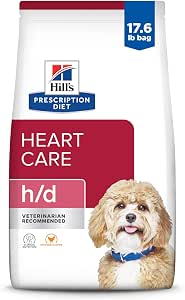
Hill’s Prescription Diet h/d Heart Care Chicken Flavor Dry Dog Food, 17.6 lb
Among these five options, Hill’s Prescription Diet h/d is the clearest fit for a dog whose veterinarian has recommended a cardiac diet. Its reduced sodium is specifically intended to help manage blood pressure and fluid retention, while added potassium and magnesium address nutrients that may need attention in dogs taking diuretics. Taurine and L-carnitine add further heart-related support.
That targeted formulation sets it apart from general senior foods such as Wellness Complete Health Age Advantage Small Breed Senior, which focuses on broader senior wellness rather than a veterinary heart-care plan. The tradeoff is that h/d is a veterinary diet, not a general senior food; its controlled protein and phosphorus may not suit every dog’s wider health needs. It contains chicken, which can be a problem for dogs with sensitivities, and the product information calls for veterinary guidance. I would choose it only with the prescribing veterinarian’s direction.
Pros:- Reduced sodium is intended to help manage normal blood pressure and fluid retention.
- Includes taurine and L-carnitine for heart-care support.
- Added potassium and magnesium may help replenish nutrients for dogs receiving diuretics.
- Controlled protein and phosphorus are intended to support liver and kidney function.
Cons:- Requires veterinary guidance and is not a general-purpose senior food.
- Chicken may not suit dogs with chicken sensitivities.
- The controlled nutrient profile may not fit every dog’s other health conditions.
Best for: Owners whose veterinarian has recommended a dry cardiac diet and wants reduced sodium plus added potassium and magnesium for a dog receiving diuretics.
Not ideal for: Owners choosing food without veterinary guidance, or dogs with chicken sensitivities or other medical needs that make the controlled nutrient profile unsuitable.
- Brand:Hill’s Prescription Diet
- Food form:Dry food
- Flavor:Chicken
- Life stage:Adult
- Package weight:17.6 lb
- Intended use:Veterinary heart-care diet
- Key nutrients:L-carnitine, taurine, potassium, magnesium
- Sodium:Reduced
- Protein and phosphorus:Controlled levels
Our verdict“For a dog with an enlarged heart, this is the most directly targeted option here when a veterinarian specifically recommends Hill’s h/d.”
Wellness Complete Health Age Advantage Small Breed Senior Dry Dog Food, 4 lb Bag
Small-breed senior sizing and a turkey-and-pea recipe make this a practical general senior-food option for owners whose dogs need a small-breed formula but have not been prescribed cardiac nutrition. It focuses on broader needs such as weight, joints, digestion, coat, and immune health. Compared with Hill’s Prescription Diet h/d, it is less medically targeted: the supplied details list no reduced-sodium claim or cardiac-specific nutrient amounts.
That distinction matters for a dog with an enlarged heart. Wellness may suit a veterinarian-approved everyday diet, but its senior positioning alone does not make it a heart-care food. The 4-pound bag is manageable for small households and may be useful when freshness or storage space matters, though it means more frequent repurchasing than the 17.6-pound Hill’s h/d bag. Its limited flavor variety and higher cost than generic foods may also narrow its appeal.
Pros:- Designed for senior dogs in small breeds.
- Turkey and peas are listed as the main ingredients.
- Product details describe support for weight, joints, digestion, coat, and immune health.
- Made without corn, wheat, soy, artificial colors, or preservatives, according to the product details.
Cons:- No reduced-sodium claim or cardiac-specific nutrient levels are provided.
- The 4-pound bag may require frequent replacement for multi-dog homes.
- Limited flavor variety may not work for dogs that need more food options.
Best for: Owners of small-breed senior dogs who want a general wellness kibble and have veterinary approval that it fits the dog’s heart condition.
Not ideal for: Owners seeking a prescribed low-sodium cardiac formula or a food with stated taurine, L-carnitine, or electrolyte amounts.
- Food form:Dry food
- Weight:4 lb
- Life stage:Senior
- Breed size:Small breed
- Main ingredients:Turkey, peas
- Made in:USA
- Dietary features:No corn, wheat, soy, artificial colors, or preservatives
Our verdict“Pick this for small-breed senior wellness only when your veterinarian confirms that a general formula is suitable for your dog’s enlarged heart.”
Jinx Senior Dry Dog Food – Real Chicken, Brown Rice & Sweet Potato, 4lb
Chicken, brown rice, and sweet potato give Jinx a familiar dry-food format for dogs aged 7 and older, with product details describing support for muscle maintenance, digestion, immune health, and heart function. That makes it a broader senior option than Stella & Chewy’s freeze-dried recipe, which lists specific amounts of taurine and a freeze-dried serving format. Jinx’s supplied information does not give taurine levels, sodium content, or other cardiac-diet controls, so its heart-function claim should not be read as evidence that it is a therapeutic diet.
The 4-pound bag is convenient for storage or a small dog, but it offers less food per package than Hill’s Prescription Diet h/d. Jinx may suit a senior dog with an enlarged heart only if the veterinarian approves a standard senior formula. Feeding-guideline details are limited in the provided information, leaving owners with less guidance for portion planning than a more fully documented product might provide.
Pros:- Formulated for dogs aged 7 and older.
- Lists USA farm-raised chicken, brown rice, and sweet potato.
- Product details describe support for muscle maintenance, digestion, and immune health.
- Includes omega fatty acids for skin and coat health, according to the product details.
Cons:- No sodium level or specific cardiac nutrient amounts are provided.
- Limited feeding-guideline information makes portion planning harder from the supplied details.
- The 4-pound bag may be a poor fit for larger dogs or households seeking less frequent restocking.
Best for: Owners looking for a familiar chicken-and-rice senior kibble for a dog aged 7 or older, with veterinary approval for a non-prescription diet.
Not ideal for: Owners who need a verified low-sodium cardiac diet, stated taurine amounts, or detailed product and feeding information.
- Food form:Dry food
- Weight:4 lb
- Target age:7+ years
- Main ingredients:Chicken, brown rice, sweet potato
- Chicken sourcing:USA farm-raised, according to product details
- Listed support:Senior health, muscle maintenance, heart function
- Other listed nutrients:Omega fatty acids
Our verdict“Choose Jinx as a straightforward senior kibble only if your veterinarian approves it; its general heart-support positioning does not replace a cardiac diet.”
Hill’s Science Diet Adult 7+ Small Bites Dry Dog Food
Small-bite kibble for dogs aged 7 and older makes this a more practical everyday format than Stella & Chewy’s freeze-dried food for owners who want conventional dry food. The product details also describe support for heart, kidney, and bladder health, plus antioxidants and balanced minerals. That broad organ-health focus is more specific than the general senior positioning of Wellness Complete Health Age Advantage, but it is still not the same as Hill’s Prescription Diet h/d.
The key tradeoff is limited product information: no weight, detailed ingredient list, sodium level, or cardiac nutrient amounts are supplied here. For an enlarged-heart diagnosis, those gaps make it difficult to judge whether the food matches a veterinarian’s nutrition plan. I would treat this as a general senior kibble candidate, not a substitute for a prescribed cardiac formula. Its small bites may appeal to dogs that prefer smaller pieces, but the product data does not specify breed-size suitability.
Pros:- Small-bite dry format may suit dogs that prefer smaller kibble pieces.
- Product details describe support for heart, kidney, and bladder health.
- Includes antioxidants and balanced minerals, according to the product description.
- Provides high-quality protein for lean-muscle support, according to the product details.
Cons:- No package weight or size information is provided.
- Detailed ingredients and nutrient levels, including sodium, are not supplied.
- The general product description does not establish suitability as a therapeutic cardiac diet.
Best for: Owners of dogs aged 7 or older who prefer small-bite dry food and want a general senior formula to review with their veterinarian.
Not ideal for: Owners who need confirmed low sodium, specific taurine or L-carnitine levels, a known package size, or detailed ingredient information before choosing.
- Brand:Hill’s Science Diet
- Product line:Adult 7+
- Food form:Dry food
- Kibble style:Small bites
- Life stage:Adult dogs aged 7+
- Listed health support:Heart, kidney, and bladder
- Other listed features:Antioxidants, balanced minerals, high-quality protein
- Made in:USA
Our verdict“Consider this small-bite senior food only after your veterinarian checks its full nutrient profile against your dog’s enlarged-heart care plan.”
Purina Pro Plan Sensitive Skin and Stomach Dry Dog Food Senior Adult 7+ Salmon and Rice Formula – 24 lb
For an older dog with an enlarged heart and a sensitive stomach, this formula’s clearest advantage is its focus on digestibility rather than a specific cardiac diet. Salmon, oatmeal, and rice make it a distinct choice from Victor Senior Healthy Weight, which centers on weight management and mixed meat meals. It also includes glucosamine and EPA for joint support, a useful extra for seniors whose mobility may limit activity. The tradeoff is that the product description does not identify a cardiac-specific nutrient profile or sodium target, so I would not treat it as a substitute for a veterinarian-directed heart diet. Its 24-pound bag may suit households feeding it regularly, but salmon may not work for dogs with fish sensitivities, and a gradual food change may be needed.
Pros:- Formulated for senior dogs with sensitive skin and stomachs
- Salmon is the primary ingredient, with oatmeal and rice described as easily digestible
- Includes glucosamine and EPA for joint and mobility support
- No artificial colors or flavors, and excludes eggs, wheat, and soy according to the product data
Cons:- No cardiac-specific formulation or sodium information is provided in the supplied product data
- Fish-based protein may not suit dogs with fish sensitivities
- A food change may require gradual introduction, and the 24 lb bag can be a large commitment if it does not agree with the dog
Best for: Caregivers of senior dogs with sensitive digestion or skin who want a salmon-based everyday food and will confirm with their veterinarian that it fits the dog’s cardiac plan.
Not ideal for: Owners seeking a diet specifically formulated for cardiac support, or dogs that cannot tolerate fish; Purina CardioCare is the more directly heart-focused option in this group.
- Brand:Purina Pro Plan
- Flavor:Salmon & Rice
- Age range:Senior (7+)
- Form:Dry pellets
- Bag weight:24 lb
- Primary ingredient:Salmon
- Key benefits:Sensitive skin, digestive health, joint support, and immune support
Our verdict“Choose this for a senior dog whose digestive or skin sensitivities drive food choice, but ask your veterinarian whether it fits an enlarged-heart care plan.”
Victor Super Premium Dog Food – Senior Healthy Weight Management, Gluten Free, 15 lbs
Victor is the weight-control pick in this group, aimed at older dogs that need help managing body condition while retaining lean muscle. Its glucosamine and chondroitin target hip and joint support, while L-Carnitine is described as supporting lean muscle development. That gives it a different purpose from Purina Pro Plan Sensitive Skin and Stomach, which puts digestion and skin sensitivities first. For a dog with an enlarged heart, maintaining a veterinarian-approved weight may be part of the care discussion, but this product is not identified as a cardiac diet, and the supplied data gives no sodium or heart-specific nutrient details. Its beef, fish, and chicken meals also make it less straightforward for dogs with particular protein sensitivities. I’d choose it for a weight-management need, not as a replacement for prescribed cardiac nutrition.
Pros:- Designed for senior and adult dogs needing weight management
- Includes glucosamine and chondroitin for hip and joint support
- L-Carnitine is included to support lean muscle development
- Gluten-free formula with beef, fish, and chicken meals
Cons:- Product data does not identify cardiac-specific support or provide sodium information
- Multiple animal protein sources may not suit dogs with specific food sensitivities
- The supplied information does not provide detailed feeding guidance or nutrient values for tailoring a cardiac diet
Best for: Caregivers of senior or adult dogs who need a weight-management formula with joint-support ingredients and whose veterinarian approves its use alongside heart care.
Not ideal for: Owners looking for a food specifically formulated for enlarged-heart support, dogs with sensitivities to its beef, fish, or chicken proteins, or puppies and very active dogs.
- Bag weight:15 lb
- Purpose:Senior and adult healthy weight management
- Dietary feature:Gluten-free
- Main ingredients:Beef, fish, and chicken meals
- Joint support:Glucosamine and chondroitin
- Additional ingredient:L-Carnitine
- Manufacturing location:Texas, USA
Our verdict“Pick Victor when weight management is the main need and your veterinarian approves it, rather than when you need a food specifically designed for cardiac support.”
Pro Plan Veterinary Diets Purina CardioCare Dog Food Dry Formula – 6 lb Bag
Among these three products, CardioCare is the clearest match for a dog with an enlarged heart because its stated purpose is supporting cardiac function and heart health. The described blend includes amino acids, fatty acids, magnesium, and vitamins A and E. That focus sets it apart from Purina Pro Plan Sensitive Skin and Stomach, which addresses digestive and skin needs, and Victor, which is geared toward weight management. The smaller 6 lb bag may be a practical way to follow a veterinarian’s recommendation without committing to a large quantity. Still, the supplied details do not give ingredient sourcing, nutrient amounts, or a sodium value, so I would not infer that it suits every heart condition or treatment plan. Because it is a veterinary diet, I’d choose it with veterinary guidance rather than on the product name alone.
Pros:- Specifically described as supporting cardiac function and heart health
- Contains amino acids and fatty acids as part of its cardiac-support formulation
- Includes magnesium and antioxidant vitamins A and E
- The 6 lb bag allows a smaller initial commitment than the 15 lb Victor or 24 lb Purina Pro Plan bags
Cons:- The supplied product data does not list nutrient amounts or sodium content
- Ingredient sourcing details are limited
- Its cardiac focus may make it a poor fit for dogs without a veterinarian-identified cardiac need
Best for: Caregivers whose veterinarian recommends a cardiac-support diet for a dog with an enlarged heart and who want a smaller bag size.
Not ideal for: Owners choosing food without veterinary guidance, dogs without a cardiac dietary need, or buyers who need detailed ingredient sourcing and nutrient values before deciding.
- Brand:Purina Pro Plan Veterinary Diets
- Formula:CardioCare
- Form:Dry dog food
- Bag weight:6 lb
- Target animal:Dog
- Stated purpose:Supports cardiac function and heart health
- Highlighted nutrients:Amino acids, fatty acids, magnesium, and vitamins A and E
Our verdict“Ask your veterinarian about CardioCare first if heart-specific nutrition is the priority; its stated cardiac focus makes it a closer match than the other two foods here.”

How We Picked
I ranked these foods by how directly their stated purpose matches the needs implied by an enlarged-heart diagnosis, then by how clearly a buyer can identify the right use case. Veterinary cardiac formulas rank first because they are specifically intended for heart care and call for professional selection. General senior foods rank below them: useful for age, size, appetite, or weight considerations, but not presented as cardiac treatment. I also distinguished small-breed and small-bite formats from standard senior kibble, since eating comfort and medical suitability are separate questions.
I weighed practical tradeoffs such as formula type, intended life stage, breed-size focus, and whether the product’s stated purpose gives a buyer a clear reason to choose it. The list does not claim that any food can reverse heart enlargement or replace medication, and it does not infer a dog’s sodium requirement from product names. Specificity to the heart condition sets the order; convenience and preference help separate the general formulas within their roles. Your veterinarian’s assessment takes priority over this editorial ranking.
| dog food for senior dog with enlarged heart | Food form | Life stage |
|---|---|---|
| Purina ONE High Protein Senior | Dry dog food | — |
| Blue Buffalo Life Protection F | Dry dog food | — |
| Blue Buffalo Life Protection F | Dry dog food | Senior, 7+ years |
| Nutro Natural Choice Small Bre | Dry dog food | Senior |
| Purina Pro Plan Small Breed 7 | Shredded blend dry food | Senior, 7+ years |
| Stella & Chewy’s Freeze-Dried | Freeze-dried raw | All life stages |
| Hill’s Prescription Diet h/d H | Dry food | Adult |
| Wellness Complete Health Age A | Dry food | Senior |
| Jinx Senior Dry Dog Food | Dry food | — |
| Hill’s Science Diet Adult 7+ S | Dry food | Adult dogs aged 7+ |
| Purina Pro Plan Sensitive Skin | — | — |
| Victor Super Premium Dog Food | — | — |
| Pro Plan Veterinary Diets Puri | — | — |
Factors to Consider When Choosing Dog Food For Senior Dog With Enlarged Heart
Food choice is only one part of care for an enlarged heart. I would use these questions to turn a broad product list into a vet-guided shortlist, rather than assuming that every senior formula is appropriate for a cardiac diagnosis.
Start With the Diagnosis and Veterinary Plan
An enlarged heart is a finding, not a complete explanation of what your dog needs to eat. Ask your veterinarian what condition is suspected or confirmed, whether a cardiac diet is recommended, and whether the recommendation changes with medication or test results. A prescription formula should be selected with that guidance, not simply because its name mentions heart care. If the dog is already eating a prescribed food, check before adding another formula or topper. This avoids treating a product label as a substitute for an individualized plan. Bring the current food’s name and feeding amount to the appointment so the discussion can be specific.
Ask About Sodium Instead of Guessing
Owners often assume that every dog with an enlarged heart needs the same sodium restriction, but the appropriate diet depends on the veterinary assessment. Do not compare foods by marketing language alone or make a switch based on a general “heart healthy” claim. Ask whether sodium limits apply to your dog, and whether treats, chews, table scraps, and supplements count toward the plan. If a specific target is recommended, request help checking complete product information rather than relying on a front-of-bag description. A diet change can also affect what treats remain suitable. This step matters even when a food is labeled senior or natural.
Balance Cardiac Guidance With Eating and Weight
A medically appropriate food only helps if the dog will eat enough of it and maintain a suitable body condition. Tell the veterinarian if your dog has lost interest in meals, has trouble chewing, or is gaining or losing weight. Small-breed kibble and small-bite formats may make meals easier for some dogs, but their size labels do not indicate heart-specific benefits. Weight-management formulas may fit a separate need, yet calorie changes should be discussed when heart disease or other illness is present. Avoid cutting portions sharply without guidance, especially if appetite is already poor. The right shortlist needs to account for both the diagnosis and the dog’s day-to-day eating.
Treat Toppers and Extras as Part of the Diet
Mix-ins, treats, table food, and supplements can change the overall diet even when the main kibble stays the same. A freeze-dried raw product may be offered as a complete food or used in another way depending on its label, so check its intended feeding instructions and ask whether it fits the veterinary plan. Do not assume that a product marketed for cardiovascular support can replace a prescribed food or medication. Keep a written list of everything your dog eats, including small extras, and share it with the clinic. This makes it easier to spot conflicts with diet guidance and to track what changed if appetite or digestion shifts. Consistency also helps the veterinarian interpret follow-up results.
Plan Food Changes and Follow-Up
Switching foods can affect appetite and digestion, so ask the veterinarian how quickly to make a change and what signs warrant a call. Do not introduce several new foods, treats, and supplements at once; that makes it hard to identify what your dog tolerates. Keep the product packaging or a photo of its label in case the clinic needs to review the formula. Ask when the dog’s weight, appetite, or other measures should be checked again. If the food is a prescription diet, confirm whether the clinic wants it fed exclusively or permits approved additions. Follow-up keeps the plan tied to the dog’s current condition rather than a one-time shopping decision.
Frequently Asked Questions
Should I choose Hill’s h/d or Purina CardioCare for my dog?
I would not choose between these veterinary diets by brand name alone. Both are specifically positioned for cardiac care, but your veterinarian can match the formula to your dog’s diagnosis, medical history, current food, and treatment plan. Ask whether one is preferred for your dog and whether it should be fed exclusively. Also confirm how to handle treats and any existing supplements. If your dog refuses one option, tell the clinic rather than switching to a general senior food without guidance.
Can a regular senior food replace a prescription cardiac diet?
Not automatically. Most senior foods in this roundup are designed around age, size, or another general feeding need, rather than a diagnosed heart condition. A senior label does not confirm that the food matches a veterinarian’s dietary instructions. If your vet recommends a therapeutic diet, ask before substituting an everyday formula, even if its ingredients sound appealing. If a prescription diet is not recommended, your vet can help identify the appropriate maintenance food and any limits that apply.
Does an enlarged heart mean my dog needs low-sodium food?
It may affect dietary advice, but the right sodium guidance depends on the dog’s condition and veterinary assessment. Do not assume every dog with heart enlargement needs the same restriction or select a food from a marketing claim alone. Ask your veterinarian whether a sodium target applies and how to account for treats, chews, and toppers. If a target is given, have the clinic help interpret the food’s complete nutrient information. This is especially useful when comparing therapeutic and non-prescription formulas.
What if my senior dog with an enlarged heart will not eat the recommended food?
Contact your veterinarian before replacing it, particularly if the food was prescribed for a specific cardiac plan. The clinic may suggest a gradual change, another suitable formula, or ways to make meals more acceptable without undermining the diet. Report how long your dog has eaten poorly and whether there are other changes in appetite or behavior. Avoid adding salty table foods or several toppers on your own. A food that the dog will eat matters, but the alternative still needs to fit the medical plan.
Are small-breed senior formulas better for a small dog with an enlarged heart?
They may be easier for a small dog to eat, but small-breed sizing does not make a food a cardiac diet. Products such as small-breed senior formulas and small-bite kibble address format or general senior needs, while the heart diagnosis calls for separate veterinary guidance. Ask whether your dog needs a therapeutic formula and whether kibble size is a concern. If the vet approves an everyday food, then compare the small-breed options for eating comfort and the dog’s other needs. Keep the medical recommendation ahead of the package’s size label.
Conclusion
Best overall: I would start a vet-guided discussion with Hill’s Prescription Diet h/d Heart Care because its stated purpose directly addresses heart care. Best alternative for a targeted cardiac discussion: Purina Pro Plan Veterinary Diets CardioCare also belongs on that shortlist. Best value among everyday senior options: Purina ONE Vibrant Maturity is a straightforward age-focused choice, but it is not a substitute for a prescribed cardiac diet. Best for beginners: ask your veterinarian to compare the two veterinary formulas before making a change, then use the clinic’s advice to narrow the broader senior-food options. Best for specific needs: consider the small-breed and small-bite foods for feeding fit, Victor for a weight-management discussion, or Stella & Chewy’s for a format preference—only if each fits the dog’s care plan. My final recommendation is to choose the food with your veterinarian, based on the diagnosis and the whole diet rather than the senior label alone.