For a turtle tank, I’d start with the Fluval FX6 as the best overall choice for large setups, where its high capacity and multi-stage filtration suit heavy waste loads. The Fluval 307 is a more manageable pick for medium tanks, while the adjustable-flow PONDFORSE External Aquarium Canister Filter gives buyers a way to tailor circulation. The main tradeoff is between strong waste-handling capacity and the noise, space, upkeep, and current that can come with a larger filter. Match the filter to the tank’s actual water volume and turtle, not just the maker’s aquarium-size rating. Read on for the full breakdown of where each model fits and what to check before choosing.

Get pet supplies delivered free with Prime
- Fast, free delivery on millions of items
- Prime Video, Amazon Music and more included
- Member-only deals all year
Complete the kit


Key Takeaways
- The Fluval FX6 leads for large turtle tanks because its high capacity is a better match for heavy waste loads than compact canisters, though its size and maintenance demands make it excessive for smaller setups.
- The Fluval 307 is the middle-ground pick: it offers more capacity than the Fluval 107 without moving up to the FX6’s much larger footprint.
- Adjustable flow is a practical advantage in turtle tanks, where strong filtration is useful but an overly forceful return can make swimming and basking areas less comfortable.
- Tank-size labels need a turtle-specific reality check: turtles create substantial waste, so a filter’s stated aquarium capacity should not be treated as a guarantee of performance at full stocking.
- The repeated PONDFORSE and AMOSIJOY listings share model names, so buyers should compare the exact listing specifications and included parts rather than assume each repeated entry represents a distinct design.
| PONDFORSE External Aquarium Canister Filter with Adjustable Flow |  | Best Value for a Compact Setup | Flow rate: 172 GPH | Item weight: 7.89 pounds | Dimensions: 7.9 x 6.1 x 12.2 inches | VIEW ON AMAZON | See Our Full Breakdown |
| AMOSIJOY Ultra-Quiet Canister Filter for Aquariums |  | Best for Quiet Operation and Easier Priming | Model: 2-ECP1000L | Noise level: 30 dB or less | Size: Large | VIEW ON AMAZON | See Our Full Breakdown |
| Fluval 307 Performance Canister Filter for Aquariums up to 70 Gallons | 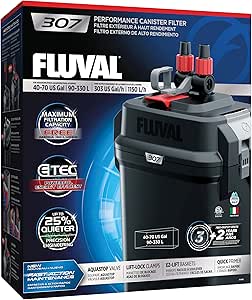 | Best for Mid-Size Turtle Tanks | Aquarium capacity: Up to 70 gallons | Flow rate: 1,150 liters per hour | Power consumption: 16 watts | VIEW ON AMAZON | See Our Full Breakdown |
| Fluval FX6 High-Performance Canister Filter for Aquariums up to 400 Gallons |  | Best High-Capacity Pick | Aquarium capacity: Up to 400 gallons | Flow rate: Up to 925 US gallons per hour | Filter media capacity: 1.5 US gallons (5.9 L) | VIEW ON AMAZON | See Our Full Breakdown |
| Fluval 107 Performance Canister Filter for Aquariums up to 30 Gallons |  | Best for Small Turtle Tanks | Aquarium capacity: Up to 30 gallons | Flow rate: 550 liters per hour | Power: 10 watts | VIEW ON AMAZON | See Our Full Breakdown |
| VEVOR 224.5 GPH 3-Stage Canister Filter for Freshwater Aquariums up to 55 Gallons |  | Best Quiet Option for Fish-Only Tanks | Brand and model: VEVOR CF800 | Flow rate: 224.5 GPH | Aquarium capacity: 35–55 gallons | VIEW ON AMAZON | See Our Full Breakdown |
| PONDFORSE External Aquarium Canister Filter |  | Best Value-Style Pick with Adjustable Flow | Model: 225GPH | Load capacity: 55 gallons | Flow control: Adjustable | VIEW ON AMAZON | See Our Full Breakdown |
| PONDFORSE External Aquarium Canister Filter |  | Best Higher-Flow PONDFORSE Option | Model number: 264GPH-1000L | Flow rate: 264 GPH | Flow control: Adjustable | VIEW ON AMAZON | See Our Full Breakdown |
| AMOSIJOY Ultra-Quiet Canister Filter for Aquariums |  | Best Turtle-Specific Fit | Filter type: External canister filter | Compatible tanks: Freshwater fish tanks, aquariums, and turtle tanks | Water flow: Adjustable from maximum to zero | VIEW ON AMAZON | See Our Full Breakdown |
| high flow canister filter for turtle tank | Flow rate | Dimensions | Weight |
|---|---|---|---|
| PONDFORSE External Aquarium Ca | 172 GPH | 7.9 x 6.1 x 12.2 inches | — |
| AMOSIJOY Ultra-Quiet Canister | — | — | — |
| Fluval 307 Performance Caniste | 1,150 liters per hour | 7.6 × 14.4 × 7.6 inches | 6 pounds |
| Fluval FX6 High-Performance Ca | Up to 925 US gallons per hour | 20.87 × 15.75 × 15.75 inches | 19.9 pounds |
| Fluval 107 Performance Caniste | 550 liters per hour | 7.5 x 11.5 x 7.5 inches | 2.22 kg |
| VEVOR 224.5 GPH 3-Stage Canist | 224.5 GPH | 7.68 x 7.68 x 16.14 inches | — |
| PONDFORSE External Aquarium Ca | — | — | 8.8 pounds |
| PONDFORSE External Aquarium Ca | 264 GPH | 10 x 8 x 16.7 inches | 9.83 pounds |
| AMOSIJOY Ultra-Quiet Canister | — | — | 8.97 pounds |
More Details on Our Top Picks
PONDFORSE External Aquarium Canister Filter with Adjustable Flow
The PONDFORSE 172GPH is the most clearly specified compact pick here: its stated flow rate gives turtle keepers a concrete starting point, while the adjustable flow valve lets them reduce circulation when a turtle or tank layout needs gentler movement. Multiple media types, including sponges and media balls, support particle removal and biological filtration. Compared with the AMOSIJOY Ultra-Quiet Canister Filter, this model provides a published flow rate, but AMOSIJOY lists a siphon-fill nozzle that may make priming easier. The PONDFORSE’s small footprint and rubber feet suit buyers short on cabinet space or sensitive to vibration. Its main limitation is that no aquarium capacity is specified, so I would not choose it for a large turtle tank based on flow alone; confirm tank size and filtration needs before buying.
Pros:- Published 172 GPH flow rate makes comparison with other options easier
- Adjustable valve allows the flow to be moderated
- Includes sponges, media balls, filter accessories, and a spare bulb
- Brushless motor and rubber feet are designed to reduce operating noise
Cons:- No recommended aquarium capacity is provided
- The stated 172 GPH may be insufficient for larger or heavily stocked turtle tanks
- The compact size limits how much media the unit can hold compared with the Fluval FX6
Best for: Keepers of smaller turtle tanks who want adjustable flow, included media, and a published 172 GPH rate.
Not ideal for: Owners of large or heavily stocked turtle tanks who need a stated tank-capacity match or higher documented flow.
- Flow rate:172 GPH
- Item weight:7.89 pounds
- Dimensions:7.9 x 6.1 x 12.2 inches
- Color:Black
- Size:Small
- Motor:Energy-efficient brushless motor
- Flow control:Adjustable flow valve
- Included media:Media balls and sponges
Our verdict“Choose this compact PONDFORSE for a smaller turtle tank where adjustable, documented flow matters more than large-tank capacity.”
AMOSIJOY Ultra-Quiet Canister Filter for Aquariums
The AMOSIJOY Ultra-Quiet Canister Filter is aimed at keepers who want a quieter setup and a less awkward start-up routine. Its stated noise level of 30 dB or less and siphon-fill nozzle give it a distinct convenience angle against the PONDFORSE 172GPH, which specifies its flow rate but not a comparable noise figure or priming aid. Flow is adjustable, including a zero-flow setting, so the filter can be stopped without disconnecting it during maintenance. The package also includes sponges, bio balls, and two replacement bulbs. The tradeoff is a major one for a high-flow roundup: the supplied description gives no flow rate or tank-capacity recommendation. I would favor this model for a freshwater turtle keeper prioritizing quiet operation and priming convenience, but not for someone choosing by circulation capacity.
Pros:- Stated operating noise is 30 dB or less
- Siphon-fill nozzle is intended to simplify priming
- Adjustable flow includes a zero-flow setting for maintenance
- Includes two replacement bulbs, filter sponges, and bio balls
Cons:- No flow rate is provided, making high-flow suitability hard to judge
- No recommended aquarium capacity is specified
- The 180-day warranty is relatively short compared with buyers seeking longer coverage
Best for: Freshwater turtle keepers who prioritize quiet operation, adjustable flow, and a built-in aid for priming.
Not ideal for: Buyers who need to compare flow rates or match a filter to a specific tank capacity before purchase.
- Model:2-ECP1000L
- Noise level:30 dB or less
- Size:Large
- Item weight:8.97 pounds
- Flow control:Adjustable, including zero-flow setting
- Priming feature:Siphon-fill nozzle
- Included accessories:Two bulbs, filter sponges, and bio balls
- Warranty:180 days
Our verdict“Pick AMOSIJOY for a quieter, easier-to-prime freshwater turtle setup only if its undocumented flow capacity fits your needs.”
Fluval 307 Performance Canister Filter for Aquariums up to 70 Gallons
The Fluval 307 suits buyers who want a defined mid-size capacity rather than guessing from a flow figure alone: it is specified for aquariums up to 70 gallons and moves 1,150 liters per hour. That makes it a more grounded choice for a medium turtle setup than the AMOSIJOY, whose flow rate and tank capacity are not stated. Maintenance access is another advantage: the EZ-Lift media baskets and independently accessible vertical pre-filter can make routine cleaning less cumbersome. It is far smaller and lighter than the large-capacity Fluval FX6, so it fits more modest installations without the same handling burden. Its limits are clear, though: 70 gallons is the stated ceiling, and the listed 220-volt requirement needs checking against the buyer’s power supply. Canister cleaning remains part of ownership.
Pros:- Specified for aquariums up to 70 gallons
- Flow rate of 1,150 liters per hour is documented
- EZ-Lift baskets and an accessible pre-filter support easier maintenance
- Quiet operation is stated to be up to 25% quieter than previous generations
Cons:- Listed 220-volt requirement may not suit every power supply
- Capacity is limited to aquariums up to 70 gallons
- Canister maintenance is still required
Best for: Turtle keepers with a mid-size aquarium up to 70 gallons who want documented capacity and convenient media access.
Not ideal for: Owners of larger tanks or buyers whose household power supply does not match the listed 220-volt requirement.
- Aquarium capacity:Up to 70 gallons
- Flow rate:1,150 liters per hour
- Power consumption:16 watts
- Voltage:220 volts
- Dimensions:7.6 × 14.4 × 7.6 inches
- Weight:6 pounds
- Included:Fluval media
- Maintenance features:EZ-Lift media baskets and independently accessible vertical pre-filter
Our verdict“Choose the Fluval 307 for a mid-size turtle tank when a stated capacity and easier media access matter more than FX6-scale output.”
Fluval FX6 High-Performance Canister Filter for Aquariums up to 400 Gallons
For a large turtle tank where waste load and circulation demand outgrow compact filters, the Fluval FX6 is the standout high-capacity option in this group. Its stated output reaches 925 GPH, and the 1.5-gallon media capacity gives keepers room for mechanical, chemical, and biological filtration. Smart Pump Technology monitors performance and removes trapped air every 12 hours, while the integrated water-change feature can simplify routine upkeep. Compared with the Fluval 307, the FX6 is built for a much larger aquarium and offers far more media space; that capacity comes with a substantial footprint and a 19.9-pound weight. I would not place it on a short list for a modest turtle tank: its scale may be excessive, and moving or servicing the canister takes more effort than with the smaller Fluval models.
Pros:- Flow rate reaches 925 GPH
- Specified for aquariums up to 400 gallons
- 1.5-gallon media capacity supports mechanical, chemical, and biological filtration
- Smart Pump Technology automatically removes trapped air every 12 hours
Cons:- Large dimensions can make placement difficult in smaller stands
- At 19.9 pounds, the canister is heavy to handle
- Likely oversized for modest turtle tanks compared with the Fluval 307 or 107
Best for: Keepers of large turtle aquariums, up to 400 gallons, who need high stated flow and substantial media capacity.
Not ideal for: Owners of small or medium tanks with limited cabinet space, or anyone who needs a light, easy-to-move canister.
- Aquarium capacity:Up to 400 gallons
- Flow rate:Up to 925 US gallons per hour
- Filter media capacity:1.5 US gallons (5.9 L)
- Filtration types:Mechanical, chemical, and biological
- Maximum lifting height:21 inches
- Dimensions:20.87 × 15.75 × 15.75 inches
- Weight:19.9 pounds
- Power source:Corded electric
Our verdict“Choose the FX6 when a large turtle tank needs its high flow and media capacity, and skip it for smaller setups.”
Fluval 107 Performance Canister Filter for Aquariums up to 30 Gallons
The Fluval 107 is the small-tank choice in this lineup, with a stated capacity of up to 30 gallons and a 550-liter-per-hour flow rate. Its 10-watt motor and compact dimensions make it a more sensible fit for a modest aquarium than the Fluval FX6, whose large capacity and physical size would be excessive for many small setups. Like the Fluval 307, it has EZ-Lift media baskets and an independently accessible vertical pre-filter, which help make filter maintenance more manageable. That convenience does not change its capacity ceiling: turtle waste can place a heavy load on filtration, so I would not stretch the 107 beyond its stated tank range. It also needs a corded power source. This is a focused pick for a small setup, not a high-capacity substitute for the 307 or FX6.
Pros:- Specified for aquariums up to 30 gallons
- 550 liters per hour of stated flow
- EZ-Lift media baskets provide quick access
- Independent vertical pre-filter access supports maintenance
Cons:- The 30-gallon capacity limit excludes larger turtle tanks
- Lower stated flow than the Fluval 307 and FX6
- Requires a corded power source
Best for: Keepers of small turtle aquariums up to 30 gallons who want a compact canister with accessible media components.
Not ideal for: Owners of tanks over 30 gallons or keepers seeking the highest documented flow and media capacity in this roundup.
- Aquarium capacity:Up to 30 gallons
- Flow rate:550 liters per hour
- Power:10 watts
- Dimensions:7.5 x 11.5 x 7.5 inches
- Weight:2.22 kg
- Power source:Corded electric
- Maintenance features:EZ-Lift media baskets and independently accessible vertical pre-filter
- Color:Black
Our verdict“Choose the Fluval 107 for a small turtle tank up to 30 gallons, but move to the 307 or FX6 for greater capacity.”
VEVOR 224.5 GPH 3-Stage Canister Filter for Freshwater Aquariums up to 55 Gallons
This is not a turtle-tank pick: the product data explicitly says it is not suitable for turtle tanks, so I would leave it off the shortlist if that is your intended use. For a freshwater fish aquarium, its 224.5 GPH flow and three media layers offer a straightforward setup for tanks listed at 35–55 gallons. The included cotton and ceramic rings cover mechanical and biological filtration, while the quiet-operation claim may appeal in a living space. Compared with the PONDFORSE 264GPH-1000L, it has a lower stated flow rate; compared with the AMOSIJOY Ultra-Quiet Canister Filter, it provides a published flow figure but lacks stated turtle compatibility. The tradeoff is clear: this is a modest-capacity fish-tank filter, and extra DIY consumables are not included.
Pros:- Three-stage media includes black filter cotton, ceramic rings, and white cotton.
- Stated 224.5 GPH flow and 35–55-gallon aquarium range make sizing easier to judge.
- Below-38 dB operating claim suits rooms where filter noise matters.
- Multi-lock design is intended to help secure the canister seal.
Cons:- Explicitly listed as not suitable for turtle tanks.
- DIY filter consumables are not included.
- Actual flow may fall with pipe height or media setup.
Best for: Freshwater fish keepers with a 35–55-gallon aquarium who value quiet operation and want a stated flow rate.
Not ideal for: Turtle keepers, since the product data says it is not suitable for turtle tanks, and buyers who need stronger stated flow or included replacement consumables.
- Brand and model:VEVOR CF800
- Flow rate:224.5 GPH
- Aquarium capacity:35–55 gallons
- Filtration stages:3
- Power:12.3 W
- Noise level:Below 38 dB
- Included filter media:Black filter cotton, ceramic rings, and white cotton
- Dimensions:7.68 x 7.68 x 16.14 inches
- Intended use:Indoor freshwater aquariums; not suitable for turtle tanks
Our verdict“Choose this for a quiet 35–55-gallon freshwater fish tank, but skip it for turtle filtration.”
PONDFORSE External Aquarium Canister Filter
Adjustable flow is the main reason to consider this PONDFORSE model for a turtle setup: it gives keepers some control over circulation rather than locking them into one output. The stated 55-gallon load capacity and included balls and sponges make it a more immediately equipped option than the VEVOR CF800, which lists its filter media but excludes DIY consumables. Its brushless copper motor is described as quiet and energy-efficient, though no exact noise or flow figure is provided here beyond the model designation. Compared with the larger PONDFORSE 264GPH-1000L, this model has less clearly specified output, so I would favor the larger version when published flow capacity is the priority. The plastic construction and need to consult the manual for operation and troubleshooting make this a more hands-on choice.
Pros:- Adjustable flow helps tailor circulation to the tank setup.
- Includes filter balls, sponge, accessories, and a spare bulb.
- Multiple media layers are intended to capture particles and impurities.
- Copper brushless motor is designed for quiet, energy-conscious operation.
Cons:- The provided product data does not state an exact flow rate.
- Plastic construction may not suit buyers seeking a more substantial housing.
- The manual needs to be consulted for use and troubleshooting.
Best for: Turtle keepers with a tank around the stated 55-gallon load capacity who want adjustable flow and included media.
Not ideal for: Buyers who need a precise published flow rate, detailed operating guidance at a glance, or a stated noise measurement.
- Model:225GPH
- Load capacity:55 gallons
- Flow control:Adjustable
- Motor:Copper brushless
- Power source:Corded electric
- Included components:Filter balls, sponge, spare bulb, and accessories
- Weight:8.8 pounds
- Material and color:Plastic, black
- Warranty:1-year limited
Our verdict“Pick this when adjustable flow and included media matter more than having a clearly stated GPH figure.”
PONDFORSE External Aquarium Canister Filter
Among these two PONDFORSE models, this one is the clearer choice when higher stated flow is the deciding factor: it is rated at 264 GPH, compared with the other PONDFORSE model’s 225GPH designation. Adjustable flow lets a keeper temper output when full circulation is more than the tank needs, and the supplied filter balls and sponges mean the basic media is in the box. The noise-reducing rubber feet are a useful detail for a canister placed near a quiet room, although no measured noise level or tank capacity is supplied. Compared with the VEVOR CF800, it has a higher published flow figure, but its 10-inch-wide footprint and lack of a listed aquarium capacity leave fit harder to judge. I would treat it as a capacity-led option, not a fully specified turtle-tank solution.
Pros:- 264 GPH stated flow exceeds the 225GPH PONDFORSE model’s designation.
- Adjustable flow supports tuning circulation to the aquarium.
- Includes filter balls, sponges, and accessories.
- Rubber feet are designed to reduce noise transmission.
Cons:- No aquarium capacity is provided in the product data.
- The 10 x 8 x 16.7-inch body requires space near the aquarium.
- No specific noise measurement or warranty detail is supplied.
Best for: Turtle keepers seeking more stated flow than the 225GPH PONDFORSE model and who have room for a large canister.
Not ideal for: Buyers who need a stated tank-capacity recommendation, a compact unit, or clearly documented noise and warranty details.
- Model number:264GPH-1000L
- Flow rate:264 GPH
- Flow control:Adjustable
- Dimensions:10 x 8 x 16.7 inches
- Weight:9.83 pounds
- Included components:Filter, accessories, filter balls, sponges, and spare bulb
- Color and size:Black, large
- Package dimensions:15.75 x 11.5 x 7.75 inches
Our verdict“Choose this PONDFORSE when its 264 GPH rating is the priority and you can accommodate its larger footprint.”
AMOSIJOY Ultra-Quiet Canister Filter for Aquariums
Stated turtle compatibility gives this AMOSIJOY the strongest fit for the roundup’s intended use; the VEVOR CF800, by contrast, explicitly rules turtle tanks out. Its adjustable water flow, including a zero-flow setting, offers control, while the siphon nozzle is intended to simplify priming. That is helpful for setup, but it does not replace the need to verify circulation needs for a particular turtle enclosure. The listed 30 dB or less noise level is quieter on paper than the VEVOR’s below-38 dB claim, and two bulbs plus sponges and bio balls are included. The main limitation is missing sizing information: there is no stated GPH or tank capacity, unlike the 264 GPH PONDFORSE. I would choose it for its turtle designation and setup features, not for a known high-flow rating.
Pros:- Product data explicitly lists compatibility with turtle tanks.
- Adjustable water flow includes a zero-flow setting.
- Siphon nozzle is designed to simplify priming.
- Includes two bulbs, filter sponges, and bio balls; stated noise is 30 dB or less.
Cons:- Neither flow rate nor supported tank capacity is specified.
- A bulb may need replacement if it breaks.
- The 180-day warranty is shorter than some buyers may prefer.
Best for: Turtle keepers who prioritize explicit compatibility, adjustable output, quiet operation, and easier priming over a published GPH rating.
Not ideal for: Buyers who need to match a filter to a specific tank capacity or compare high-flow output using a stated GPH figure.
- Filter type:External canister filter
- Compatible tanks:Freshwater fish tanks, aquariums, and turtle tanks
- Water flow:Adjustable from maximum to zero
- Noise level:30 dB or less
- Included bulbs:2
- Included filter media:Filter sponges and bio balls
- Weight:8.97 pounds
- Warranty:180 days
- Color and size:Black, medium
Our verdict“This is my turtle-focused choice when compatibility and adjustable, quiet operation matter more than a published flow rating.”

How We Picked
I ranked these filters around the demands of turtle tanks rather than treating them like ordinary fish aquariums. The main criteria were stated flow and tank capacity, room for mechanical and biological media, usable flow adjustment, expected maintenance effort, and the practical fit of the canister for the tank size. A filter that moves a lot of water can help circulate and process waste, but strong flow alone does not make it the right choice if its capacity, return current, or upkeep does not fit the setup.
The Fluval FX6 ranks first for large, waste-heavy tanks, while the Fluval 307 and 107 rank as more practical options for smaller volumes. Adjustable-flow PONDFORSE models earn consideration for tunable circulation; AMOSIJOY and VEVOR options offer alternatives where quiet operation, a simpler setup, or stated capacity are priorities. Because several entries repeat the same product name and the supplied details do not distinguish their configurations, I treat those listings as model-level options and advise checking each listing’s exact specifications. No single filter ranks first for every tank: scale, flow control, and maintenance needs shape the order.
Factors to Consider When Choosing High Flow Canister Filter For Turtle Tanks
Choosing a canister filter for a turtle tank takes more than matching a gallon figure to a box label. I’d first think about the water volume, turtle size and number, waste load, and how the filter’s return flow will affect the layout. These broader checks can prevent an oversized, undersized, or inconvenient setup.
Size for the Actual Waste Load, Not Just the Tank Label
A filter’s stated capacity usually describes a general aquarium fit, not every turtle’s waste output. A large turtle, multiple turtles, or frequent feeding can load mechanical media quickly, even when the tank volume appears to fall within the listed range. I’d leave capacity headroom rather than planning to run a canister at its limit. That may point a large-tank owner toward an FX6, while a smaller, lightly stocked setup may not need that much hardware. Bigger is not automatically better if the unit takes up too much room or creates a return current the enclosure cannot accommodate.
Treat Flow Rate and Current as Separate Questions
High flow can support circulation, but the number on a product listing does not tell me how forceful the current will feel at the outlet. Hose routing, return placement, spray bars, obstructions, and media loading all affect water movement in the tank. A strong return aimed across an open swimming area may be uncomfortable for a turtle, even if the filter is well suited to the tank’s waste load. I’d plan a return that spreads flow or directs it toward a wall, while keeping a calmer area available. Adjustable-flow models can help, but reducing flow should not become a substitute for selecting enough filtration capacity.
Prioritize Mechanical Filtration and Easy Cleaning
Turtle waste makes mechanical filtration especially important because debris can clog media and reduce circulation between cleanings. Before buying, check how the canister opens, how its trays are arranged, and whether the parts you need to rinse are easy to reach. A complicated cleaning routine can lead to longer gaps between maintenance, which is a poor fit for a messy tank. Mechanical media should catch debris without making the rest of the filter difficult to service. I’d also make sure the cleaning process can be handled without moving or disturbing the entire enclosure.
Plan Space, Hose Routes, and Leak Checks
A canister needs a stable, accessible location below or beside the aquarium, plus enough clearance to open it for service. Measure the cabinet before buying; a large filter can be a poor match even when its capacity looks appealing. Check hose length, inlet and outlet placement, and how the hoses will pass around the tank stand. A clear route reduces tight bends and makes routine inspection easier. After setup or maintenance, check seals and connections before leaving the filter running unattended, especially if the cabinet contains electronics or supplies.
Decide How Much Automation You Need
Features that simplify priming, startup, or routine handling can matter as much as raw output for a new canister-filter owner. A more powerful model may require more space and involve heavier, messier cleaning, while a smaller unit can be easier to handle but leave less room for media or capacity headroom. I’d compare the actual maintenance steps and included components rather than relying on phrases such as quiet or high-performance. For a first canister, a manageable service routine is often more useful than buying the largest model available. If a listing repeats a model name, verify its exact configuration before treating it as a separate option.
Frequently Asked Questions
Should I buy a filter rated for the full gallon capacity of my turtle tank?
I would not use the stated tank capacity as the only sizing rule, because turtle waste loads can be heavier than those of a lightly stocked fish aquarium. Consider the tank’s actual water volume, turtle size and number, and how often you can clean the filter. If the setup is heavily stocked, extra filtration capacity can offer more breathing room between cleanings, though it does not remove the need for water changes. Also check whether the larger filter will fit the stand and whether its return flow can be managed. Choose a model that suits both the waste load and the physical layout.
Will a high-flow filter create too much current for my turtle?
It can, depending on how the return is positioned and how the tank is laid out. A high stated flow rate does not always translate to an uncomfortable current, but a concentrated outlet aimed through the main swimming area may create one. Direct the return toward a wall or use an outlet arrangement that spreads the flow, and keep calmer water available. Adjustable flow can help fine-tune circulation, but lowering it too far may reduce useful movement through the filter. Watch how the turtle uses the tank after setup and adjust the outlet placement if needed.
Is the Fluval FX6 too much filter for a small turtle tank?
For a small tank, the FX6 is likely to be more hardware than most owners need, given its intended capacity and larger footprint. Its strongest fit is a large, waste-heavy setup where its capacity can be put to use. A smaller option such as the Fluval 107 or 307 may be easier to fit and service, depending on the tank and stocking. Consider cabinet space, hose routing, cleaning effort, and return current alongside filtration capacity. A filter that is powerful on paper can still be an awkward choice if the setup cannot use it comfortably.
How often will I need to clean a canister filter in a turtle tank?
There is no reliable interval that fits every turtle tank, since waste load, feeding, tank volume, and media arrangement all affect how quickly the filter collects debris. Check flow and mechanical media regularly at first so you can learn how quickly your particular setup clogs. A noticeable drop in return flow is a reason to inspect the canister, not a cue to wait for a fixed calendar date. Rinse reusable media with aquarium water when cleaning, and follow the filter maker’s instructions for the specific media. Regular water changes remain necessary even when the canister has substantial capacity.
If two listings show the same PONDFORSE or AMOSIJOY name, how do I choose between them?
The repeated names in this roundup do not establish that the listings are different filter designs. Compare the exact model details on each listing, including stated flow, tank capacity, included media, hose parts, and any adjustable-flow controls. Check that replacement or setup information matches the version you intend to buy. If the specifications appear identical, there may be little reason to treat one listing as a distinct choice based on the name alone. I would make the decision on the verified configuration and the fit for your tank.
Conclusion
For a large turtle tank with a heavy waste load, I’d choose the Fluval FX6 as the best overall and best premium pick, provided there is room for its footprint and upkeep. The Fluval 307 is my best value middle-ground choice for buyers who need more capacity than a compact filter without stepping up to the FX6. For a smaller tank or a first canister setup, the Fluval 107 is the best beginner-friendly direction among the Fluval options listed, subject to the tank’s actual waste load. Buyers who want tunable return flow can look at the adjustable-flow PONDFORSE, while the AMOSIJOY and VEVOR models merit a closer look when their exact specifications better fit the setup. My final rule is to verify the listing, size for turtle waste rather than gallons alone, and plan a return flow the tank can comfortably handle.