
When a miniature horse cuts a leg on a fence or scrapes itself in the paddock, the first few minutes of wound care matter more than anything else you’ll do that day. Miniatures are small, but their first aid needs mirror full-sized horses — wrapped legs, protected wounds, and supplies you can actually find when your hands are shaking. After comparing the most practical options on the market, two products stand out for different reasons. The EVE TotalWrap System earns my top spot as the Best Overall pick because it solves the hardest part of equine first aid: knowing how to bandage correctly with the right materials in one box. The Rnyleeg Horse First Aid Kit Bag takes the Best Value for DIY Stockers slot because it gives you a durable, organized shell to build a fully customized kit around. The main tradeoff here is simple — one product gives you supplies but no storage case, while the other gives you storage but no supplies. Neither is a complete solution on its own, and I’ll explain exactly who each one suits.
Complete the kit


Key Takeaways
- The EVE TotalWrap is a 6-piece consumable bandage system, not a full first aid kit — it covers wound care only and contains no antiseptics, thermometers, or medications.
- The Rnyleeg bag ships completely empty, so it only makes sense if you want to hand-pick every supply yourself.
- EVE’s materials are non-sterile, meaning they’re designed for stable-side wound management under veterinary guidance rather than sterile surgical use.
- The Rnyleeg’s roughly 11 x 9.5 x 5 inch interior is generous for a miniature horse setup — small enough for a tack room shelf, big enough for full-size supplies.
- The smartest setup for most miniature horse owners is combining both: the Rnyleeg bag as the container, with EVE TotalWrap kits as the wound care core inside it.
| EVE TotalWrap System | Horse Wound Care Bandage Kit, 6-Piece Equine Wound Care System |  | Best Overall — Complete wound care system with vet-guided technique | Number of pieces: 6 | Pad size: 3″ x 4″ | Material: Non-sterile | VIEW ON AMAZON | See Our Full Breakdown |
| Rnyleeg Horse First Aid Kit Bag Portable First Aid Kit for Home, Travel, and Outdoor Use |  | Best Value for DIY Stockers — Durable organized case to build your own kit | Material: 310D polyester fabric | Size: 11.02 x 9.46 x 4.92 inches / 28 x 24.5 x 12.5 cm | Closure: Half zipper | VIEW ON AMAZON | See Our Full Breakdown |
| miniature horse first aid kit | Material | Number of pieces | Pad size | Included components |
|---|---|---|---|---|
| EVE TotalWrap System | Horse W | Non-sterile | 6 | 3" x 4" | Non-adherent pads, gauze, vet wrap, tape |
| Rnyleeg Horse First Aid Kit Ba | 310D polyester fabric | — | — | — |
More Details on Our Top Picks
EVE TotalWrap System | Horse Wound Care Bandage Kit, 6-Piece Equine Wound Care System
The EVE TotalWrap System earns the top spot in this comparison because it addresses the part of equine first aid that most owners get wrong: proper layered bandaging. A miniature horse’s lower legs are narrow and tapered, which makes improvised bandaging with whatever’s in the bathroom cabinet slip, bunch, or fail entirely. This 6-piece system solves that by giving you the correct layers in the correct relationship to each other — non-adherent pads that protect the wound bed without sticking, gauze for padding and conforming, vet wrap for compression, and tape to anchor everything. Compared with the Rnyleeg bag, which ships empty, the TotalWrap delivers actual consumables you can use the moment an injury happens.
What separates this from a generic human first aid kit is the vet-guided application technique included with the kit. Bandaging too tightly can damage tendons; too loosely and the wrap slides off within hours. Having a reference method built into the product means a first-time mini owner isn’t guessing. The 3″ x 4″ pad size is also well matched to minis — large enough to cover typical leg wounds on a small horse without the excess bulk that full-size equine pads create.
The honest tradeoff is the non-sterile material rating. These supplies are designed for wound management under veterinary oversight, not sterile field surgery, so deep punctures or severe injuries still need a professional. And unlike the Rnyleeg, there’s no organized carrying case — the components come as a set, so you’ll want a designated container in your barn. I’d also note this is a wound-focused system: it contains nothing for colic, fever, or eye injuries, so it functions as the core of a kit rather than the whole thing. For the most common emergency minis face, though, this pick makes the most sense.
Pros:- Complete 6-piece layered bandaging system designed specifically for equine wounds
- Non-adherent pads protect the wound bed without sticking to healing tissue
- Vet-guided application technique teaches correct wrap pressure and layering
- Pad and wrap sizes suit miniature horse legs better than full-size equine kits
Cons:- Materials are non-sterile and intended for use under veterinary guidance
- No storage case, antiseptics, tools, or medications included
- Not sufficient alone for deep wounds or severe injuries
Best for: Miniature horse owners who want ready-to-use wound care supplies with proper bandaging technique guidance, especially for leg cuts and abrasions
Not ideal for: Owners seeking an all-in-one kit with medications, tools, and instruments included, or anyone needing sterile surgical-grade materials
- Number of pieces:6
- Pad size:3″ x 4″
- Material:Non-sterile
- Included components:Non-adherent pads, gauze, vet wrap, tape
- Intended use:Equine wound care and bandaging
- Guidance:Vet-guided application technique included
- Species suitability:Horses, ponies, and miniature horses
- Storage case:Not included
Our verdict“The strongest single purchase for miniature horse first aid because it solves bandaging — the emergency you’re most likely to face — with the right materials and the technique to use them.”
Rnyleeg Horse First Aid Kit Bag Portable First Aid Kit for Home, Travel, and Outdoor Use
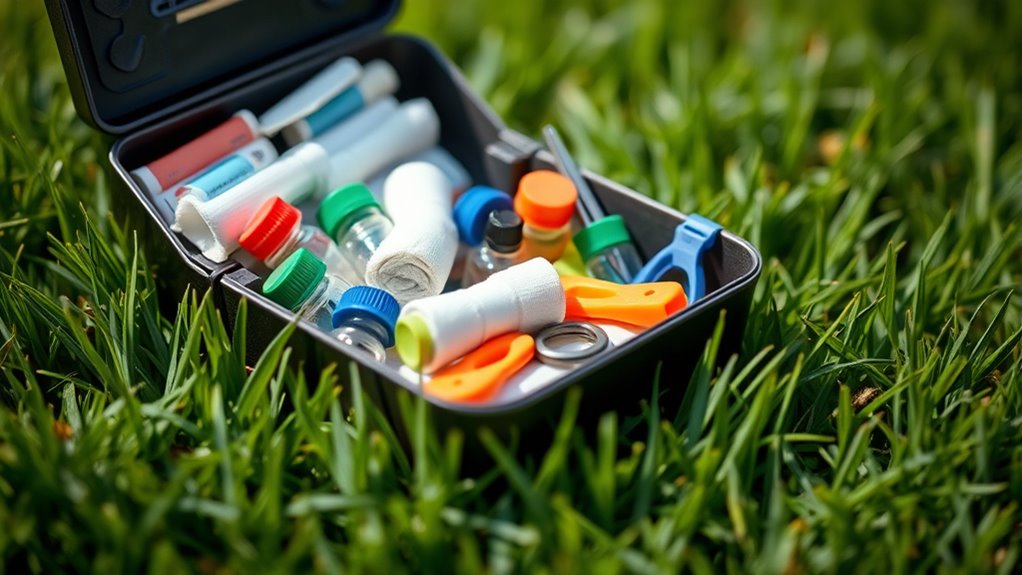
The Rnyleeg takes the opposite approach to first aid readiness, and for a certain kind of owner it’s the smarter buy. Rather than paying for pre-selected supplies, you get a well-built organizational shell and fill it with exactly what your situation demands. The 310D polyester fabric is the kind of material that survives being tossed in a truck bed, dragged across a barn floor, or sat on by a curious mini — a real step up from soft zip pouches that tear at the seams. At roughly 11 x 9.5 x 5 inches, the interior has room for full-size vet wrap rolls, a stethoscope, a digital thermometer, hoof pick, and several EVE-style bandage sets without everything becoming a jumble.
The internal layout is where this bag justifies itself against simply using a plastic tote. Mesh bags and labeled folders mean you can see and grab what you need in seconds, which matters enormously when you’re one-handed and holding a lead rope. Compared with the EVE TotalWrap, the Rnyleeg gives you nothing to treat a wound with today — but it gives you a system that will still be organized five years from now, long after consumables run out.
The obvious drawback is that it arrives completely empty. If you buy this expecting bandages and antiseptic, you’ll be disappointed. The half-zipper closure also means the bag doesn’t open fully flat, which can make deep-corner access slightly awkward. And while the top handle is convenient, there’s no shoulder strap for carrying it across a large property. This option is better suited to experienced keepers who already know their supply list — for beginners, the EVE’s guided, supplies-included approach removes a layer of decision-making that the Rnyleeg pushes onto you.
Pros:- Durable 310D polyester construction stands up to barn and trailer abuse
- Mesh compartments and folders keep supplies visible and sorted
- Generous capacity fits full-size equine supplies plus multiple bandage kits
- Lightweight with a top handle for grab-and-go emergencies
Cons:- Ships empty — no medical supplies included at all
- Half-zipper closure prevents the bag from opening fully flat
- Bulkier than a compact pouch for owners with minimal storage space
Best for: Experienced miniature horse owners who want a durable, organized case to stock with their own hand-picked supplies for barn and travel use
Not ideal for: First-time owners who want supplies included, or anyone who needs a ready-to-use kit straight out of the box
- Material:310D polyester fabric
- Size:11.02 x 9.46 x 4.92 inches / 28 x 24.5 x 12.5 cm
- Closure:Half zipper
- Organization:Mesh bags and internal folders
- Carrying:Top handle
- Supplies included:None — empty bag only
- Use settings:Barn, home, travel, and outdoor use
- Weight:Lightweight
Our verdict“A smart buy for keepers who want full control over their kit’s contents, provided they understand they’re buying organization, not treatment supplies.”

How We Picked
Since true miniature-horse-specific first aid kits barely exist as a category, I evaluated products on how well they serve the practical realities of keeping minis. My first criterion was wound care capability — leg cuts and body abrasions are by far the most common emergencies minis face, so any product claiming first aid relevance had to handle bandaging or wound management credibly. The second criterion was organization and grab-and-go usability, because a pile of loose supplies in a feed room drawer is not a kit. Third, I weighed completeness versus customization: some owners want everything pre-assembled, while experienced keepers prefer choosing their own scissors, thermometers, and antiseptics. I also considered material quality and usability, including whether instructions exist and whether the components suit equine anatomy rather than generic household use. Finally, I filtered for honest value — products that hide empty interiors or oversell sterile capability were penalized. That process surfaced two very different but complementary options, and I ranked them by how directly each solves the bandaging problem that miniature horse owners actually encounter.
Factors to Consider When Choosing Miniature Horse First Aid Kits
Choosing between these two products — or deciding to buy both — comes down to what kind of first aid preparedness you actually need. These are the factors I’d weigh before clicking buy.Supplies Included or Supplies Chosen
This is the single biggest fork in the road. The EVE TotalWrap hands you a working wound care system immediately, with the tradeoff that you don’t control the brands or quantities inside. The Rnyleeg bag gives you zero supplies but total control — you choose your scissors, your thermometer, your antiseptic, and your wrap brands. Beginners almost always do better with included supplies; experienced keepers usually have opinions and prefer choosing.
Wound Care Scope
Leg wounds and abrasions dominate miniature horse emergencies, which is why I weight bandaging capability so heavily. Check whether a kit includes the three functional layers: a non-adherent pad for the wound bed, conforming gauze for padding, and a cohesive wrap for compression. The EVE system covers all three. If you’re assembling your own kit in the Rnyleeg, make sure those three layers are the first things you buy.
Sterility and Veterinary Guidance
Most equine first aid materials are non-sterile, which is fine for stable-side wound management but means you should still flush wounds and involve your vet for anything deep or contaminated. I favor products that include or reference a correct application technique, because bandage pressure errors cause real harm on small equine legs. Instruction quality is a genuine differentiator, not a bonus.
Storage, Portability, and Visibility
An unusable kit is a decoration. Whatever container you choose needs to survive barn conditions, open in seconds, and let you see contents without unpacking. The Rnyleeg’s mesh organization excels here; a kit in a cardboard box fails. Think about where the kit lives — tack room shelf, trailer, or truck — and pick a size that fits that spot permanently rather than migrating around the property.
Sizing for Minis Specifically
Miniature horse legs are narrow, so full-size equine pads often overhang and full-size wraps need extra layers. Smaller pad dimensions like 3″ x 4″ fit better and waste less material. When stocking any kit for minis, lean toward smaller consumable sizes while keeping standard tools like thermometers and stethoscopes, which work the same regardless of horse size.
Frequently Asked Questions
Can I use a regular horse first aid kit for a miniature horse?
Yes, in most cases you can, with a few adjustments. Tools like thermometers, stethoscopes, scissors, and antiseptics work identically regardless of the horse’s size. Where size matters is in consumables: bandage pads and wraps sized for full-size horses will be oversized on a mini’s narrow legs, causing bunching, slippage, and wasted material. I’d choose smaller pad dimensions — around 3″ x 4″ works well — and expect to use more overlap layers on cohesive wrap. Dosing is the other big difference; medications and dewormers must be scaled to your mini’s actual weight, so always confirm doses with your veterinarian rather than estimating from full-size horse guidelines.
What should a complete miniature horse first aid kit contain beyond bandages?
Bandaging supplies like the EVE TotalWrap are the core, but a complete kit adds a digital thermometer (a mini’s normal temperature runs roughly 99–101°F), a stethoscope for gut sounds during colic scares, blunt-tipped scissors, antiseptic solution such as chlorhexidine for wound flushing, saline for eyes, disposable gloves, a hoof pick and hoof boot, petroleum-based ointment for minor abrasions, and your veterinarian’s phone number written inside the lid. I’d also include a small flashlight and a weight tape sized for minis, since accurate weight estimates matter for any medication your vet directs you to give.
Why does the Rnyleeg bag come with no supplies inside?
It’s sold as an organizational case rather than a stocked kit, which is a deliberate design choice that splits buyers into two camps. Some owners prefer this because they can select their own trusted brands, replace expired items on their own schedule, and avoid paying for generic supplies they’d swap out anyway. Others find it frustrating because an empty bag can’t treat anything on arrival. If you value customization and already know what you want inside, the empty format is an advantage. If you want to open a box and be ready, pair it with pre-stocked supplies like the EVE TotalWrap, or skip it in favor of a supplies-included product.
Are non-sterile bandage materials safe to use on my miniature horse?
For typical stable-side wound care, yes — non-sterile materials are the standard in equine first aid because barn environments can’t maintain sterility anyway, and most horse wounds are contaminated from the start. Proper practice is to clean and flush the wound first with antiseptic solution, then apply the non-adherent pad and wrap. Sterility becomes a real concern with deep puncture wounds, wounds needing suturing, or injuries near joints or tendon sheaths. Those situations call for veterinary care regardless of what your kit contains, and the vet-guided instructions included with the EVE system reflect exactly that supervisory approach.
How often should I check or replace items in my miniature horse first aid kit?
I’d do a full inventory check every three to six months, plus an immediate restock after any use. Adhesive tape loses tack, wraps dry out, antiseptics pass their effectiveness date, and gloves degrade in barn temperature swings — heat and cold both shorten shelf life. Check expiration dates on every consumable, verify scissors still cut, and confirm nothing has migrated out of its compartment. If you build your kit in a case like the Rnyleeg, write the last-checked date on a card inside so you know at a glance whether the kit is current. A kit that’s two years stale is barely better than no kit at all when an emergency hits.
Conclusion
Between these two options, the right choice depends entirely on where you’re starting from. New miniature horse owners should buy the EVE TotalWrap System first — it delivers usable wound care immediately and teaches correct bandaging technique, which is knowledge that pays off for the life of your horse. Experienced keepers who already know their supply list will get more long-term value from the Rnyleeg Kit Bag, using its mesh organization to maintain a fully customized kit that evolves with their needs. Barn managers or owners who travel to shows and trail rides benefit most from buying both: the Rnyleeg as a durable, organized container that lives in the trailer or tack room, stocked with EVE TotalWrap sets as the wound care core plus a thermometer, stethoscope, antiseptics, and gloves. Whatever route you take, don’t let the kit sit sealed — check it seasonally, restock after every use, and keep your veterinarian’s number where you can find it in the dark.