Choosing a rabbit cage with an attached run means balancing shelter, exercise space, cleaning access, and the room you have available. My leading pick for flexible indoor and outdoor placement is the GUTINNEEN Indoor and Outdoor Rabbit Hutch, thanks to its six wheels and tray that pulls out from either end. The newer GUTINNEEN Two-Story Hutch is a stronger fit if cleaning access and reinforced framing matter more, while the Rockever Wooden Rabbit Cage offers a broad, floorless activity area for natural grazing.

Get pet supplies delivered free with Prime
- Fast, free delivery on millions of items
- Prime Video, Amazon Music and more included
- Member-only deals all year
These options are not interchangeable: some prioritize a raised, two-level layout and movable trays, while others trade mobility for ground-level run space. I rank them by how well their attached-run design serves a clear buyer need, not by treating every listed feature as equally useful. Before choosing, compare the stated dimensions with your rabbit’s space needs and decide whether a floor, wheels, or a separate sleeping area matters most.
Complete the kit


Key Takeaways
- The GUTINNEEN two-story model offers the most cleaning access in this group, with three deep trays, five doors, and two locking casters.
- The first GUTINNEEN is easier to reposition and clean from either side, but its large footprint and hutch-only package call for space and setup planning.
- The Phonjoroo A-frame separates a sleeping area from the run, though its 47.2-inch length makes it a more compact choice than the Rockever.
- The Rockever provides a 49-by-36-inch floorless grazing area, but its open bottom is less suited to buyers who need a contained, easy-to-sweep run.
- None of these listed dimensions alone settles whether a hutch is suitable for a particular rabbit; check usable space, exercise needs, and safe outdoor conditions before buying.
| GUTINNEEN Two-Story Rabbit Hutch with Metal-Reinforced Frame, 62-Inch, Brown |  | Best Overall for Cleaning Access and Reinforced Construction | Dimensions: 62 x 22.6 x 33.5 inches | Living area: 10.93 square feet | Materials: Solid wood, aluminum alloy reinforced frames, and wire mesh | VIEW ON AMAZON | See Our Full Breakdown |
| GUTINNEEN Indoor and Outdoor Rabbit Hutch with Casters, Waterproof Roof, and Pull-Out Tray |  | Best for Flexible Placement Between Indoor and Outdoor Spaces | Material: Fir | Dimensions: 61.2 x 22.6 x 33.5 inches | Weight: 49.5 pounds | VIEW ON AMAZON | See Our Full Breakdown |
| Wooden Rabbit Cage – Outdoor & Indoor Bunny and Guinea Pig Enclosure |  | Best for a Broad, Floorless Grazing Area | Brand: Rockever | Model: 6003cover | Material: Fir | VIEW ON AMAZON | See Our Full Breakdown |
| Wooden A-Frame Rabbit Hutch with Outdoor Run | 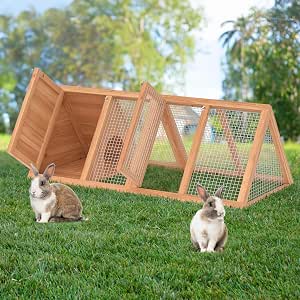 | Best Compact Pick with a Separate Sleeping Area | Material: Fir wood | Finish: Non-toxic, waterproof paint | Dimensions: 47.2 x 23.2 x 17.7 inches | VIEW ON AMAZON | See Our Full Breakdown |
| rabbit cage with attached run | Dimensions | Material | Levels | Doors |
|---|---|---|---|---|
| GUTINNEEN Two-Story Rabbit Hut | 62 x 22.6 x 33.5 inches | — | — | — |
| GUTINNEEN Indoor and Outdoor R | 61.2 x 22.6 x 33.5 inches | Fir | Two | Five |
| Wooden Rabbit Cage | 49 x 36 x 14 inches | Fir | One | One |
| Wooden A-Frame Rabbit Hutch wi | 47.2 x 23.2 x 17.7 inches | Fir wood | One | Two |
More Details on Our Top Picks
GUTINNEEN Two-Story Rabbit Hutch with Metal-Reinforced Frame, 62-Inch, Brown
This is my best overall choice for buyers who want an attached-run hutch with several ways to reach the interior. Its five doors and openable roof make feeding and cleaning access less dependent on one small opening, while three deep pull-out trays offer more separation for waste collection than the single removable tray on the other GUTINNEEN. That difference matters in routine care: multiple trays can make it easier to manage sections without having to clear one large surface at once.
The listed solid wood and aluminum-alloy reinforced frames also give this model a construction detail the other options do not share. Six swivel casters help with repositioning, and two have brakes to help hold the hutch in place. Compared with the first GUTINNEEN, this pick adds locking tray design and reinforced framing; compared with the Phonjoroo A-frame, it gives a raised two-story setup rather than a compact single-level sleeping-and-run layout.
There are real limits. At 62 inches long and 22.6 inches wide, it still needs a planned location, and assembly is required even with pre-drilled holes and hardware included. The listed 10.93 square feet of living area is useful context, but does not by itself establish that the enclosure provides enough room for every rabbit or replaces time outside the hutch. I rank it first for the combination of access, tray design, and stated frame reinforcement, not because it is the smallest or simplest option.
Pros:- Three deep pull-out trays with locking design
- Five doors and an openable roof provide several access points
- Reinforced frame and ventilated wire mesh are specified
- Six swivel casters, including two with brakes
Cons:- Assembly is required, with approximately 30 minutes listed
- The 62-inch footprint needs a dedicated location
- The supplied details do not give a separate run-area measurement
Best for: Rabbit owners who want frequent access for cleaning and feeding, plus a movable two-story hutch with multiple trays.
Not ideal for: Buyers who need a compact enclosure, want a ready-to-use setup without assembly, or need a documented run-size measurement before choosing.
- Dimensions:62 x 22.6 x 33.5 inches
- Living area:10.93 square feet
- Materials:Solid wood, aluminum alloy reinforced frames, and wire mesh
- Waste trays:Three deep pull-out trays with locking design
- Access:Five doors and openable run roof
- Casters:Six swivel casters; two with safety brakes
- Assembly:Pre-drilled holes; hardware included
- Suitable for:Rabbits, guinea pigs, chinchillas, and ferrets
Our verdict“I rank this first for buyers who value accessible cleaning and reinforced construction more than a compact footprint.”
GUTINNEEN Indoor and Outdoor Rabbit Hutch with Casters, Waterproof Roof, and Pull-Out Tray
My pick for easier repositioning is this two-level GUTINNEEN with six wheels. Its stated indoor-and-outdoor use and waterproof asphalt roof make it more adaptable to changing placement than the Phonjoroo A-frame, which has a waterproof-painted roof but no listed wheels. The roof and casters are a useful pairing for owners who may need to move the hutch; they do not remove the need to choose a suitable, protected location.
Cleaning access is another strength. The removable tray pulls out from the front or back, so the hutch can be arranged without relying on access from only one side. The open roof and front doors provide additional ways to reach the enclosure. Compared with the newer GUTINNEEN, however, this one has one listed tray rather than three and does not specify reinforced framing or caster brakes. Those details make the newer model a more compelling pick for buyers prioritizing tray management and keeping a wheeled hutch stationary.
The 61.2-by-22.6-inch footprint is substantial, and at 49.5 pounds it is not a lightweight enclosure to carry when wheels are unsuitable for the surface. The supplied package is the hutch only, so buyers should not assume decorations or other accessories are included. I place it second because its two-ended tray access and mobility suit flexible placement particularly well, while its listed cleaning and frame details are less developed than the top-ranked model.
Pros:- Six wheels support easier repositioning
- Removable tray pulls out from the front or back
- Waterproof asphalt roof is specified for indoor or outdoor use
- Open roof and front doors provide access
Cons:- Large footprint may be difficult to place in a small room
- Package includes the hutch only
- Only one removable tray is listed, unlike the three-tray newer GUTINNEEN
Best for: Owners who want to reposition a two-level hutch and need a waste tray accessible from either end.
Not ideal for: Buyers who need the smallest footprint, multiple waste trays, or specified wheel brakes and reinforced framing.
- Material:Fir
- Dimensions:61.2 x 22.6 x 33.5 inches
- Weight:49.5 pounds
- Levels:Two
- Doors:Five
- Wheels:Six
- Tray:Removable; pulls out from front or back
- Roof:Waterproof asphalt
Our verdict“I recommend this for flexible placement and two-sided tray access, but not for buyers who want the most detailed waste-management setup.”
Wooden Rabbit Cage – Outdoor & Indoor Bunny and Guinea Pig Enclosure
The Rockever takes a different approach from both raised GUTINNEEN hutches: it offers a 49-by-36-inch activity area with a floorless design. That makes it the most distinctive option here for owners who want an attached enclosure where small animals can reach natural ground for grazing. A nesting box supplies a sheltered area, while the heavy-duty lockable wire construction is described as providing ventilation and security.
Its wide, low shape is a better fit for a ground-level setup than the two-story, wheeled GUTINNEEN models, which emphasize elevated living areas and pull-out waste trays. The Rockever also differs from the Phonjoroo: it has a larger listed overall width and a floorless run, whereas the A-frame separates a sleeping compartment from its run in a smaller overall footprint. Buyers choosing between them should decide whether natural ground access or a more enclosed sleeping-and-run structure better suits the intended placement.
The tradeoff is inherent in the open-bottom layout: debris can accumulate, and the enclosure does not provide the same contained floor surface as a tray-equipped hutch. At 32 pounds, it is also heavy enough that frequent relocation may be inconvenient, especially compared with wheeled alternatives. The listed 3.3-inch gap size deserves attention when checking whether the wire construction suits the animal being housed. I rank this third: it has the broadest stated activity-area dimensions, but its floorless design is less practical for buyers who prioritize simple waste collection or a fully contained base.
Pros:- Broad 49-by-36-inch overall activity area
- Floorless run allows access to natural ground
- Nesting box offers a sheltered area
- Lockable wire construction and removable bottom are specified
Cons:- Open bottom can allow debris to accumulate
- At 32 pounds, it may be awkward to relocate regularly
- Listed 3.3-inch gap size needs checking against the animal
Best for: Owners seeking a ground-level, floorless run for supervised grazing and a separate nesting shelter.
Not ideal for: Buyers who need a closed-bottom enclosure, easy waste collection, or an option that is simple to roll between locations.
- Brand:Rockever
- Model:6003cover
- Material:Fir
- Dimensions:49 x 36 x 14 inches
- Weight:32 pounds
- Levels:One
- Doors:One
- Gap size:3.3 inches
Our verdict“I would choose the Rockever for ground-level grazing space, provided an open bottom fits the site and animal.”
Wooden A-Frame Rabbit Hutch with Outdoor Run
This Phonjoroo A-frame is the most compact listed option and the clearest choice for a buyer who wants a defined sleeping compartment beside an attached run. The separated layout offers a sheltered area without relying on a two-level design, unlike either GUTINNEEN. Its triangular roof has a non-toxic, waterproof paint finish, and ventilating wire mesh is described as supporting airflow and helping protect small animals from predators.
At 47.2 inches long, it takes up less length than either GUTINNEEN model and avoids the Rockever’s wide, floorless grazing format. Two doors provide access for feeding and cleaning. That simpler layout may appeal to a first-time owner assembling a smaller enclosure, but the listed dimensions of 47.2 by 23.2 by 17.7 inches also make it the option I would scrutinize most carefully for usable room. Its compactness is a space advantage for the home, not proof that it will suit every rabbit.
Compared with the other picks, it gives up wheels and multiple pull-out trays, so it is less adaptable for routine repositioning and waste management. Assembly is required, though instructions are included, and the product has a stated one-year warranty. I rank it fourth because its distinct sleep-and-run layout is appealing, yet it offers fewer mobility and cleaning features than the GUTINNEEN pair and less stated activity-area width than the Rockever.
Pros:- Separate enclosed sleeping area and outdoor run
- Two doors support feeding and cleaning access
- Ventilating wire mesh and waterproof-painted roof are specified
- Instructions and a one-year warranty are listed
Cons:- Small overall dimensions may limit usable space for larger animals
- Assembly is required
- No wheels or pull-out waste tray are listed
Best for: Buyers with limited space who want a simple single-level hutch with a separate sleeping section and run.
Not ideal for: Owners of larger rabbits or anyone prioritizing wheels, pull-out trays, or a roomy floor-level run.
- Material:Fir wood
- Finish:Non-toxic, waterproof paint
- Dimensions:47.2 x 23.2 x 17.7 inches
- Doors:Two
- Levels:One
- Assembly:Instructions included
- Warranty:One year
- Model:Phonjoroo GLARC46E
Our verdict“I recommend this compact A-frame when a separate sleeping space matters more than a larger run or easier tray cleaning.”

How We Picked
I ranked these four products around the specific promise of a rabbit cage with an attached run. A shelter and an exercise area need to work together, so I looked at the described layout first: whether a model has a distinct sleeping area, how the run is accessed, and whether the available dimensions suggest a compact or more open footprint. I also separated raised, two-level hutches from ground-level grazing designs rather than treating those layouts as equivalent.
Next, I compared everyday practical details that change how an enclosure fits a household: tray access, doors, roof access, wheels, and frame materials. The three pull-out trays and reinforced frame on the second GUTINNEEN give it an edge for cleaning and stated construction features; the first GUTINNEEN is easier to reposition and has a tray accessible from either end. The Phonjoroo’s appeal is its divided sleeping-and-run layout, while the Rockever stands apart for its wider, floorless grazing area.
I used only the supplied product details and did not infer unlisted run dimensions, predator resistance, or suitability for every rabbit. The ranking gives weight to useful, stated features and makes room for drawbacks: a wheeled hutch may still take up substantial floor space, and a floorless run can leave debris or allow access beneath the enclosure. Buyers should match the footprint and construction to their animal, space, and intended placement.
| rabbit cage with attached run | Assembly | Material | Levels | Doors |
|---|---|---|---|---|
| GUTINNEEN Two-Story Rabbit Hut | Pre-drilled holes; hardware included | — | — | — |
| GUTINNEEN Indoor and Outdoor R | — | Fir | Two | Five |
| Wooden Rabbit Cage | — | Fir | One | One |
| Wooden A-Frame Rabbit Hutch wi | Instructions included | Fir wood | One | Two |
Factors to Consider When Choosing Rabbit Cage With Attached Run
I would choose by matching the enclosure’s run layout and cleaning method to your space and routine, rather than starting with the number of levels alone. A raised hutch with wheels behaves differently from a low, floorless run, even when both are described as indoor/outdoor options.
Check usable space, not just the overall footprint
Compare the listed dimensions with the space your rabbit will actually have inside the enclosure. The newer GUTINNEEN states a 10.93-square-foot living area, while the other products provide overall dimensions without a separate run-area measurement. The Rockever’s 49-by-36-inch footprint is wider, but its height is only 14 inches and its base is open. The Phonjoroo is the shortest listed at 47.2 inches long, making it more compact for placement but also the model to inspect most carefully for fit. I would not assume that a two-story design or a broad outside measurement automatically supplies sufficient usable exercise space.
Choose a cleaning setup you can keep up with
Tray access affects how much effort routine cleaning takes. The two-story GUTINNEEN with reinforced framing has three deep pull-out trays; the other GUTINNEEN has one removable tray that slides out from either the front or back. Those are the strongest stated waste-management features in this group. The Phonjoroo lists doors but no pull-out tray, while the Rockever has a removable bottom but also a floorless design that can leave debris beneath the run. Think about the location of the hutch, how much room you have to pull trays out, and whether you prefer a contained surface or ground access.
Treat wheels as a placement aid, not a substitute for a plan
Both GUTINNEEN hutches have six wheels, making them easier to reposition than the Phonjoroo and Rockever. The newer model lists two caster brakes, which help keep it in place; the first GUTINNEEN does not specify brakes. Wheels do not make a large hutch small, and the first weighs 49.5 pounds, so check both floor space and the path between locations. The Rockever weighs 32 pounds but has no listed wheels. If the enclosure will stay in one carefully chosen spot, mobility may matter less than run layout or shelter.
Match roof, base, and mesh to where the hutch will sit
Weather-related descriptions vary: the first GUTINNEEN specifies a waterproof asphalt roof, while the Phonjoroo lists waterproof paint on its triangular roof. The second GUTINNEEN describes an openable roof and ventilated mesh, and the Rockever is described as weatherproof with lockable wire construction. These claims do not replace checking the actual site for shade, drainage, protection, and secure placement. The Rockever’s floorless run has a specific benefit for natural grazing, but it also means the ground beneath is part of the enclosure. Check the listed wire gap against the animal and the intended use.
Separate a sleeping nook from a run when that suits your routine
The Phonjoroo makes the division between sheltered sleeping area and run explicit, and the Rockever includes a nesting box. The GUTINNEEN models instead emphasize two levels, doors, roof access, and trays. A distinct sheltered space may be appealing if your setup benefits from a dedicated nook, while a two-level layout may suit a buyer who values raised access and easier waste handling. Whichever design you choose, check dimensions and access points against the animal’s needs; a listed species range is not a substitute for checking whether the enclosure is an appropriate size.
Frequently Asked Questions
Which of these rabbit hutches is easiest to clean?
The GUTINNEEN Two-Story Hutch with reinforced frame has the most detailed cleaning setup here: three deep pull-out trays, five doors, and an openable roof. The first GUTINNEEN is also convenient in a different way because its single tray pulls out from the front or back. The Phonjoroo lists two doors but no pull-out tray, and the Rockever’s floorless design can leave debris beneath the run.
Which option has the most room for an attached run?
The Rockever has the broadest stated overall footprint at 49 by 36 inches and is designed with a floorless activity area. That does not mean it has the largest enclosed living space: its base is open, and its height is 14 inches. The newer GUTINNEEN is the only model here with a stated living-area figure, 10.93 square feet. Compare the full layout and usable dimensions, not just the longest or widest measurement.
Can these hutches be used outdoors?
The product details describe all four as suitable for indoor and/or outdoor use, with roof or weatherproofing features called out on several models. The first GUTINNEEN lists a waterproof asphalt roof, and the Phonjoroo lists waterproof paint on its roof. Those descriptions do not tell you that any hutch can be left in every outdoor condition. Choose a suitable sheltered location and check the construction and site for your climate and animal’s needs.
Which hutch is the most compact?
The Phonjoroo A-frame has the smallest listed overall length and height at 47.2 by 23.2 by 17.7 inches. It also has a distinct sleeping section and run, but its compact dimensions may restrict usable space, especially for larger animals. The Rockever is shorter in height but wider, while both GUTINNEEN models are around 61 to 62 inches long. Measure your available spot and verify that the interior suits the animal before deciding.
What should I check before putting a rabbit in an attached-run hutch?
Check that the interior and run provide appropriate usable space, that doors and mesh are suitable for the animal, and that the enclosure can be secured in its intended location. Review the base design too: the Rockever is floorless, while the GUTINNEEN models have pull-out trays. For outdoor placement, assess the site’s shelter and surface as well as the product’s roof description. I would also plan access for regular cleaning before choosing a hutch with a fixed or difficult-to-reach position.
Conclusion
My recommendation depends on what you need from the attached run. Choose the GUTINNEEN Two-Story Hutch with reinforced frame if you want the strongest stated combination of multiple trays, access points, and caster brakes. Pick the first GUTINNEEN if moving the hutch and pulling its tray from either end matter more than extra tray capacity. For natural ground access, the Rockever is the distinct choice, provided an open bottom suits your setup. If your priority is a compact layout with a separate sleeping area, consider the Phonjoroo A-frame, but check its limited listed dimensions against your rabbit’s needs. Before ordering, measure the spot, inspect usable space, and decide which cleaning and base design you can maintain.