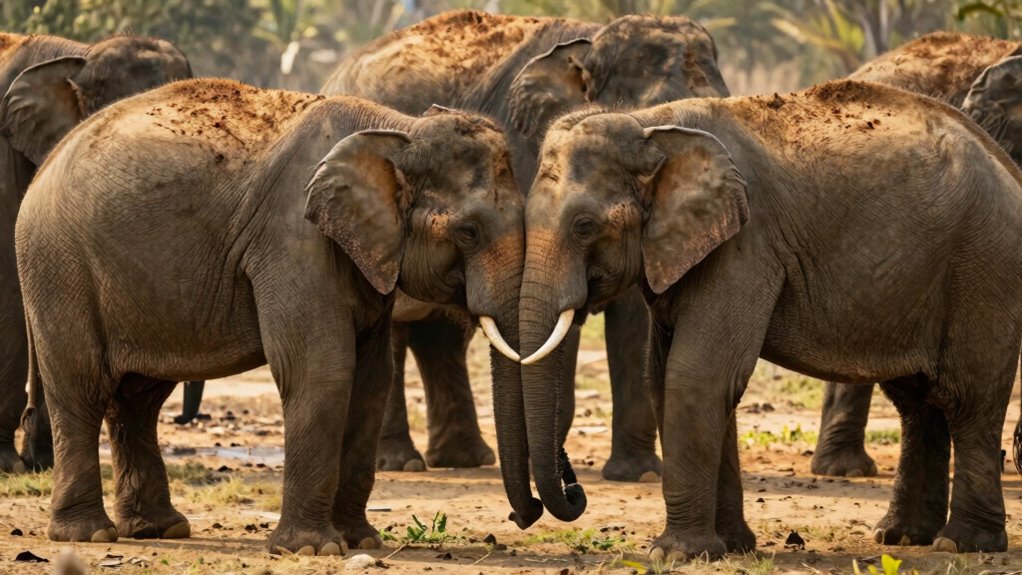

When an elephant is distressed, you’ll see the herd respond with gentle physical gestures like caressing or nudging, which directly comfort them. They also use soft vocalizations and infrasound—low-frequency sounds that travel long distances—to signal support and reassurance. The herd gathers close together, offering emotional strength through collective presence and empathy. Their behaviors show remarkable emotional intelligence and deep social bonds. Fascinatingly, their ways of comforting go beyond survival, revealing their profound empathy and community care.
Key Takeaways
- Elephants use gentle trunk gestures, like nudging or caressing, to physically comfort distressed herd members.
- They emit low-frequency infrasound signals to communicate reassurance over long distances.
- Collective gatherings and physical contact help provide emotional support and reinforce social bonds.
- The herd’s matriarch guides the group through emotional and environmental challenges with experience and empathy.
- Elephants recognize and respond to emotional cues, demonstrating high emotional intelligence and empathy.
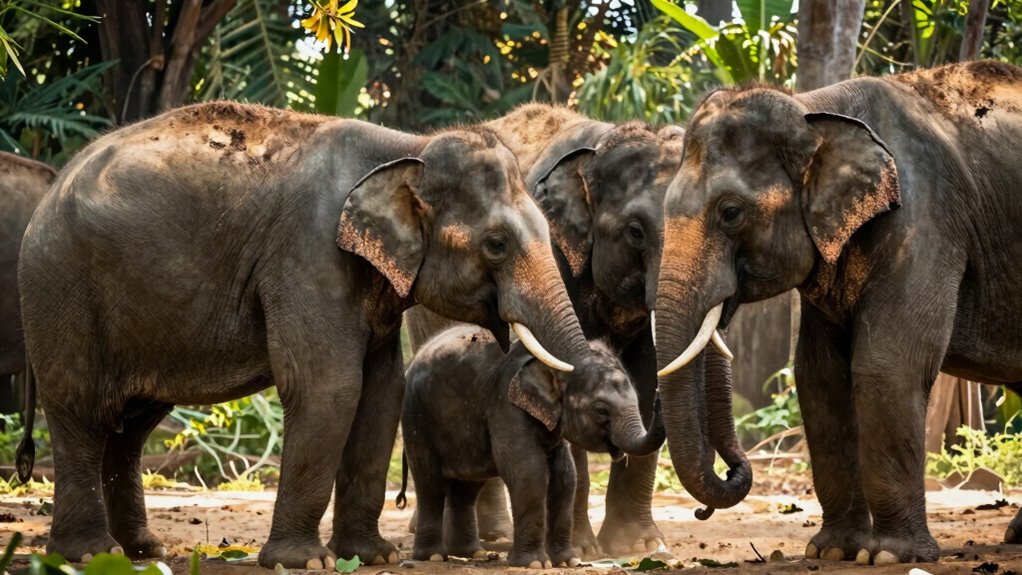
Have you ever wondered how elephants manage to offer comfort to their distressed herd members? It’s a fascinating display of their complex social behavior, rooted in advanced elephant communication and strong herd bonding. When an elephant is upset or grieving, others in the herd instinctively respond with specific signals that convey empathy and reassurance. These signals are part of their sophisticated communication system, which includes vocalizations, body language, and tactile gestures. Through low-frequency rumbles, trumpets, and gentle touches, they create a network of understanding that helps soothe their distressed companions.
Elephants communicate in ways that humans might find subtle but are incredibly effective. For example, they often emit low-frequency sounds called infrasound, which can travel long distances through the ground and air. When a herd member is upset, other elephants nearby pick up on these sounds and respond accordingly. These vocal cues serve as a form of social reassurance, signaling that help and support are available. It’s not just about the sounds; their body language plays a role too. When comforting a distressed member, elephants may gently nudge or caress with their trunks, a tactile expression of empathy that reinforces herd bonding. These physical gestures are deliberate, conveying compassion without the need for words.
Elephants use subtle infrasound and gentle trunk gestures to communicate compassion and strengthen their social bonds.
Herd bonding is essential to their social structure, and it’s what enables elephants to comfort each other in times of distress. Their social groups are tight-knit, often led by an experienced matriarch who guides the herd through emotional and environmental challenges. When one elephant is suffering—whether from injury, loss, or fear—the others instinctively gather around, forming a protective circle or offering physical contact. This collective response helps the distressed member feel safe and supported, reinforcing their emotional connection. Over generations, this behavior has evolved into an intricate system of mutual aid, where every member’s well-being is intertwined with the herd’s stability. Their emotional intelligence allows them to recognize and respond to each other’s feelings with remarkable sensitivity. Recognizing emotional cues is crucial for their social cohesion and survival.
Furthermore, this behavior demonstrates an impressive capacity for empathy, which is often considered a hallmark of advanced social animals. In essence, when you observe elephants comforting each other, you’re witnessing a remarkable blend of communication and social bonding that highlights their intelligence and emotional depth. Their ability to perceive distress and respond with compassionate signals underscores the importance of empathy in animal societies. It is also observed that elephants sometimes engage in collective mourning, which further emphasizes their deep emotional connections. Their methods of offering comfort demonstrate that their social bonds are not just about survival but also about fostering emotional well-being within their community.
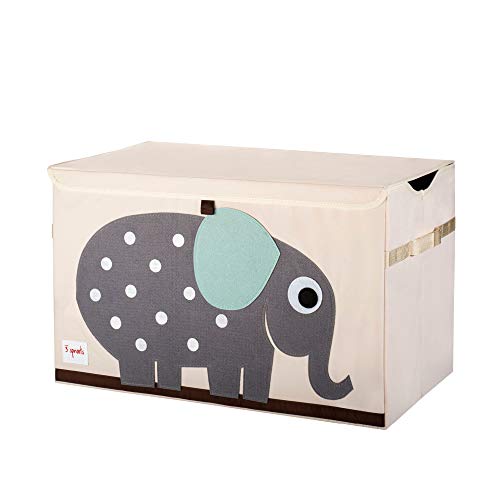
3 Sprouts Large Toy Chest for Kids with Lid and Handles – Collapsible Toy Storage Bin/Trunk/Box/Basket Organizer for Boys & Girls Playroom, Nursery, Elephant
- Spacious and versatile storage: Holds toys, books, blankets, and more
- Foldable for easy storage: Collapsible design when not in use
- Sturdy and reinforced sides: Maintains shape even when empty
As an affiliate, we earn on qualifying purchases.
As an affiliate, we earn on qualifying purchases.
Frequently Asked Questions
Do Elephants Recognize Individual Herd Members in Distress?
Yes, elephants recognize individual herd members in distress through their sophisticated communication. You observe that they use vocalizations, gestures, and even their sense of smell to identify who’s upset. These behaviors strengthen social bonding, showing their deep emotional connections. When a member is distressed, elephants respond with gentle touches, vocal reassurance, and supportive behavior, demonstrating their remarkable ability to recognize and comfort each other during tough times.
How Quickly Do Elephants Respond to a Distressed Member?
Elephants respond rapidly to distress signals, often within moments, showcasing swift social support. Their communication channels, including vocalizations and body language, facilitate fast, focused herd bonding. When a member shows signs of suffering, others instantly interpret these signals, rushing to provide reassurance and protection. This quick reaction underscores how essential elephant communication is for maintaining herd cohesion, ensuring everyone stays safe, secure, and socially connected in their shared sanctuary.
Are Male Elephants Involved in Herd Comforting Behaviors?
Yes, male elephants participate in herd comforting behaviors. They use elephant vocalizations to communicate and offer reassurance, reinforcing social bonding within the group. When a herd member is distressed, males often respond quickly, sharing in the emotional experience through gentle touching and vocal cues. Your understanding of their social dynamics highlights how both genders contribute to maintaining the emotional health and cohesion of the herd.
Do Elephants Comfort Other Species Besides Their Herd?
Elephants do show interspecies empathy and cross-species bonding. You might see elephants gently approach and touch other animals, like dogs or lions, offering comfort or curiosity. They often use their trunks to touch or caress, displaying a gentle, compassionate nature beyond their herd. This behavior highlights their remarkable ability to connect emotionally across species, fostering bonds that go beyond their own kind and demonstrating their nurturing instincts in diverse interactions.
How Do Young Elephants Learn Comforting Behaviors?
You might be surprised, but young elephants learn comforting behaviors mainly through observation and social bonding within their herd. Studies show calves spend up to 70% of their time with adults, mimicking their communication and actions. They pick up cues from vocalizations, touch, and body language, gradually understanding how to soothe distressed members. This learning process is essential for maintaining the strong social bonds that are crucial for their survival and emotional well-being.
Conclusion
So, next time you see elephants gently wrapping their trunks around a distressed herd member, remember—they teach us that compassion isn’t just a human trait. Their silent gestures speak volumes, reminding us that comfort, like a warm embrace, can heal even the deepest wounds. In their tender actions, you find a mirror for your own kindness—a gentle reminder that sometimes, all it takes is a simple touch to make a world of difference.