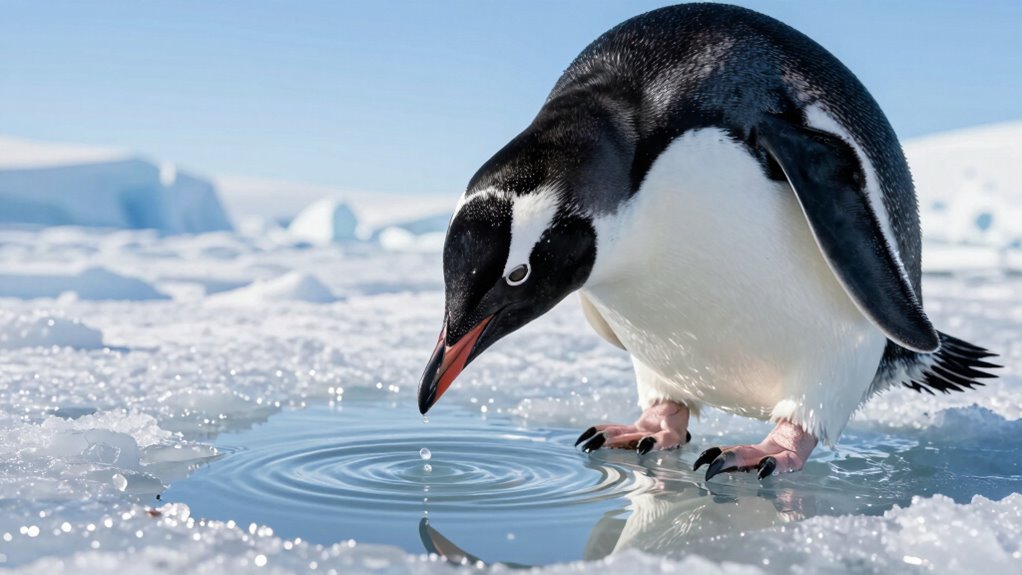

You might wonder if penguins can drink salt water, but they actually can’t due to their specialized adaptations. Their bodies are designed to excrete excess salt through highly efficient nasal glands, which remove salt without dehydrating them. This ability lets them survive long periods at sea without needing freshwater. Their diet provides most of their hydration, and their salt excretion keeps their internal balance in check. If you want to learn more about how they manage this, keep exploring their fascinating adaptations.

Get pet supplies delivered free — and shop member deals
- Fast, free delivery on millions of items
- Access to Prime Big Deal Days deals on October 6–7
- Prime Video, Amazon Music and more included
Key Takeaways
- Penguins cannot drink seawater directly due to the risk of dehydration from high salt intake.
- They rely on specialized nasal salt glands to excrete excess salt efficiently.
- Their diet provides moisture, reducing the need for freshwater intake.
- Internal osmoregulatory systems maintain salt and water balance despite high salinity.
- These adaptations enable penguins to survive and thrive in marine environments without drinking salt water.

Have you ever wondered if penguins can drink salt water? It’s a common question, especially since these birds spend so much time in the icy waters of the Southern Hemisphere. The truth is, penguins have a remarkable saltwater adaptation that allows them to survive in their salty environment. Their penguin diet primarily consists of fish, krill, and other small sea creatures—foods rich in moisture that help meet their hydration needs. But, since they’re surrounded by saltwater, you might wonder if they can simply drink it to stay hydrated. Unlike many land animals, penguins can’t drink seawater directly without risking dehydration. Instead, they’ve evolved specialized mechanisms to handle the salt.
Penguin diet plays a major role in their hydration. When they consume their preferred foods—like fish and krill—they get a significant amount of water from these sources. This natural intake reduces their need to drink freshwater, which is scarce in their icy habitats. However, they do need a way to deal with the excess salt that comes with drinking seawater. Penguins have a saltwater adaptation that involves their nasal glands, which are highly efficient at excreting salt. When they swallow seawater, the salt is quickly absorbed into their bloodstream, but the glands filter it out and excrete it as a concentrated salt solution through their beaks or nostrils. This process allows them to maintain a proper internal salt balance without becoming dehydrated. Their specialized salt glands are vital for their survival in the marine environment. Additionally, these glands are capable of producing a highly concentrated salt solution, which helps with their osmoregulation.
Furthermore, penguins’ ability to excrete excess salt efficiently is an impressive example of their adaptation to a marine lifestyle. Their bodies are also equipped with efficient osmoregulatory systems that help them maintain internal balance despite the high salinity of their environment. Interestingly, research shows that the excretion process is so effective that penguins can survive in saltwater environments without needing to drink it directly. Because of this saltwater adaptation, penguins don’t need to drink seawater like some marine animals do. Instead, they rely on the moisture from their diet and their ability to excrete salt efficiently. This adaptation is crucial for their survival, especially during long periods at sea where freshwater sources are unavailable. It also explains why they are such successful marine birds, capable of spending weeks or even months in the open ocean. Their bodies are finely tuned to handle the salty environment around them, and their specialized glands keep their internal salt levels in check. So, while they are constantly surrounded by saltwater, penguins don’t drink it in the traditional sense, thanks to their unique saltwater adaptation. Their ability to manage salt and extract hydration from their diet makes them well-suited for life in some of the harshest aquatic environments on Earth.
As an affiliate, we earn on qualifying purchases.
Frequently Asked Questions
Do Penguins Ever Drink Fresh Water in the Wild?
Yes, penguins do drink fresh water in the wild when they can find it, especially during breeding seasons or when their diet includes more freshwater sources. Your understanding of their diet and breeding habits helps explain this behavior—penguins primarily feed on fish and krill, which contain freshwater inside. They’re adapted to survive in salty environments, but they’ll seek freshwater sources when available to stay hydrated.
How Do Penguins Process Salt From Seawater?
You might wonder how penguins handle salt from seawater. Their salt gland function plays a key role, as these specialized glands filter excess salt from their bloodstream. Through osmoregulation mechanisms, penguins excrete concentrated salt solutions via their bills or nasal passages, allowing them to stay hydrated despite drinking seawater. This efficient process helps them maintain internal balance, enabling them to thrive in their salty ocean environment.
Are All Penguin Species Capable of Drinking Salt Water?
Not all penguin species can drink salt water. Some, like the African penguin, have specialized glands for salt regulation, aiding their hydration from seawater. Others, such as the Galápagos penguin, rely more on fresh water sources. You should understand that penguin hydration depends on their ability to process salt efficiently, which varies among species. Their salt regulation mechanisms are vital for survival in their diverse marine environments.
What Happens if a Penguin Drinks Too Much Salt Water?
If a penguin drinks too much salt water, it risks dehydration because excess salt can disrupt their salt regulation. To maintain proper hydration, penguins have specialized glands that excrete the salt, allowing them to consume seawater safely. However, overconsumption can overwhelm these glands, leading to imbalanced salt levels and dehydration. So, while penguins are adapted for salt water, moderation is essential for their hydration and overall health.
Can Penguins Survive Long-Term Without Freshwater Sources?
You might wonder if penguins can survive long-term without freshwater sources. In their natural habitat, penguins rely on their dietary adaptations, such as eating seawater fish and prey that help manage salt intake. These adaptations allow them to effectively process salt through their specialized glands, meaning they can survive in their harsh environments even without access to freshwater. So, their unique biology supports their long-term survival in saltwater habitats.
Conclusion
So, you now know that penguins, much like sailors of old, have a special adaptation that allows them to drink salt water without a second thought. Their supraorbital salt glands act like tiny, ancient desalination plants, keeping them hydrated in the icy seas. Unlike a sailor lost at sea with only a flask of water, these birds thrive in salty surroundings, proving that even in a world full of salt, they’ve got it all figured out — just like the legendary sailors of yore.
Fall Picks
fall essentials
As an affiliate, we earn on qualifying purchases.