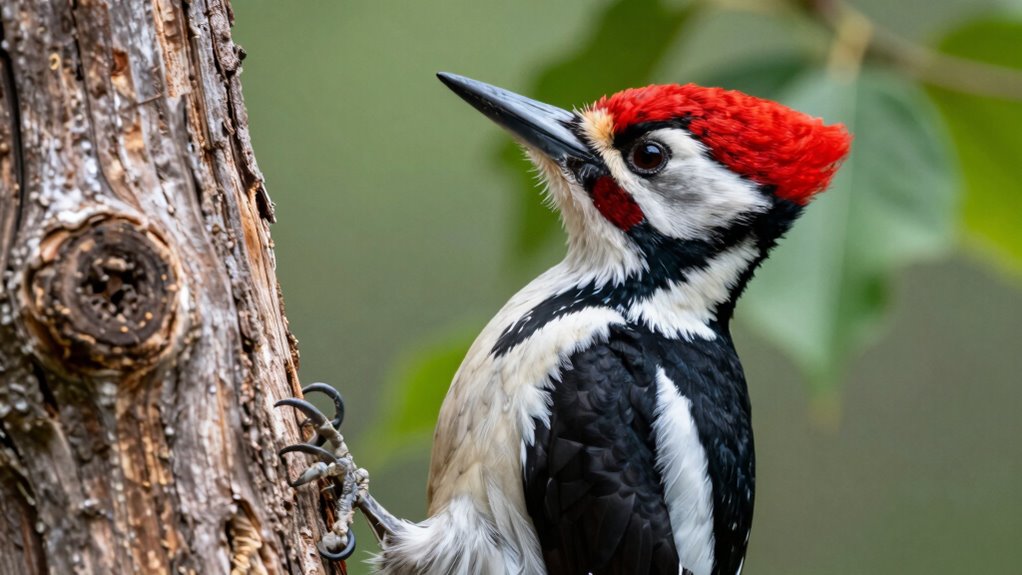

You might wonder why woodpeckers rarely get concussions, and it’s because their skulls and brains are specially evolved to handle intense impacts. Their skulls are thicker, spongy, and designed to absorb shock and disperse energy evenly, preventing localized damage. Inside, their brains are cushioned by cerebrospinal fluid and securely anchored, reducing rotational forces. These unique features act together to keep their brains safe during vigorous pecking—discover how these remarkable adaptations work in detail.

Get pet supplies delivered free with Prime
- Fast, free delivery on millions of items
- Prime Video, Amazon Music and more included
- Member-only deals all year
Key Takeaways
- Their skulls are thicker, spongy, and designed to absorb shock and distribute impact evenly.
- The brain is cushioned by cerebrospinal fluid, reducing injury risk during pecking.
- Skull bones are arranged to minimize vibration transfer to the brain.
- Brain orientation and neural anchoring limit rotational and lateral forces.
- Evolutionary adaptations enhance resilience, preventing concussions despite repeated impacts.
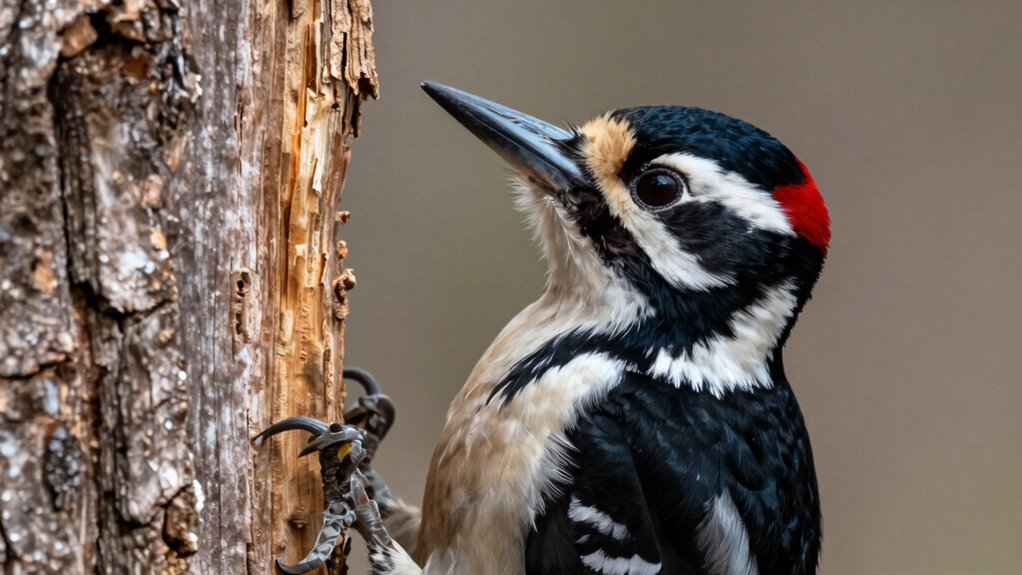
Woodpeckers repeatedly slam their heads against tree trunks without suffering brain injuries, which might seem impossible to us. This incredible feat puzzles many and raises questions about how their brains stay safe despite such relentless pounding. The secret lies in their unique brain protection mechanisms and skull adaptation. Unlike humans, who risk concussions with repeated impacts, woodpeckers have evolved specialized features that shield their brains from damage. Their skulls are not just regular bone structures; they’re engineered for shock absorption and energy dispersion.
Woodpeckers’ skulls and brains are uniquely designed to absorb impacts and prevent injuries during relentless pecking.
When you examine a woodpecker’s skull, you’ll notice it’s thicker and more spongy than that of other birds. This spongy bone acts as a cushion, absorbing much of the force generated during the pecking process. The skull’s structure is designed to distribute the impact evenly, preventing localized damage that could harm the brain. Additionally, the bones are arranged in a way that reduces vibration transfer to the brain tissue, and this bone arrangement is a key factor in their resilience. This adaptation significantly enhances their ability to withstand repeated strikes without injury. This structural adaptation demonstrates how evolution can optimize physical features for specific behaviors. The development of these features showcases the power of natural selection in shaping survival strategies.
But the skull is only part of the story. Woodpeckers also have remarkable brain protection features inside their heads. Their brains are tightly packed with little cerebrospinal fluid, which acts as a natural shock absorber. This fluid creates a cushion that reduces the jarring motion of the brain during impact. Moreover, their brains are oriented in a way that minimizes rotational forces—these forces are often responsible for concussions in humans. The neural tissues are also anchored securely within the skull, limiting movement and potential injury. This specialized structure has evolved over time to support their vigorous pecking behavior.
You might wonder how these adaptations evolved. It’s a perfect example of natural selection shaping a species to handle its environment’s demands. Over generations, woodpeckers developed skull structures that could endure their intense pecking behavior. Their skull’s design, combined with brain protection features like the cushioning cerebrospinal fluid and brain orientation, work together to prevent concussions. This combination ensures they can perform their vital foraging activities without risking brain damage. Interestingly, these adaptations highlight the importance of evolutionary pressure in shaping resilient biological traits.
In essence, the resilience of a woodpecker’s brain is a marvel of evolution. Their skull adaptation and internal protection mechanisms serve as a natural blueprint for brain safety. While humans still work on improving brain protection, nature has already fine-tuned these birds’ heads to withstand the repeated impacts of pecking. It’s a fascinating reminder of how specialized structures can evolve to keep vital organs safe, even under extreme conditions.
As an affiliate, we earn on qualifying purchases.
Frequently Asked Questions
Do Woodpeckers Ever Suffer Head Injuries?
You might wonder if woodpeckers ever suffer head injuries, but they rarely do. Their specialized skulls and strong neck muscles protect them, even during intense pecking. While their diet mainly consists of insects, their migration patterns keep them active year-round. These adaptations help prevent injuries, allowing woodpeckers to peck tirelessly without harm. Their unique physiology showcases how evolution can safeguard creatures in their natural behaviors.
How Do Woodpecker Skulls Compare to Human Skulls?
You’ll notice that woodpecker skulls are uniquely adapted compared to human skulls. Their biomechanics include a reinforced structure with spongy bone cushions that absorb shock, preventing brain injury. Unlike humans, who have a relatively rigid skull, woodpeckers’ skull reinforcement and specialized hyoid bone help distribute impact forces efficiently. This combination allows them to peck repeatedly without suffering concussions, showcasing an impressive natural design for head protection.
Can Humans Learn From Woodpecker Head Protection?
Yes, humans can learn from woodpecker head protection. Woodpeckers exhibit impressive brain protection through evolutionary adaptation, with skull structures and shock-absorbing tissues that prevent concussion. By studying their mechanisms, we might develop better helmet designs or brain injury prevention strategies. Emulating their natural defenses could lead to advancements in protecting humans from head trauma, especially in high-impact activities or sports.
Do All Woodpecker Species Have the Same Head Adaptations?
Like a master musician tuning their instrument, all woodpecker species have unique head adaptations shaped by evolutionary pressures. These adaptations include shock-absorbing skulls and stiff neck muscles, tailored for acoustic communication and relentless pecking. While these features vary slightly among species, the core protective traits remain consistent, ensuring they avoid concussions despite their intense head-banging. Your understanding deepens as you see nature’s precise engineering across different woodpecker species.
How Often Do Woodpeckers Peck Without Injury?
You’d be surprised how often woodpeckers peck without injury; they drill hundreds of times daily, thanks to their specialized head adaptations. Their unique skull structure and reinforced brain area absorb energy efficiently, preventing harm during high-frequency drilling. These birds continually strike wood with remarkable precision and resilience, showcasing their ability to withstand repeated impacts through biological engineering that minimizes injury risk, even with frequent pecking.
Conclusion
So, next time you witness a woodpecker’s wild whacks, remember their resilient anatomy and remarkable adaptations. Their sturdy skulls and shock-absorbing structures serve as superb shields against brain bumps. It’s a reminder that with the right resilience and research, we can protect ourselves too. Embrace their example—build better barriers, bolster your brain’s boundaries, and boldly bounce back from life’s blows. Woodpeckers teach us that strength, science, and survival go hand in hand.
Halloween Picks
halloween
As an affiliate, we earn on qualifying purchases.



![Pentulive (Puppy Live) [Video]](https://aplaceforanimals.com/wp-content/uploads/2026/10/pentulive-puppy-live-video-featured-260x140.jpg)