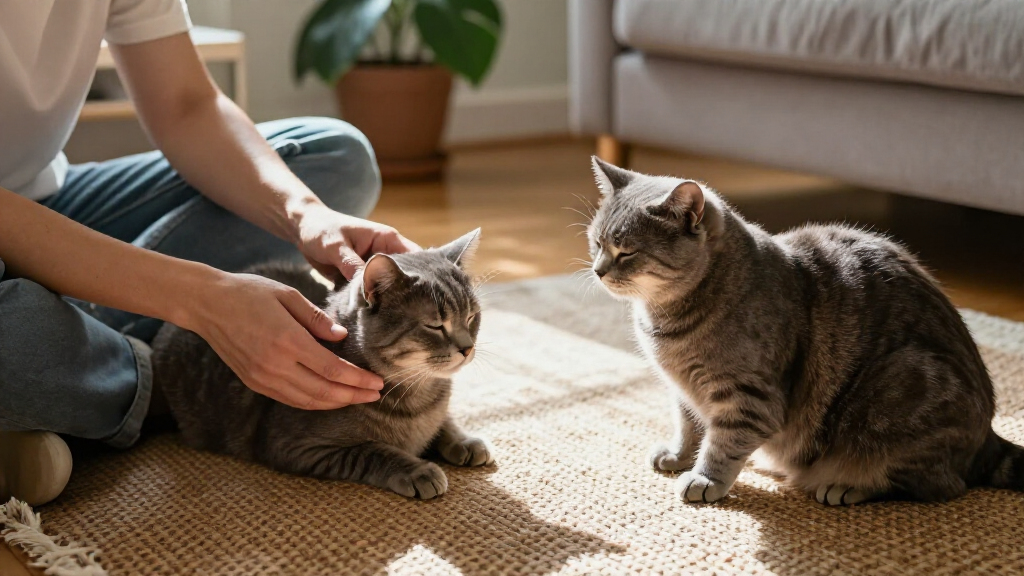

TL;DR

Get pet supplies delivered free with Prime
- Fast, free delivery on millions of items
- Prime Video, Amazon Music and more included
- Member-only deals all year
A 2020 study in Scientific Reports tested whether cats respond to human slow blinks and whether the interaction affects their willingness to approach an unfamiliar person. The researchers reported that cats were more likely to narrow their eyes in response and more likely to approach after a slow-blink exchange than under comparison conditions. The findings suggest a possible communication signal, but do not establish what cats intend or feel.
A 2020 study published in Scientific Reports found that cats were more likely to produce slow-blink eye movements after a person directed the same expression at them, and were more likely to approach an unfamiliar person after a slow-blink interaction. The experiments provide evidence that this familiar cat facial movement may have a role in cat–human communication, though they do not establish what cats mean by it or whether it reliably signals a particular emotion.
The researchers ran two experiments to test different parts of the proposed interaction. In the first, they examined whether cats would respond to a human slow-blink sequence with one of their own. In the second, they tested whether cats were more likely to approach an unfamiliar experimenter after a slow-blink exchange. The study compared the interactions with a neutral human expression and with no human interaction.
The first experiment included 21 cats from 14 households, tested in familiar rooms in their homes. After three cat–human pairs were excluded as statistical outliers, the analysis included 18 dyads. The paper describes a slow blink as a sequence of partial blinks followed by sustained eye narrowing or eye closure. The researchers filmed the cats during the human-initiated stimulus and compared their responses with the control condition.
The authors reported that cats were more likely to narrow their eyes after a person slow-blinked at them than during the neutral-face comparison. In the second experiment, cats were more likely to approach an unfamiliar person after a slow-blink interaction than when the person maintained a neutral expression. These results are observations from controlled tests; they do not show that every cat responds this way, or prove that an approach reflects affection, trust or a specific message.
What Slow Blinks May Signal
The findings add experimental evidence to an everyday observation often shared by cat owners: cats sometimes narrow or close their eyes in interactions with people. By testing both the cat’s facial response and its subsequent approach to an unfamiliar person, the study examined not just whether cats mirror a movement, but whether the interaction is associated with a change in behavior.
That matters because cats are frequent human companions, yet their social communication has received less research attention than that of some other domestic animals. A better understanding of their responses could inform how people interact with cats and may contribute to improving human–cat relationships and welfare. Still, the study does not prescribe a universal greeting. Its results support a possible communicative role, not a definitive translation of the expression or proof that a slow blink always makes a cat comfortable.
As an affiliate, we earn on qualifying purchases.
How Researchers Tested the Exchange
The study was motivated by the relative lack of research on cat–human communication. Earlier work cited by the authors had found that cats can use some human cues, including pointing, and may look toward their owners in uncertain situations. Other research had examined cats’ responses to human voices and emotional cues. The 2020 paper focused on a less-studied visual behavior: the so-called slow-blink sequence, commonly described as partial blinks followed by narrowed eyes or eye closure.
The authors noted that eye narrowing also appears in positive-affect displays in some other species and in human smiling. That resemblance helped motivate the research, but it does not by itself show that the expressions carry the same meaning across species. The experiments therefore tested observable responses rather than assuming that a cat’s narrowed eyes express a particular feeling.
Testing cats at home was intended to place them in a more familiar setting than a laboratory. The study’s first experiment used cats living with their owners for at least three months and excluded cats with visual impairment or eye-related medical issues. The paper reports a sample of 21 cats initially, with 18 dyads included in the first experiment’s final analysis.
“The paper describes the slow-blink sequence as a series of half-blinks followed by prolonged narrowing of the eye aperture or full eye closure.”
— The study authors
What the Experiments Cannot Show
The results do not establish what cats intend when they narrow their eyes, whether the movement is consciously directed as a message, or whether it communicates the same thing across cats and situations. The reported approach behavior also cannot, on its own, distinguish among possible explanations such as reduced wariness, interest or another response to the interaction. The source material provided here does not include the full methods and statistical results for the second experiment, so its sample size and detailed measurements cannot be reported from this material.
The study was limited in scale: its first experiment’s final analysis covered 18 cat–human pairs from household settings. Cats with eye conditions or visual impairment were excluded, so the findings should not be assumed to apply to them. The research supports a possible association between human slow blinking and cat responses; it does not demonstrate a guaranteed effect or settle the emotional meaning of the behavior.
Further Tests of Cat Communication
The 2020 report does not announce a follow-up study or a scheduled next milestone. Further research could test slow-blink interactions with larger and more varied groups of cats, in different settings, and with clearer measures of how the cats respond over time. Researchers could also examine whether factors such as familiarity with the person or the cat’s immediate situation change the response.
For now, the paper offers evidence that cats may respond to a human slow blink and that the exchange can be followed by greater willingness to approach an unfamiliar person in the experimental setting. It leaves the meaning of the signal open. Any practical interpretation should remain cautious: one observed eye movement is not a complete measure of a cat’s emotional state or comfort.
Key Questions
What did the 2020 cat slow-blink study find?
The researchers reported that cats were more likely to narrow their eyes after a person slow-blinked at them and more likely to approach an unfamiliar person after a slow-blink interaction than in a neutral-expression comparison.
What is a cat slow blink?
In the study, it refers to partial blinks followed by sustained eye narrowing or eye closure. The researchers tested whether cats produced this kind of movement after seeing a person do it.
Does a slow blink prove that a cat is happy or affectionate?
No. The study supports a possible role in cat–human communication, but it does not establish a single emotional meaning or prove that every cat’s slow blink signals happiness or affection.
How many cats took part?
The first experiment began with 21 cats from 14 households. After three dyads were excluded as statistical outliers, the final analysis included 18 cat–human pairs.
Were the cats tested at home?
Yes. The first experiment took place in familiar rooms in the cats’ homes. The researchers said this setting was intended to be more comfortable for the cats than a laboratory.
Source: hn
Fall Picks
fall essentials
As an affiliate, we earn on qualifying purchases.