
Animals master disguise by blending into their surroundings using camouflage, mimicry, and adaptive colors. They shape-shift, change hues, or imitate objects to avoid predators and catch prey effectively. For example, chameleons adjust their skin color, while leaf-tailed geckos mimic leaves perfectly. These clever strategies, refined through evolution, help animals survive in complex environments. As you explore further, you’ll discover even more incredible ways nature’s masters of disguise stay safe and thrive.
Key Takeaways
- Many animals blend into their environment using adaptive coloration, making them nearly invisible to predators and prey.
- Animals mimic objects or other creatures through shape, pattern, and behavior to enhance concealment.
- Some species change their skin or feathers in real-time to match surroundings, aiding in hunting and self-defense.
- Combining multiple strategies like shape, color, and movement mimicry increases the effectiveness of camouflage.
- Evolution refines these disguises, making animals masters of concealment for survival and predation.

Have you ever wondered how some animals and humans seamlessly blend into their surroundings? It’s a fascinating display of nature’s ingenuity, where creatures use a variety of concealment strategies to stay safe and hunt effectively. One of the most impressive methods they employ is camouflage, which relies heavily on mimicry techniques and adaptive coloration. These strategies help animals become virtually invisible or resemble their environment so well that predators overlook them or prey cannot distinguish them from their surroundings.
Animals and humans use camouflage, mimicry, and adaptive colors to blend seamlessly with their environment for safety and hunting.
Mimicry techniques involve more than just blending in; some animals adopt shapes, patterns, or behaviors that mimic other objects or creatures. For example, certain insects resemble twigs or leaves, swaying gently to mimic the movement of the wind, further enhancing their disguise. Some snakes and lizards adopt the appearance of rocks or bark, enabling them to sit motionless, undetected by both predators and prey. Meanwhile, other animals mimic the appearance of dangerous or unappetizing creatures, such as the harmless king snake that looks like a venomous coral snake. This form of mimicry discourages predators from attacking, giving the mimic an advantage in survival.
Adaptive coloration is another critical component of camouflage. It involves changing skin or feather colors to match the environment, often rapidly. Chameleons are iconic examples; they can shift from vibrant hues to dull browns or greens, depending on their surroundings or emotional state. Similarly, cuttlefish and certain fish use adaptive coloration to blend into coral reefs or sandy seabeds, making them nearly invisible to predators and prey alike. This ability to adjust their appearance in real time is essential for both hunting and self-defense. Some animals also utilize cryptic coloration to better integrate into their environments, further improving their chances of survival.
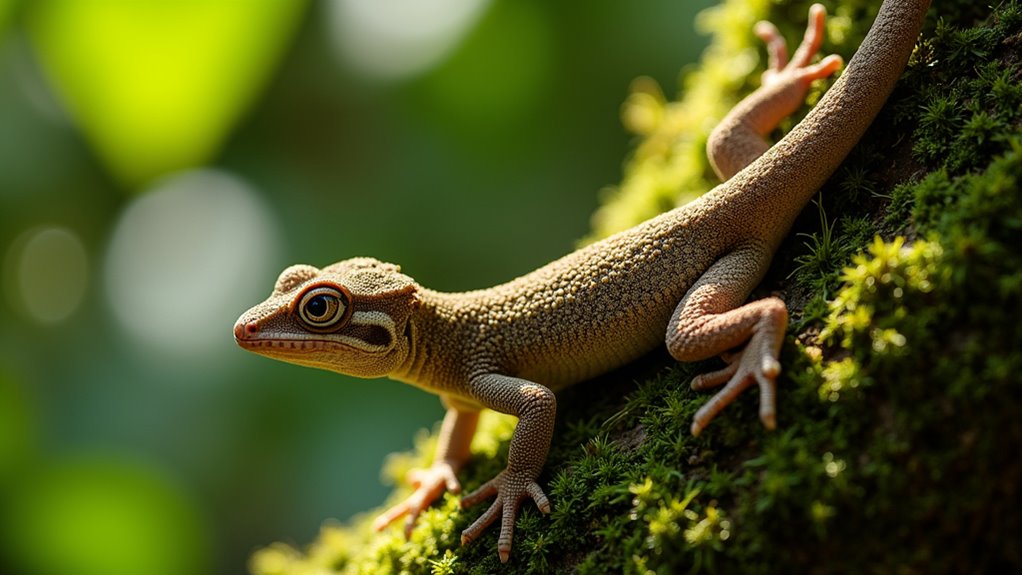
You might notice that many animals use a combination of these techniques to maximize their chances of survival. For example, a leaf-tailed gecko employs mimicry techniques by adopting the shape of a leaf and uses adaptive coloration to match the color of its environment. This dual strategy makes it remarkably difficult for predators to detect it, even when it’s still. Evolution has further refined these strategies through natural selection, ensuring that only the best disguises persist. Some animals also utilize behavioral mimicry, such as insects that imitate the sounds or movements of other creatures to evade predators or lure prey, highlighting the diverse ways evolution enhances disguise.
In essence, the use of mimicry techniques and adaptive coloration exemplifies how evolution fine-tunes survival strategies. It’s not just about hiding; it’s about becoming part of the environment so seamlessly that predators and prey alike overlook you entirely. This constant adaptation and mastery of disguise showcase the remarkable ways animals have evolved to thrive in a complex, competitive world.
animal camouflage educational kit
As an affiliate, we earn on qualifying purchases.
As an affiliate, we earn on qualifying purchases.
Frequently Asked Questions
How Do Animals Develop Their Camouflage Abilities?
You might wonder how animals develop their camouflage abilities. They do so through evolutionary adaptations driven by natural selection, where those with better camouflage survive longer and reproduce more. Over generations, these traits become ingrained via genetic inheritance. As a result, animals develop specific features, like color, pattern, and texture, that help them blend into their environment, increasing their chances of survival and passing these advantageous traits to their offspring.
Can Animals Change Their Camouflage Instantly?
You might wonder if animals can change their camouflage instantly. Some species, like chameleons and cuttlefish, excel at rapid color adaptation through specialized skin cells called chromatophores. This ability allows them to perform visual deception quickly, blending into their surroundings or signaling danger. Their quick responses help evade predators or communicate, making instant camouflage a crucial survival tool in their environment.
Are There Predators That Can See Through Camouflage?
You might wonder if predators can see through camouflage. Some predators have evolved exceptional vision and skills in predator detection, allowing them to recognize visual deception despite an animal’s efforts to blend in. For example, birds of prey and certain fish can detect subtle movements or patterns that reveal hidden prey. So, yes, some predators can counter camouflage effectively, making survival a constant game of hide-and-seek in nature.
Do All Animals Rely on Camouflage for Survival?
Imagine hiding in a crowd, feeling invisible—some animals do too. Not all rely solely on camouflage for survival; many use other strategies like speed or mimicry. Camouflage effectiveness varies, offering evolutionary advantages in avoiding predators. For example, chameleons change colors, but some animals like the peacock rely on display. So, while camouflage’s essential, it’s just one tool in an animal’s survival toolkit.
How Does Camouflage Affect Animal Behavior?
Camouflage critically influences animal behavior by promoting strategies like visual deception and predator evasion. When you observe animals blending into their surroundings, they are actively avoiding detection, which affects their movement and habitat choices. This behavior helps them stay safe from predators and increases their chances of survival. You’ll notice that animals often adapt their actions and locations to maximize the effectiveness of their camouflage, demonstrating how essential it is for their survival tactics.
Conclusion
Just like a skilled magician vanishing behind a curtain, animals master disguise to survive in their world. Their camouflage isn’t just hiding—it’s a silent dance with nature, a game of hide and seek where only the cleverest win. Remember, in the grand theater of life, those who adapt and blend in often hold the greatest power. So, next time you see a creature vanish, think of it as a masterful act in the ongoing play of survival.