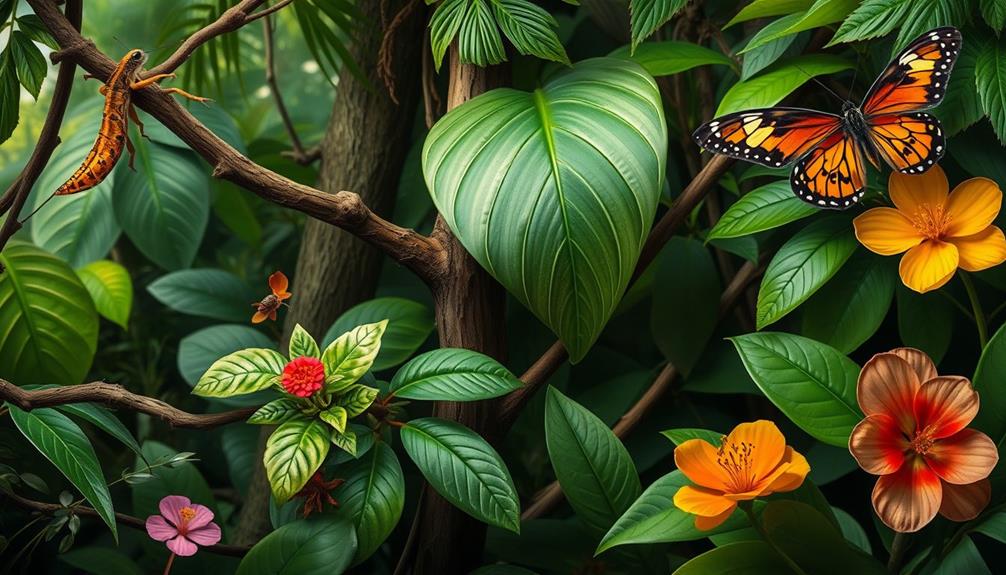

Animal mimicry is an incredible evolutionary tool that helps species survive by resembling one another. You'll often see harmful or unpalatable species that mimic dangerous ones, like the Viceroy butterfly imitating the Monarch. This resemblance tricks predators into keeping their distance. There's also aggressive mimicry, where predators disguise themselves as harmless creatures to lure in prey, like the anglerfish. Additionally, some organisms mimic their own features to confuse attackers. Understanding these strategies reveals the complex ways species interact with their environments. If you're intrigued, there's so much more to explore about these fascinating adaptations!

Get pet supplies delivered free with Prime
- Fast, free delivery on millions of items
- Prime Video, Amazon Music and more included
- Member-only deals all year
Key Takeaways
- Mimicry enhances survival by allowing species to resemble harmful or unpalatable organisms, deterring predators through learned avoidance behaviors.
- Batesian mimicry involves harmless species mimicking harmful ones, while Müllerian mimicry features unpalatable species resembling each other for mutual protection.
- Aggressive mimicry allows predators to imitate harmless organisms, deceiving prey to increase hunting success.
- Automimicry occurs when organisms mimic their own features to mislead attackers, improving their chances of survival.
- Natural selection shapes mimicry strategies, favoring traits that enhance species' ability to avoid threats in their environments.
animal mimicry educational model
As an affiliate, we earn on qualifying purchases.
As an affiliate, we earn on qualifying purchases.
Definition of Mimicry
Mimicry is an intriguing evolutionary strategy where organisms develop a resemblance to other species or objects, enhancing their chances of survival. The definition of mimicry encompasses the evolved similarities that can occur between different species or even individuals of the same species. This phenomenon serves as a crucial adaptation, particularly in the animal kingdom, much like how various plants have evolved to utilize their unique properties for survival and health benefits in the field of herbalism.
You'll encounter two primary forms of mimicry: Batesian mimicry and Müllerian mimicry. Batesian mimicry involves harmless species mimicking harmful species to deceive predators, reducing the chances of being attacked. On the other hand, Müllerian mimicry occurs when multiple unpalatable species evolve to share similar warning signals, reinforcing predator avoidance. This mutual resemblance benefits all involved species by enhancing their survival rates through natural selection.
Mimicry can also manifest in other interesting ways, like aggressive mimicry, where a predator imitates a harmless organism to lure prey, or automimicry, where an organism mimics its own features to misdirect predators.
Understanding the definition of mimicry reveals how these strategies enable various species to navigate their environments more effectively and avoid threats.
Types of Mimicry
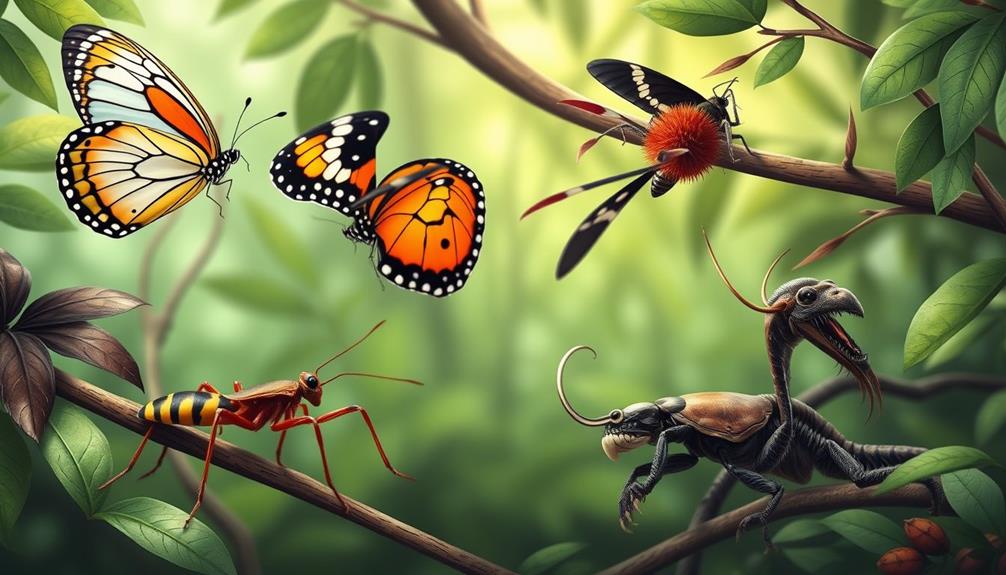
Understanding the different types of mimicry reveals the fascinating strategies animals use to survive in their environments. One well-known example is Batesian mimicry, where a harmless species mimics the warning patterns of a harmful one to deter predators. The Viceroy butterfly, for instance, mimics the toxic Monarch butterfly to avoid being eaten.
In contrast, Müllerian mimicry occurs when two unpalatable species, like the Monarch and Viceroy, evolve to resemble each other, reinforcing predator avoidance. This intriguing phenomenon reflects the complex relationships found in nature, similar to how astrological compatibility can affect relationships.
Aggressive mimicry takes this concept further, as predators imitate harmless or beneficial organisms to lure prey, like the anglerfish with its bioluminescent lure.
Meanwhile, automimicry involves an organism mimicking its own body parts, such as snakes with tails that resemble their heads, to confuse attackers.
Finally, chemical mimicry shows how some species, like certain orchids, mimic the pheromones of female bees to attract male pollinators.
These types of mimicry highlight the intricate relationships between mimic and model, showcasing how species mimics develop unique adaptations to thrive, as noted by naturalist Henry Walter Bates.
Historical Context
Throughout history, humans have been fascinated by the deceptive behaviors of animals, with early thinkers like Aristotle documenting these intriguing strategies. He noted how partridges protect their young from predators, showcasing the importance of mimicry in survival. The term "mimicry," first used in 1637, comes from the Greek word "mimetikos," meaning imitative, gaining prominence in the 19th century.
In this era, Fritz Müller proposed a mathematical model for the evolution of mimicry, which greatly advanced our understanding of how these strategies develop. Additionally, William Kirby and William Spence's 1823 work on insects illustrated various forms of mimicry, laying essential groundwork for future biological studies.
Here's a summary of key historical figures and their contributions:
| Thinker | Contribution | Era |
|---|---|---|
| Aristotle | Documented behaviors like partridge protection | Ancient Greece |
| William Kirby | Illustrated mimicry in insects | 19th century |
| Fritz Müller | Proposed a mathematical model for mimicry | 19th century |
| William Spence | Co-authored foundational mimicry research | 19th century |
These foundational observations shaped modern research in evolutionary biology and ecological interactions.
Mechanisms of Mimicry
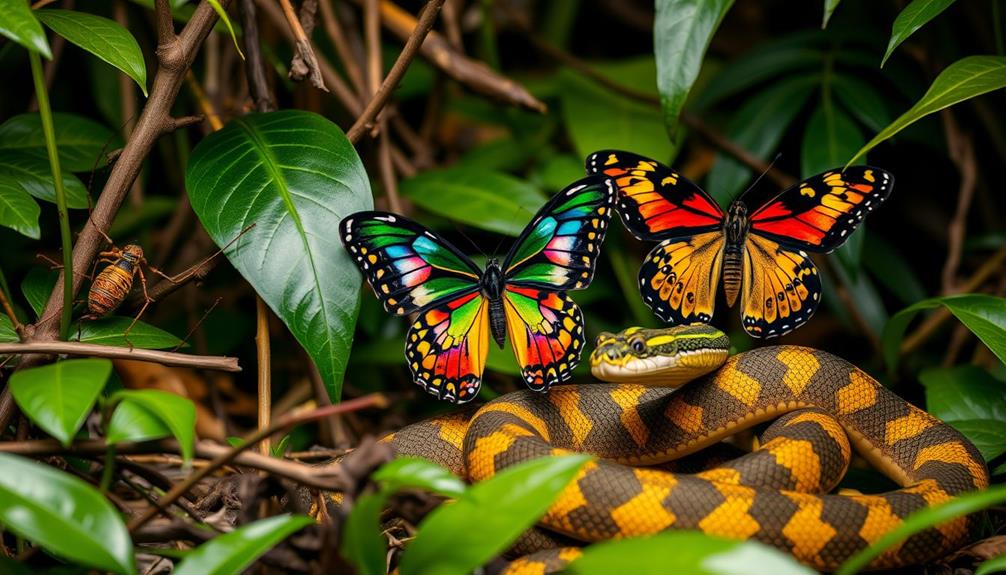
The fascinating domain of mimicry operates through the powerful mechanism of natural selection, where species that closely resemble harmful or unpalatable organisms gain a significant advantage in avoiding predators. This resemblance often leads to enhanced survival rates, as predators learn to associate certain appearances with danger.
In the field of biology, understanding these adaptive strategies is essential for appreciating the complexities of ecological interactions and evolutionary processes, much like key traits of successful SQA engineers that enhance their performance in a different domain.
Batesian mimicry serves as a prime example of this mechanism. In this scenario, a harmless species mimics a toxic counterpart, reducing its risk of predation by relying on the predator's learned avoidance behaviors. As these predators become familiar with the warning signs of danger, the effectiveness of mimicry solidifies over generations.
On the other hand, Müllerian mimicry involves multiple unpalatable species evolving to resemble each other. This mutual resemblance reinforces avoidance learning among predators, ultimately benefiting all involved species through shared protection.
While the physiological basis for mimicry, such as color changes in species like fangblennies, is still under study, it's clear that these adaptations are vital for successful concealment and predatory strategies.
Through these mechanisms, mimicry highlights the intricate relationship between species and their environments, showcasing nature's remarkable innovation in survival tactics.
Examples in Nature
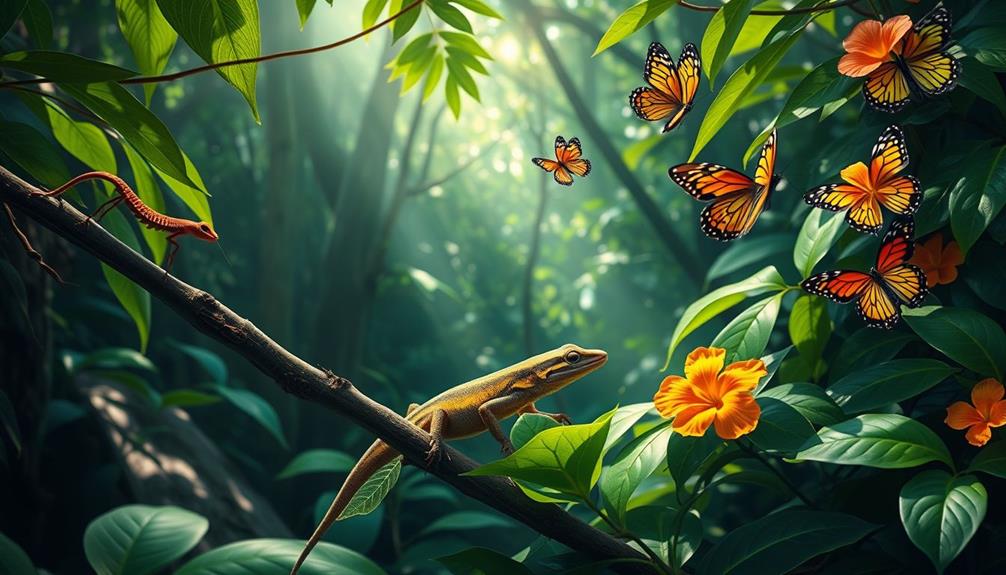
Mimicry in nature showcases some of the most ingenious survival strategies among various species. For instance, the Viceroy butterfly and the toxic Monarch butterfly demonstrate Müllerian mimicry, reinforcing predator deterrence through their similar appearances. Meanwhile, the Mimic Octopus skillfully impersonates various venomous creatures like lionfish and sea snakes, using color and posture to evade danger.
Below are some enthralling examples of mimicry in the animal kingdom:
| Species | Mimicry Type |
|---|---|
| Viceroy butterfly | Müllerian mimicry |
| Alligator Snapping Turtle | Aggressive mimicry |
| Eyed Hawkmoth caterpillar | Deceptive appearance |
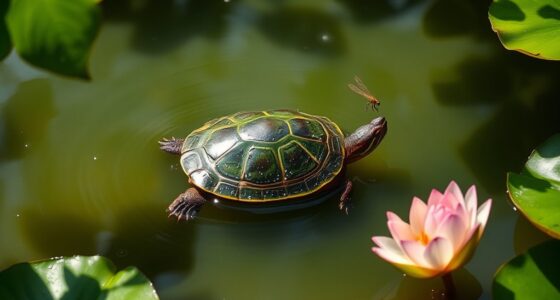
In addition, the Alligator Snapping Turtle employs aggressive mimicry, using a worm-like tongue to lure fish while staying motionless. The Eyed Hawkmoth caterpillar features false eye markings to resemble snakes, effectively deterring predators. Another fascinating example is the Fangblenny fish, which mimics the bluestreak cleaner wrasse to sneakily bite off scales from larger fish. These examples of mimicry highlight nature's creativity in ensuring survival among diverse species.
Frequently Asked Questions
Why Do Some Species Mimic Another Species?
Some species mimic others to enhance survival. By resembling harmful or unpalatable models, they trick predators into avoiding them. This clever strategy allows you to navigate your environment more safely and effectively.
Why Do Animals of Different Species Looks Similar?
You might notice animals of different species looking similar because they've evolved to share characteristics that enhance survival. This resemblance can deter predators, attract mates, or improve camouflage, showcasing nature's clever strategies for adaptation.
What Mimicry Occurs When Two Different Species Look Alike?
When two different species sport similar looks, it's often Müllerian mimicry. This clever collaboration reinforces predator avoidance, as both species are unpalatable. You'll find it fascinating how nature cleverly enhances survival through shared appearances!
When an Organism Can Look Like Some Other Object It Is Using Mimicry?
When you observe an organism resembling another object, it's employing mimicry. This adaptation helps it survive by confusing predators or attracting prey, showcasing nature's incredible ability to evolve for better chances of survival.
Conclusion
In exploring animal mimicry, you uncover a fascinating web of survival strategies and evolutionary wonders. It's intriguing how two seemingly unrelated species can share such striking similarities, often by mere coincidence of their environments or predator perceptions. This intricate dance of adaptation not only highlights nature's creativity but also reminds us that appearances can be deceiving. So, the next time you observe wildlife, consider the hidden stories of mimicry at play, shaping their existence in unforeseen ways.
Halloween Picks
halloween
As an affiliate, we earn on qualifying purchases.