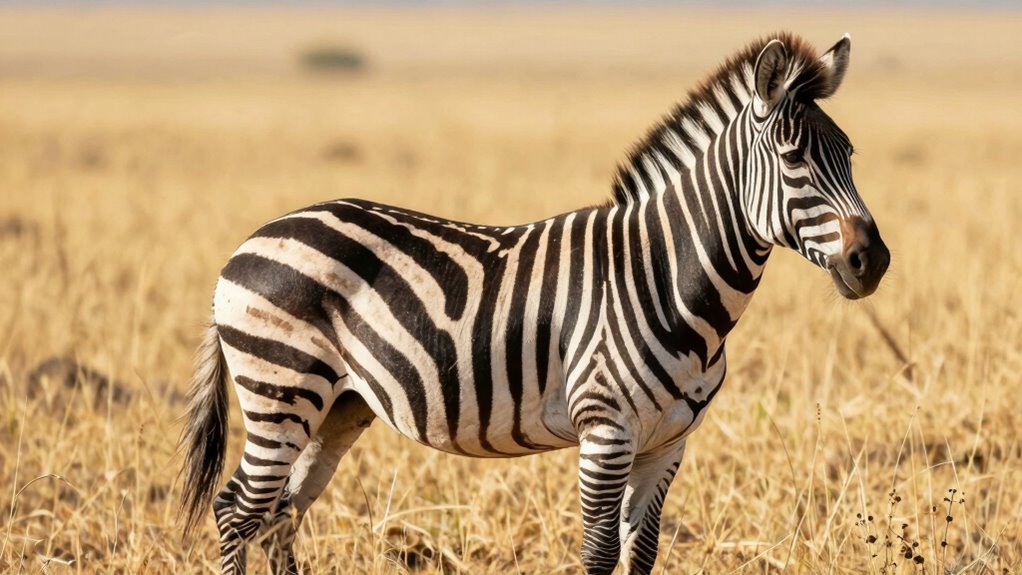

The Grevy’s zebra stands out with its very narrow stripes, an adaptation to life in dry, rocky regions of Ethiopia and northern Kenya. These stripes help it stay camouflaged in sparse vegetation and assist in heat regulation. Their distinct pattern is a result of natural selection shaped by harsh environments. This evolution has made them highly specialized and resilient. To discover how these unique traits support their survival and why conserving them matters, keep exploring.

Get pet supplies delivered free — and shop member deals
- Fast, free delivery on millions of items
- Access to Prime Big Deal Days deals on October 6–7
- Prime Video, Amazon Music and more included
Key Takeaways
- Grevy’s zebra has uniquely narrow stripes that provide camouflage in arid, rocky habitats.
- Its stripe pattern helps regulate body temperature in extreme desert heat.
- Narrow stripes distinguish Grevy’s zebra from other zebra species like plains or mountain zebras.
- The stripe pattern is an evolutionary adaptation to its semi-desert environment.
- The species’ genetic traits and physical adaptations are vital for its survival and conservation.

Have you ever wondered what makes the Grevy’s zebra stand out among its relatives? It’s not just its narrow stripes that catch your eye—it’s also how it has adapted to survive in its environment. The Grevy’s zebra is uniquely suited to its habitat, which mainly includes arid, rocky plains and semi-desert regions of Ethiopia and northern Kenya. Unlike other zebras that prefer grasslands, the Grevy’s zebra has evolved to endure harsh conditions with limited water sources. Its narrow stripes aren’t just a visual trait; they serve specific purposes in this environment. They help with camouflage, breaking up the animal’s outline against the dry, sparse vegetation, which makes it harder for predators to spot. Additionally, the stripes are thought to aid in temperature regulation, allowing heat to dissipate more effectively, an essential adaptation for thriving in extreme heat. This adaptation is a prime example of how physical traits develop to meet environmental challenges. Furthermore, research into genetic traits reveals how natural selection has shaped these distinctive features over time. The genetic traits of the Grevy’s zebra also contribute to its resilience, enabling it to survive in fragmented and challenging habitats. You’ll also find that the Grevy’s zebra’s genetic diversity plays a key role in its ability to survive in such challenging habitats. Because these animals are spread across relatively isolated regions, their populations tend to be smaller and more fragmented than those of other zebra species. This geographic separation can lead to a reduction in genetic diversity, which might sound like a disadvantage. However, the Grevy’s zebra has managed to maintain enough genetic variation to adapt to its environment over generations. This genetic resilience helps it withstand diseases, adapt to changing conditions, and survive threats like habitat loss and poaching. Conservation efforts are essential to preserving this diversity, as reducing genetic variation could make the species more vulnerable to extinction. You might notice that the narrow stripes of the Grevy’s zebra are also a sign of its evolutionary history. Over time, natural selection favored individuals with particular stripe patterns that suited their environment best. The result is a zebra that’s more specialized compared to its relatives, like the plains zebra or the mountain zebra, which have broader stripes and different habitat preferences. This specialization underscores the importance of habitat adaptation and genetic diversity in shaping the species’ characteristics. Understanding these evolutionary traits can help inform conservation strategies for the species. In addition, studying the evolutionary history of the Grevy’s zebra offers insights into how species adapt over time to specific environments. Researchers also explore how environmental pressures influence physical traits, providing a clearer picture of evolutionary processes. In the end, understanding how the Grevy’s zebra’s narrow stripes and habitat adaptation are intertwined reveals a story of resilience. It’s a species that’s finely tuned to its environment, relying on genetic diversity and unique physical traits to survive in some of the harshest parts of Africa. Protecting this species is about preserving not just its stripes but the delicate balance of its adaptations that have helped it endure through generations.
As an affiliate, we earn on qualifying purchases.
Frequently Asked Questions
How Do Grevy’s Zebras Communicate With Each Other?
You can observe Grevy’s zebras communicating through various zebra vocalizations, like snorts and brays, which convey different messages such as alarm or reassurance. They also engage in social grooming, strengthening bonds and establishing hierarchy within the herd. These interactions help them stay connected and respond quickly to threats, ensuring their survival. Your attention to these behaviors reveals how essential communication is for their social structure and well-being.
What Is the Lifespan of a Grevy’s Zebra in the Wild?
In the wild, Grevy’s zebras typically live around 20 to 25 years. Their zebra coloration, especially the narrow stripes, plays a significant role in their survival, helping them hide from predators and stay cool. The stripes’ significance isn’t just visual; it’s essential for social signaling and identification. You’ll find that their lifespan is a proof of their toughness, thriving despite threats in their natural habitat.
Are Grevy’s Zebras Endangered or Protected?
You should know that Grevy’s zebras are considered endangered, mainly due to habitat loss and poaching. Conservation efforts focus on protecting their remaining habitats and establishing reserves, which help stabilize their populations. By supporting these initiatives, you can contribute to their survival. Although their numbers are declining, ongoing protections and habitat preservation are vital to guarantee they don’t become extinct.
How Do Grevy’s Zebras Adapt to Drought Conditions?
Like a desert traveler in biblical tales, you adapt to droughts by conserving water and relying on camouflage strategies. Grevy’s zebras reduce water intake, grazing at cooler times, and browsing sparse vegetation. Their narrow stripes help them blend into the dry, grassy landscapes, offering protection from predators. These survival tactics enable you to endure harsh conditions, ensuring you remain resilient even when water is scarce.
What Predators Mainly Hunt Grevy’s Zebras?
You should know that lions and hyenas mainly hunt Grevy’s zebras. These predators prefer habitats with open plains and sparse trees, where they can spot prey easily. Grevy’s zebras, with their narrow stripes, primarily graze on grasses and sometimes browse on shrubs. Their habitat preferences keep them accessible to predators, especially during grazing, making vigilance essential for their survival in such environments.
Conclusion
You now see how the Grevy’s zebra’s narrow stripes are like a delicate fingerprint, making each one uniquely beautiful. These stripes aren’t just for show—they’re a masterclass in survival, blending seamlessly into the shadows of the wild. Just as a finely woven tapestry tells a story, each stripe reveals a chapter of this zebra’s life. So, next time you spot one, remember you’re gazing at a living work of art, perfectly designed by nature’s hand.
Fall Picks
fall essentials
As an affiliate, we earn on qualifying purchases.