The sifaka, often called Madagascar’s dancing lemur, captivates with its graceful leaps and energetic movements that resemble a dance. Its long, powerful legs help it leap great distances between trees and from the ground to shrubs, conserving energy and steering through its fragile habitat. Found in Madagascar’s dry forests, its survival depends on protecting these forest patches. If you keep exploring, you’ll discover how their unique behaviors and habitat needs highlight the importance of conservation efforts.

Get pet supplies delivered free with Prime
- Fast, free delivery on millions of items
- Prime Video, Amazon Music and more included
- Member-only deals all year
Key Takeaways
- Sifakas are known for their graceful, dance-like leaps across trees and ground, enabled by their long, powerful legs.
- They inhabit fragile dry forests and spiny thickets in Madagascar, making habitat conservation crucial for their survival.
- Their unique movement adaptations help them escape predators and efficiently find food in their environment.
- Protecting their habitats supports not only sifakas but also Madagascar’s broader biodiversity.
- Conservation efforts are essential to preserve their remarkable behavioral traits and ecological roles.
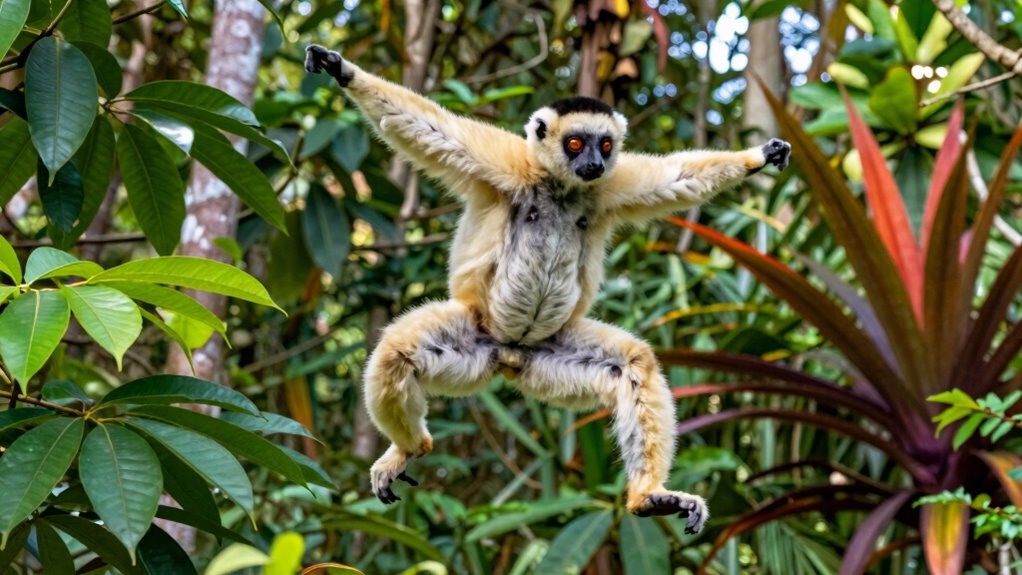
If you’ve ever seen a lemur move with surprising agility and rhythm, you’ve likely witnessed the Sifaka, Madagascar’s renowned dancing lemur. These remarkable creatures are known for their unique, graceful leaps across the forest floor, which resemble a dance. Their movements aren’t just for show—they’re a result of specialized behavioral adaptations that help them navigate their environment efficiently. As you observe a Sifaka, you’ll notice how their long, powerful legs enable them to leap great distances, conserving energy while crossing open spaces. Their ability to hop from tree to tree or ground to shrubbery showcases their mastery of movement, which is essential for escaping predators and finding food. Protecting their habitat is crucial for ensuring these remarkable adaptations can continue to support their survival. The Sifaka’s habitat is primarily the dry deciduous forests and spiny thickets of Madagascar. Because these forests are fragile and vulnerable to deforestation and habitat fragmentation, habitat conservation becomes imperative for their survival. Conservation efforts focus on protecting the remaining forest patches and establishing protected areas where these lemurs can thrive without the threat of habitat destruction. You might find yourself supporting local initiatives aimed at preserving Madagascar’s unique ecosystems, which are indispensable not only for the Sifaka but also for countless other endemic species. Maintaining healthy habitats guarantees that these lemurs continue their elegant dances and remain a key part of Madagascar’s biodiversity. Additionally, understanding their behavioral adaptations helps highlight the importance of preserving their environment for the continuation of these fascinating traits. Recognizing the threats to their survival underscores the urgent need for ongoing conservation efforts. Ensuring the preservation of their natural habitat is vital for safeguarding their future and maintaining the ecological balance of Madagascar. Protecting their environment also plays a crucial role in supporting the complex web of biodiversity that sustains Madagascar’s ecosystems.
As an affiliate, we earn on qualifying purchases.
Frequently Asked Questions
What Is the Lifespan of a Sifaka in the Wild?
In the wild, you can expect a sifaka to live around 18 to 20 years. Their lifespan is influenced by their social structure, which typically involves small, cohesive groups, and their reproductive habits, including seasonal mating and single offspring births. These factors help guarantee their survival and health in their natural habitat. Understanding their social dynamics and reproductive behaviors highlights how they thrive in Madagascar’s forests.
How Do Sifakas Communicate With Each Other?
You observe that sifakas communicate through a variety of vocalization patterns, including loud calls and whistles, which help maintain social bonding. These vocalizations alert others to predators, mark territory, and strengthen group cohesion. As you watch, you’ll notice that their sounds vary depending on the situation, showcasing their complex social structure. By understanding these vocal cues, you gain insight into how sifakas coordinate and stay connected within their community.
Are Sifakas Endangered or Threatened Species?
You should know that sifakas are critically threatened species. Habitat loss and climate change continue to shrink their forest homes, pushing them closer to extinction. As their environment deteriorates, their numbers decline rapidly. Every day, their chances of survival diminish, and it’s up to us to act. Without intervention, these incredible dancers of Madagascar may soon become nothing more than a distant memory, lost forever to the destructive forces around them.
What Do Sifakas Eat Besides Leaves?
You’ll find that sifakas have a diverse diet beyond just leaves, showcasing their diet diversity. They also eat fruits, flowers, and bark, depending on what’s available in their habitat. Their food preferences change with the seasons, allowing them to adapt to different food sources. This varied diet helps them meet their nutritional needs and thrive in Madagascar’s changing environment, demonstrating their flexible and resourceful feeding habits.
How Do Sifakas Navigate Their Forest Habitats?
You observe that sifakas navigate their forest habitats by expertly moving through the canopy, jumping between trees with remarkable agility. Their sifaka social structure supports this skill, as they work together and communicate effectively. You’d notice that they use their powerful legs for leaps and their long, strong arms for grasping branches, allowing them to efficiently traverse the dense forest canopy. This movement is essential for finding food and avoiding predators.
Conclusion
You’ve learned that the sifaka is a remarkable lemur known for its unique dancing leaps across Madagascar’s forests. With their incredible agility, they can leap up to 10 feet horizontally and 3 feet vertically in a single bound — a true proof of their agility. These fascinating creatures remind you of the vibrant biodiversity on the island, emphasizing the importance of protecting their habitat. By conserving the sifaka, you’re helping preserve one of nature’s most extraordinary dancers.
Halloween Picks
halloween
As an affiliate, we earn on qualifying purchases.