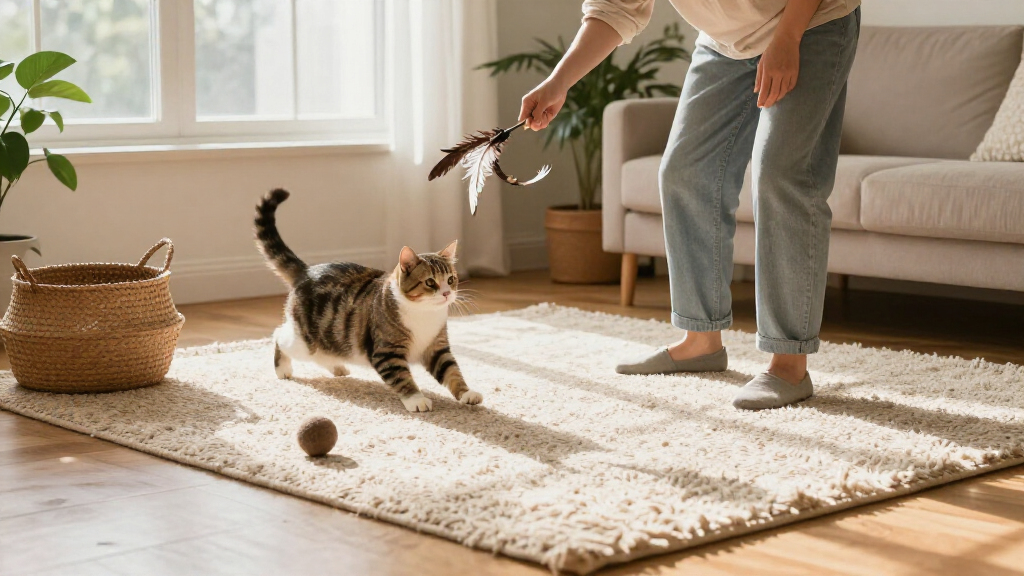

When shoppers compare interactive pet toys, the real choice is often between a toy that runs on its own and one they can control through a phone. Automatic interactive pet toys use preset movements, timers, or sensors to prompt play with little setup. App-controlled interactive pet toys add remote controls and, depending on the model, adjustable play patterns or connected features. Automatic designs generally cost less and are easier to hand over for routine play; app-controlled designs suit owners who want more control while away or want to vary the activity. Neither category replaces supervision, exercise, or interaction with a person. The better fit depends on how your pet plays, how much setup you’ll tolerate, and whether remote control adds useful value to your day.

Get pet supplies delivered free with Prime
- Fast, free delivery on millions of items
- Prime Video, Amazon Music and more included
- Member-only deals all year

Interactive Squirrel Dog Toy – Self-Moving, Rolling & Bouncing with Sound, USB Rechargeable, 6" x 6", Indestructible
- ✔ Pet type: Dog
- ✔ Toy type: Ball
- ✔ Action: Self-moving, rolling, and bouncing

BABORUI Interactive Cat Toy Ball – Automatic Indoor Cat Toy with 3 Tails, 2 Speeds (Blue)
- ✔ Pet type: Cat
- ✔ Toy type: Interactive ball
- ✔ Modes: Normal and intelligent
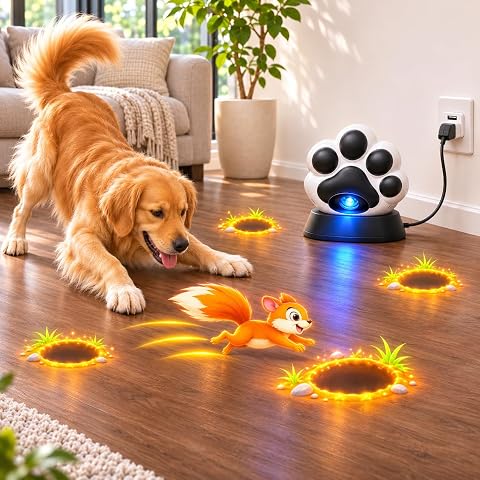
Interactive Pet Projector Toy for Dogs and Cats – USB Powered Floor Light
- ✔ Pet type: Cats and dogs
- ✔ Toy type: Projector / floor light
- ✔ Patterns: Multiple selectable animal silhouettes and floor targets
At a Glance
| Criteria | Automatic interactive pet toys | App-controlled interactive pet toys | Winner |
|---|---|---|---|
| Setup and ease of use | Usually simple: charge or add batteries, switch on, and select a preset mode. | Requires a compatible phone and often app setup, pairing, and network access for remote features. | A |
| Control and customization | Limited to built-in modes, timers, or sensor-triggered responses. | May allow remote starts, speed or pattern changes, and other model-specific controls. | B |
| Independent play | Designed to start play without an owner operating a phone. | Can be triggered remotely, but still depends on the toy’s design and the pet’s interest. | Depends |
| Reliability and upkeep | Fewer connected parts; batteries, moving components, and cleaning still require attention. | Adds app and connection dependencies alongside the toy’s physical maintenance. | A |
| Price and value | Typically the lower-cost route to movement or stimulation. | Often costs more; worth it when remote control or customization gets regular use. | A for most; B for regular remote use |
| Fit for different pets | Best for pets who respond well to predictable movement and owners who prefer simple controls. | Best for owners who want to adjust play remotely and pets who stay engaged with the toy’s available movement. | Depends |
Interactive Squirrel Dog Toy – Self-Moving, Rolling & Bouncing with Sound, USB Rechargeable, 6" x 6", Indestructible
For dogs that follow moving objects, this squirrel-shaped toy offers the most varied action in the lineup. It can roll, bounce, and make sounds, giving a pet more than one cue to chase or investigate. Compared with the projector, it creates physical movement on the floor; compared with the BABORUI ball, it is explicitly designed for dogs and adds bouncing and sound effects to its movement.The USB-rechargeable design avoids disposable batteries, though the supplied details do not state runtime or charging time. The toy is for indoor use and is not water resistant, so damp floors or outdoor play are poor fits. There is also a notable listing inconsistency: the title describes a 6-by-6-inch toy, while a dimensions field says 1 by 1 by 1 inch. The ABS body is described as indestructible, but we would not treat that wording as proof it will withstand every dog’s chewing. Active supervision is sensible, especially for powerful chewers.This is our first-ranked pick because it combines several kinds of stimulation for its intended species. It makes more sense for a dog that enjoys chasing a moving toy than for an animal that prefers gentle visual play or needs a toy for unsupervised use.
Pros:
- Rolling and bouncing offer more movement variety than the projector.
- Sound effects add an extra cue alongside motion.
- USB rechargeable; no disposable batteries are needed.
- Dog-oriented design and indoor use are clearly stated.
Cons:
- Not water resistant, limiting play to dry indoor spaces.
- The listing gives conflicting dimensions, complicating size assessment.
- The indestructible claim is not accompanied by supporting durability details.
Best for: Dogs that enjoy chasing moving toys indoors and respond to sound and bouncing action.
Not ideal for: Very large or powerful chewers, pets that play outdoors or in wet areas, and owners seeking a clearly documented toy size or unsupervised chewing toy.
Bottom line: Choose this for a dog drawn to moving, noisy toys, provided the unclear sizing and indoor-only limitation work for your situation.
“Choose this for a dog drawn to moving, noisy toys, provided the unclear sizing and indoor-only limitation work for your situation.”
BABORUI Interactive Cat Toy Ball – Automatic Indoor Cat Toy with 3 Tails, 2 Speeds (Blue)
The BABORUI is the most clearly cat-oriented option here. Its ball rolls across the floor, makes a chittering sound, and carries three bell-tipped tails that add movement and noise. Two speeds and normal or intelligent modes give us more ways to match the play to a cat’s energy than the projector offers, while the squirrel’s sound-and-bounce approach is aimed at dogs.Its intelligent mode pauses after five minutes and resumes when touched. That can make play more intermittent and may suit cats who engage in short bursts, but it also interrupts a longer session. The toy is intended for indoor use and is not water resistant. Its listed dimensions—5 inches long by 0.5 inches wide by 0.5 inches high—may be worth checking against the actual item details, since that profile is unusual for a ball. The description calls the silicone construction chew-proof and durable; we would still supervise play, particularly if a cat tends to bite or pull at attachments.We rank it second because its controls and multi-part cues offer a strong fit for cats, but the short automatic pause makes its play less continuous than the squirrel’s described movement. It is the better match for a cat that responds to chasing and bells; the projector is the alternative for visual interest without a rolling toy.
Pros:
- Two speeds and two modes allow some flexibility in play.
- Rolling motion, chittering, and three bell-tipped tails provide varied cues.
- Automatic pause and touch-activated restart support short interactive bursts.
- Silicone is the listed material.
Cons:
- Automatic shut-off after five minutes can interrupt an extended session.
- Not water resistant and intended for indoor use.
- The listed 5 x 0.5 x 0.5-inch dimensions are unusual for a ball.
Best for: Indoor cats who enjoy chasing rolling objects and may respond to chittering sounds or bell-tipped tails.
Not ideal for: Cats that need long uninterrupted play sessions, pets that play in wet areas, or buyers who want a clearly documented full-size ball dimension.
Bottom line: Pick the BABORUI for a cat who likes short, varied chase sessions and can be engaged by sound as well as motion.
“Pick the BABORUI for a cat who likes short, varied chase sessions and can be engaged by sound as well as motion.”
Interactive Pet Projector Toy for Dogs and Cats – USB Powered Floor Light
This paw-shaped projector takes a different route from the two moving balls: it casts colorful animal silhouettes and floor targets instead of rolling across the room. Multiple patterns give us a way to change the visual cue during supervised indoor play, which may appeal to cats or dogs that notice shifting shapes. Compared with the BABORUI, it offers light patterns rather than tails, bells, and a chittering sound; compared with the squirrel, it does not describe self-propelled physical movement.The compact 4-by-4-by-4-inch body and USB power are straightforward, but the cord introduces a supervision concern if a pet chews or paws at it. The projector also needs an appropriate USB outlet and is limited to indoor use. Its description says the patterns capture attention, but individual pets may react differently to projected light, so we should treat engagement as pet-dependent and keep play supervised. The supplied information does not specify a timer, brightness settings, or whether the projector moves automatically.We place it third because it is the most specialized option: useful when visual novelty is the goal, but less suited to buyers who want a toy that physically moves by itself. It can complement a pet’s routine, while the squirrel and BABORUI provide more explicit rolling action.
Pros:
- Multiple projection patterns add visual variety.
- USB powered, so disposable batteries are not required.
- Small paw-shaped body measures 4 inches on each side.
- Intended for both cats and dogs.
Cons:
- Cord requires supervision around pets that chew.
- Indoor use and access to a USB outlet are required.
- Does not provide the rolling or bouncing action of the two ball toys.
Best for: Pet owners seeking a compact, USB-powered visual activity for supervised indoor play with a cat or dog.
Not ideal for: Pets that mainly engage by chasing moving objects, households without a convenient USB connection, or owners who need a cord-free toy.
Bottom line: Choose the projector when changing visual patterns are the main appeal and you can supervise play near its USB cord.
“Choose the projector when changing visual patterns are the main appeal and you can supervise play near its USB cord.”
As an Amazon Associate we earn from qualifying purchases.
Key Differences
The strongest difference is who starts and shapes the play. An automatic toy follows its built-in routine, which is convenient when you want a simple option that can prompt activity without a phone. An app-controlled model gives you more say over when play starts and, on some products, how it moves. That control matters most when you are away from home or your pet loses interest in a fixed pattern. It adds little value if you are usually nearby and the toy’s preset behavior already holds your pet’s attention.
That extra flexibility comes with a higher price and more setup. App features vary widely, so remote control should not be assumed to mean live video, reliable operation from anywhere, or sophisticated play. Check the specific model’s connection requirements, available controls, charging routine, and replacement-part costs. Automatic toys are simpler to operate, but they still have moving parts that can wear, need cleaning, or be unsuitable for unsupervised use with a particular pet.
For most buyers, the sensible starting point is an automatic toy matched to the pet’s play style. Pay more for app control when you can name a recurring use for it, such as starting a short play session while you are out or changing a pattern your pet has outgrown. If your pet ignores moving toys, chews or swallows small parts, or needs interactive attention, neither category is a substitute for a safer, more suitable activity or time with you.
Detailed Comparison
Setup and ease of use (Automatic interactive pet toys wins — moderate)
Automatic toys usually take fewer steps: charge or insert batteries, choose a mode, and start. App-controlled toys add pairing and phone setup, and may depend on a network for remote features. The gap is moderate for owners who like straightforward controls, minor for people comfortable managing connected devices. Choose automatic if you want a toy that is easy for other household members to operate too.
Control and customization (App-controlled interactive pet toys wins — moderate)
App-controlled models win when they provide useful remote starts or adjustable movement; automatic toys are limited to their installed routines. The advantage is major only if you will use those controls regularly. Since app capabilities vary, compare the actual controls instead of paying for the label alone. If you simply want the toy to run a preset session, automatic is enough.
Independent play (moderate difference)
Both types can prompt a pet to play without someone holding the toy, but neither guarantees sustained interest or safe solo use. Automatic models are built around self-running modes; app control gives an owner another way to initiate play but does not make the toy more engaging by itself. The winner depends on the pet’s response to the toy’s movement and on whether its materials and design suit unsupervised use. Start with supervised sessions.
Reliability and upkeep (Automatic interactive pet toys wins — minor)
Automatic toys avoid app pairing and connectivity as possible points of friction, so they have a slight practical edge for simple operation. Both still rely on physical parts, power, and cleaning; app models also need compatible software and, for remote functions, a working connection. This is a minor difference for most households. Review care instructions and replacement-part availability for the specific product.
Price and value (App-controlled interactive pet toys wins — moderate)
Automatic toys are generally less expensive and are better value for owners who want occasional, uncomplicated play. App-controlled toys cost more, and the premium makes sense when remote access or customization solves a real routine problem. This is a moderate difference: paying more can be worthwhile for frequent remote use, but is poor value when the app’s controls go unused.
Fit for different pets (moderate difference)
Neither category is universally better for cats or dogs: preferences depend on the animal’s size, energy, play style, and response to motion or sound. Automatic routines may suit pets who enjoy repeated predictable movement; app controls may help owners vary sessions for pets who respond to changing patterns. The difference is moderate, but the toy’s size, durability, noise, and safety matter more than its control method. Check age and supervision guidance.
Automatic interactive pet toys: Pros and Cons
Pros:
- Usually costs less than an app-controlled model.
- Simple controls and fewer setup steps.
- Preset play can run without phone operation.
Cons:
- Limited control over timing and play patterns.
- A fixed routine may lose a pet’s interest.
- Still requires charging or batteries, cleaning, and supervision suited to the toy.
App-controlled interactive pet toys: Pros and Cons
Pros:
- Remote starts can fit owners’ schedules.
- Some models offer more ways to vary movement or play.
- More control may help when a pet responds to changing activity.
Cons:
- Usually costs more.
- Pairing, app compatibility, and connectivity add setup and possible friction.
- App features differ by model and may go unused.
Who Should Choose What
Choose Automatic interactive pet toys if:
- You want a lower-cost toy with straightforward controls.
- Your pet enjoys predictable movement and does not need frequent changes.
- You are usually home to start play and do not need phone control.
Choose App-controlled interactive pet toys if:
- You will regularly start or adjust play while away from the toy.
- Your pet responds better when movement or timing can be varied.
- The specific app features solve a routine problem worth the added cost.
Skip both if: Your pet tends to chew or swallow toy parts, ignores moving toys, or needs direct interactive play. Look for a safer activity suited to your pet and supervise play.
Value for Money
For most households, automatic interactive pet toys offer the better value because they cover the basic job—prompting movement or curiosity—at a lower price and with less setup. App control is worth paying more for when you will use remote starts or customization often enough to change your routine. Before choosing, check which features work without a subscription or stable internet, and whether the app supports your phone. If the premium buys controls you will rarely touch, spend less on a simpler toy and choose it for the pet’s size, play style, and safety needs.
Final Verdict
Choose an automatic interactive pet toy if you want an affordable, simple way to encourage short play sessions and your pet enjoys preset movement. Choose an app-controlled model if remote starts or adjustable activity will get regular use and the specific app works with your setup. For most buyers, automatic is the better first choice; the biggest deciding factor is whether phone control solves a real, recurring problem. Skip both if your pet needs direct engagement or cannot safely use the toy unsupervised.
Frequently Asked Questions
Are app-controlled pet toys worth the extra cost?
They can be if you regularly use remote starts or adjustable play to fit your schedule. If you will operate the toy only when you are already nearby, an automatic model is usually better value.
Can either type keep a pet entertained while I am away?
Both may prompt brief independent play, but neither guarantees that a pet will stay engaged or that solo use is safe. Introduce the toy while you are present and follow its supervision guidance.
Which type is better for a cat?
There is no category-wide winner. Match the toy’s movement, sound, size, and durability to your cat’s preferences, and supervise early sessions to see how your cat interacts with it.
Do app-controlled toys need Wi-Fi?
Requirements vary by model. Some controls may work over a nearby connection, while remote operation can require internet access. Check the product specifications for connection, phone compatibility, and any subscription requirements before buying.