
Use this guide to choose an interactive toy for a dog or cat, set it up safely, and introduce it at a pace your pet can handle. It is for pet owners who are new to puzzle feeders, treat dispensers, motion toys, and similar products. Allow about 20-30 minutes to check a toy and introduce it, then plan short play sessions of 5-15 minutes. Your pet’s age, health, chewing habits, and comfort with noise or movement should guide your choice.

Get pet supplies delivered free with Prime
- Fast, free delivery on millions of items
- Prime Video, Amazon Music and more included
- Member-only deals all year

Interactive Squirrel Dog Toy – Self‑Moving, Rolling & Bouncing with Sound, USB Rechargeable, 6" x 6", Indestructible
- ✔ Pet type: Dog
- ✔ Toy type: Ball
- ✔ Play features: Self-moving, rolling, bouncing, sound effects

BABORUI Interactive Cat Toy Ball – Automatic Indoor Cat Toy with 3 Tails, 2 Speeds (Blue)
- ✔ Pet type: Cat
- ✔ Toy type: Automatic ball with three tails
- ✔ Speed settings: Two
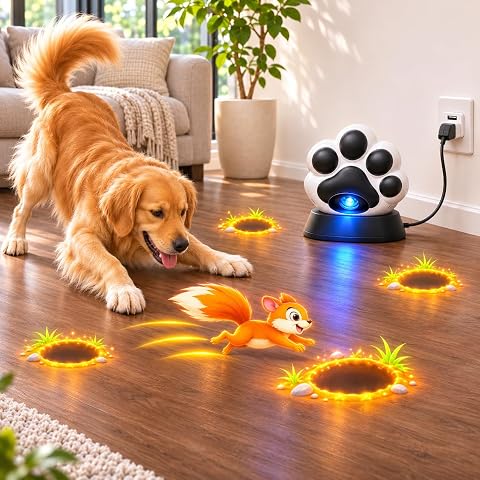
Interactive Pet Projector Toy for Dogs and Cats – USB Powered Floor Light
- ✔ Pet type: Cats and dogs
- ✔ Toy type: Projector; listed as a laser pointer
- ✔ Power: USB
Difficulty: Beginner | Time: 20-30 minutes to choose and introduce a toy; 5-15 minutes per play session
What You’ll Need
Tools & Materials:
- Your pet’s usual treats or a portion of its regular food
- A clear, supervised play area
- The toy’s packaging and care instructions
Knowledge:
- Your pet’s approximate size and chewing strength
- Any food allergies, diet limits, or mobility concerns
- The difference between supervised play toys and toys designed to be left with a pet
Check with your veterinarian before introducing a food toy if your pet has a swallowing problem, a prescribed diet, dental pain, or a condition affected by extra activity. Follow the product’s age and size guidance. Do not use a toy with loose parts, exposed wires, damaged seams, or pieces small enough for your pet to swallow.
Interactive Squirrel Dog Toy – Self‑Moving, Rolling & Bouncing with Sound, USB Rechargeable, 6" x 6", Indestructible
For dogs drawn to movement, this squirrel-shaped toy offers the lineup’s most energetic play pattern: it rolls, bounces, and makes sounds while moving on its own. That mix can give a dog more to follow than the projector’s stationary visual targets, and it is designed specifically for dogs rather than cats. USB recharging also avoids disposable batteries, a practical advantage for a toy intended for repeated indoor sessions.There are meaningful limits to that promise. The listing calls the ABS body indestructible, but no toy should be assumed suitable for every chewing style; the stated small size is a particular concern for very large dogs or determined chewers. It is also not water resistant, so play belongs indoors and away from wet floors. Compared with the BABORUI ball, this one is the more dog-oriented, bouncing option, while the cat ball has a more explicit pause-and-resume mode. We rank the squirrel first because its movement, sound, and rechargeable setup form the broadest active-play package here, provided the dog and room suit its scale.
Pros:
- Self-moving rolling and bouncing creates an active chase game.
- Sound effects add another cue beyond motion.
- USB rechargeable design avoids disposable batteries.
- ABS construction is specified for the body.
Cons:
- Small listed dimensions may not suit large dogs or strong chewers.
- Not water resistant, limiting play to dry indoor settings.
- Electronic movement and sound may not appeal to noise-sensitive dogs.
Best for: Dogs that enjoy chasing moving objects during supervised indoor play, especially in homes looking for rolling, bouncing action and rechargeable power.
Not ideal for: Very large dogs, powerful chewers whose owners need a proven chew-proof toy, or pets that play outdoors or around water.
Bottom line: We recommend it as the lineup’s most complete active-play choice for appropriately sized dogs that chase toys indoors.
“We recommend it as the lineup’s most complete active-play choice for appropriately sized dogs that chase toys indoors.”
BABORUI Interactive Cat Toy Ball – Automatic Indoor Cat Toy with 3 Tails, 2 Speeds (Blue)
The BABORUI ball makes the most sense for a cat that responds to a combination of movement, sound, and dangling details. It rolls across the floor and emits a chittering sound, while three bell-tipped tails add a visual and audible target. Two speeds and normal and intelligent modes give owners some flexibility in how play starts and continues. That makes it more configurable for cats than the projector, which relies on light patterns rather than a moving object.The automatic shutoff is both a useful boundary and a real constraint: the toy stops after five minutes and resumes when touched, so it may break up a longer play session. Its indoor-only, non-water-resistant design also rules out wet areas. The listed dimensions are unusual—one entry gives 5 inches by 0.5 inches by 0.5 inches—so we would check the actual product size before buying rather than assume it is a substantial ball. Compared with the dog squirrel, this toy is tailored to feline hunting cues and offers speed choices, but it does not provide the same stated bouncing action. We place it second because its interaction is thoughtfully varied, while the short automatic cycle makes its play less continuous.
Pros:
- Rolling motion and chittering sound cue a hunting-style chase.
- Two speed settings allow some adjustment to a cat’s pace.
- Normal and intelligent modes offer different interaction patterns.
- Three bell-tipped tails add movement and sound.
Cons:
- Automatic shutoff after five minutes can interrupt play.
- Not water resistant and intended for indoor use.
- The listed dimensions are inconsistent and merit checking before purchase.
Best for: Indoor cats that enjoy following rolling objects and react to sound or dangling, bell-tipped details.
Not ideal for: Owners who want uninterrupted long play sessions, cats that avoid sound, or anyone seeking a water-resistant toy.
Bottom line: We’d choose this cat-specific ball for varied indoor hunting cues, as long as its short play cycle and stated size fit the household.
“We’d choose this cat-specific ball for varied indoor hunting cues, as long as its short play cycle and stated size fit the household.”
Interactive Pet Projector Toy for Dogs and Cats – USB Powered Floor Light
This paw-shaped projector takes a different route to interaction: instead of rolling toward a pet, it casts colorful animal silhouettes and floor targets. Multiple patterns provide visual variety for indoor play, which may suit a dog or cat that follows moving or changing light cues. Its compact, four-inch form is also easier to place than a larger floor toy, and USB power means there is no battery replacement to manage.Its role is narrower than the moving balls. The projector depends on a suitable floor surface, an available USB outlet, and a person nearby to supervise; the cord must stay out of reach to prevent chewing. It is therefore less suited to independent play than the squirrel’s self-moving action or the BABORUI ball’s touch-resume mode. The listing describes it as a laser pointer, but the supplied details focus on floor projections and do not establish that it should be directed at an animal’s eyes. We rank it third because it offers a distinct, low-motion visual activity, yet its setup and supervision needs make it less flexible as an everyday interactive toy.
Pros:
- Multiple projection patterns offer visual variety.
- USB powered, so disposable batteries are unnecessary.
- Compact paw-shaped body is easy to place indoors.
- Can provide an activity when outdoor play is limited.
Cons:
- Requires supervision and careful cord placement.
- Limited to indoor use near a USB power source.
- Does not provide the rolling and bouncing interaction of either ball.
Best for: Owners seeking a supervised indoor visual activity for a cat or dog, with a nearby USB connection and a clear play area.
Not ideal for: Pets that need a toy to move and engage them independently, homes without a safe USB setup, or sessions where a cord cannot be kept away from chewing.
Bottom line: We’d pick the projector for short, supervised visual sessions when a pet enjoys light cues and the USB cord can be kept safely out of reach.
“We’d pick the projector for short, supervised visual sessions when a pet enjoys light cues and the USB cord can be kept safely out of reach.”
As an Amazon Associate we earn from qualifying purchases.
Before You Start
Interactive toys include food puzzles, treat balls, electronic toys, and toys that move or make noise. Choose one that fits your pet’s behavior and the way you plan to supervise play. Food rewards count toward your pet’s daily intake; use part of its normal meal when possible. Start while you can watch closely, and stop if your pet becomes distressed, plays too roughly, or tries to chew off parts.
Step-by-Step Instructions
Step 1: Match the toy to your pet
Choose a toy designed for your pet’s species and size. For a beginner, select a simple puzzle or treat dispenser with a clear way to access the reward. Pick a durable chew-resistant design for a dog that bites hard, and avoid small toys for pets that may swallow them. For cats, consider their play style: a wand or moving toy may suit a chaser, while a food puzzle may suit a cat that enjoys working for treats.
Tip: Read the label for age, weight, and supervision guidance. A toy’s appearance alone does not show whether it can withstand chewing.
Check: The toy fits your pet’s size and behavior, and its label gives clear care and supervision instructions.
Step 2: Inspect and prepare the play area
Read the setup and cleaning instructions before filling or switching on the toy. Inspect it for sharp edges, loose seams, detachable pieces, or battery compartments your pet could open. Set it on a non-slip surface in a quiet area with enough room for your pet to move. Remove nearby cords, breakable objects, and other pets if they might crowd or startle the player.
Tip: Keep electronic toys away from water unless the manufacturer states that they are water-safe. Install batteries only as directed and secure the compartment before play.
Check: The toy is intact and assembled as directed, and the play area is clear and stable.
Step 3: Choose a safe reward
Use a few pieces of your pet’s regular kibble or a treat it already tolerates. Check the ingredient list if you use a new treat, and account for it in the day’s food allowance. Use pieces that fit the toy’s openings and are appropriate for your pet to chew. Avoid sticky or soft fillings unless the toy is made for them and the care instructions allow them.
Tip: A strong-smelling familiar treat can help a hesitant pet notice the toy, but begin with a small amount.
Check: The reward fits without jamming the toy and is suitable for your pet’s diet and chewing ability.
Step 4: Show your pet how it works
Place the toy where your pet can see and smell it. For a puzzle, leave the reward partly visible or use the easiest setting. For a moving toy, switch it on briefly at a low setting if one is available, then let your pet approach at its own pace. Point to or gently move the toy to show how the reward comes out, but let your pet do the pawing, nudging, or chasing.
Tip: Do not push the toy toward a frightened pet or take its paws to demonstrate. Back off if your pet hides, freezes, growls, or repeatedly tries to escape.
Check: Your pet investigates or engages voluntarily, even if it needs time to learn the toy.
Step 5: Supervise a short first session
Stay close and watch how your pet interacts for about 5-10 minutes. Notice whether it can access the reward without excessive force, whether it chews the toy, and whether the motion or sound seems comfortable. End the session while your pet is still calm. Take the toy away if your pet bites off pieces, becomes frustrated, guards it aggressively, or shows signs of distress.
Tip: Keep dogs and cats separate during early sessions if one might steal the toy or guard food. Do not leave an unfamiliar toy with either pet unsupervised.
Check: Your pet plays without damaging the toy or showing distress, and you can safely retrieve it afterward.
Step 6: Adjust the challenge and routine
Repeat short sessions and change only one thing at a time. If your pet solves the puzzle quickly, increase the difficulty according to the instructions. If it gives up, simplify the setup, show the reward again, or try a different toy type. Offer interactive play at a predictable time, and rotate among safe toys so the same item does not lose its appeal.
Tip: Stop before your pet is overtired. For active toys, follow the maker’s limits for session length and rest periods.
Check: Your pet can make progress, remains interested, and finishes play in a calm state.
Step 7: Clean, check, and store the toy
Remove leftover food after each session. Wash the toy as its care instructions direct, then dry it fully before refilling or storing it. Inspect it for cracks, worn fabric, loose parts, and battery damage. Put it away between sessions if it is not designed for unsupervised access; discard it if damage could expose small parts or create a swallowing or injury risk.
Tip: Do not immerse an electronic toy or use a cleaning product unless the manufacturer permits it.
Check: The toy is clean, dry, and undamaged, and it is stored in a place your pet cannot reach.
Common Mistakes to Avoid
- Starting with a puzzle that is too difficult. — Use the easiest setting and make a reward visible at first. Raise the challenge only after your pet understands the basic action.
- Leaving a new toy with a pet before checking how it plays. — Supervise first sessions and follow the label’s guidance about when, if ever, the toy can be used alone.
- Adding too many treats on top of regular meals. — Use part of the daily food portion in the toy, and count any extra treats in the pet’s daily allowance.
- Keeping a toy in use after it starts to break. — Inspect it after play and remove it as soon as it develops loose pieces, exposed filling, sharp edges, or a damaged battery cover.
Troubleshooting
Problem: Your pet ignores the toy.
Solution:
Try a familiar treat, make the reward easier to reach, and present the toy in a quiet area. Check that the toy suits your pet’s play style. If your pet still avoids it, put it away and try again later with a different type; do not force interaction.
Problem: Your pet becomes frustrated or paws at the toy aggressively.
Solution:
End the session and remove the toy calmly. Next time, use a simpler setting, demonstrate how a reward is released, and keep the session shorter. If frustration continues, switch to an easier toy or ask your veterinarian whether pain or mobility limits could affect play.
Problem: Treats will not come out.
Solution:
Remove the treats and check the opening size and loading instructions. Use smaller pieces that fit freely, and make sure the toy is assembled correctly. Do not force the mechanism or pry open a compartment; contact the maker if it remains jammed.
Problem: Your pet chews or damages the toy instead of using it.
Solution:
Take the toy away and check for missing pieces. Choose a sturdier design suited to your pet’s size and chewing strength, and supervise the next session closely. Contact a veterinarian promptly if you think your pet swallowed part of the toy or is choking, vomiting, or acting unwell.
What Success Looks Like
The toy is appropriate for your pet, intact, and used in a clear space with a suitable reward. Your pet engages voluntarily, can make progress at a manageable difficulty, and finishes without distress or unsafe chewing. After play, the toy is clean, dry, and stored or left out according to its instructions.
Next Steps
Keep sessions short and observe how your pet responds over the next several uses. Adjust the difficulty gradually, rotate toys, and check each one before play. Replace toys that wear out, and ask your veterinarian for advice if play causes pain, unusual fatigue, persistent frustration, or a change in behavior.
Frequently Asked Questions
How long should my pet use an interactive toy?
Start with about 5-10 minutes while supervised. Follow the product’s limits and shorten the session if your pet becomes tired, distressed, or overly excited.
Can I leave an interactive toy out while I am away?
Only if the maker says it is suitable for unsupervised use and you have already observed your pet using it safely. Remove toys with detachable parts, food that can spoil, cords, or damage risks when you cannot supervise.
What should I put in a treat toy?
Use a small portion of familiar kibble or a treat your pet tolerates, in a size that moves through the toy freely. Check your pet’s diet restrictions and count the reward as part of its daily food.
What if my pet is afraid of a moving or noisy toy?
Turn it off and let your pet inspect it while it is still. If the toy has adjustable settings, try a quieter or slower mode from a distance. Stop using it if your pet remains frightened.