Dog food for muscle atrophy can support a dog’s nutrition, but it cannot diagnose or treat the cause of muscle loss. My best overall pick is Purina Pro Plan Sport 30/20 Chicken and Rice for its high-protein, high-fat profile and larger bag; MYOS Canine Muscle Formula stands out as a supplement option to discuss with a veterinarian, while Bully Max Pro Series 2X suits dogs that need a calorie-dense diet. The main tradeoff is choosing between a complete food, a calorie-focused formula, and a supplement without adding calories or ingredients your dog does not need. Health conditions, appetite, body condition, and activity level all affect what makes sense. Read on for how the eight options differ and what I’d weigh before changing a dog’s diet.

Get pet supplies delivered free with Prime
- Fast, free delivery on millions of items
- Prime Video, Amazon Music and more included
- Member-only deals all year
Complete the kit


Key Takeaways
- Complete food and supplements serve different purposes: the two Purina Pro Plan Sport formulas and the Bully Max dry foods are diets, while MYOS and the chew products are additions rather than meal replacements.
- Purina Pro Plan Sport Chicken and Rice is the most practical all-around diet pick: its 30/20 protein-and-fat profile and 37.5-pound format suit buyers seeking a larger supply, though the formula may not fit dogs that need calorie restriction or a different nutrient profile.
- Bully Max Pro Series 2X is the calorie-focused option: its high-calorie positioning may suit a dog needing more energy per serving, but it is not an automatic choice for a dog with low activity or a condition affected by excess calories.
- MYOS is the distinct supplement pick: it lets owners discuss a targeted add-on with a veterinarian without switching the dog’s main food, but it should not replace a complete diet or assessment of muscle loss.
- The lineup’s chews are less suitable as a sole nutrition change: Bully Max 11-in-1 and Weight Gain and Muscle Support Chews may appeal to owners seeking an easy add-on, but the dog’s full diet and the chew’s ingredients matter more than the muscle-support label.




| dog food for muscle atrophy | Protein | Flavor | Form | Life stage |
|---|---|---|---|---|
| Bully Max 11-in-1 Dog Muscle B | — | — | Soft chews | — |
| Bully Max 30/20 High-Protein C | 30% | — | — | Puppies and adults |
| Purina Pro Plan Sport 30/20 Hi | 30% | Salmon & Rice | Pellet | Adult |
| Weight Gain and Muscle Support | — | Chicken | — | — |
| Purina Pro Plan Sport 30/20 Hi | 30% | Chicken and rice | — | All life stages |
| MYOS Canine Muscle Formula Dog | — | — | Powder | — |
| Bully Max Pro Series 2X High-C | 31% | Chicken | — | — |
| Purina ONE True Instinct Lean | 32% | Beef | Dry kibble | Adult |
More Details on Our Top Picks
Bully Max 11-in-1 Dog Muscle Builder Power Chews, 75 Soft Chews
Bully Max 11-in-1 Power Chews are a supplement option for owners who want to add muscle-oriented ingredients without changing their dog’s main food. The formula includes 165 mg of BCAAs, protein, vitamins, minerals, and astaxanthin per the supplied product details; its soft-chew format may also be simpler to portion than adding another dry food. Unlike Bully Max 30/20 High-Protein Chicken Dry Dog Food, these chews are not a complete meal and do not disclose protein per chew, so I would treat them as an adjunct rather than a nutritional plan. They are listed for puppies from 12 weeks and adult dogs of all breeds, but that broad age range does not establish suitability for an individual dog with muscle loss. I would ask a veterinarian to investigate atrophy and approve supplements before use.
Pros:- Lists 165 mg of BCAAs per serving
- Combines protein with vitamins, minerals, and astaxanthin
- Soft-chew format can be easier to portion than a separate dry-food ration
- Listed for puppies 12 weeks and older and adult dogs of all breeds
Cons:- Protein amount per chew is not specified
- Supplement rather than complete and balanced food
- Product details do not provide supporting evidence for muscle-building effectiveness
Best for: Owners whose veterinarian has approved a supplemental chew and who want a product with listed BCAAs alongside their dog’s regular complete diet.
Not ideal for: Anyone seeking a complete food, a clearly quantified protein dose, or a substitute for veterinary assessment of unexplained muscle loss.
- Form:Soft chews
- Count:75 chews
- Package weight:10.6 oz (300 g)
- BCAAs:165 mg
- Astaxanthin:5 mg
- Suitable for:Dogs 12 weeks and older; all breeds
- Made in:USA
Our verdict“Choose these chews only as a veterinarian-approved add-on when you want listed BCAAs, not as a replacement for a complete diet or a workup for muscle loss.”
Bully Max 30/20 High-Protein Chicken Dry Dog Food, 15 lb
For dogs that need a nutrient-dense complete food and can safely take in more calories, Bully Max 30/20 Chicken is the most calorie-focused meal in this group: it supplies 535 calories per cup, with 30% protein and 20% fat. That density may help owners deliver more energy in a smaller volume, but it also makes portion control especially relevant when weight gain is not the goal. Compared with the 37.5 lb Purina Pro Plan Sport Chicken and Rice, this 15 lb option has a smaller bag and specified calorie count, while Purina’s supplied details emphasize active-dog muscle and joint support. Bully Max lists chicken meal and whitefish meal and meets AAFCO complete-and-balanced standards. I would not treat high calories as a remedy for atrophy; a veterinarian should guide feeding amounts and investigate its cause.
Pros:- Provides 30% protein and 20% fat
- Specified energy density of 535 calories per cup
- Chicken meal and whitefish meal provide animal-based protein sources
- Meets AAFCO standards for complete and balanced nutrition for puppies and adults
Cons:- High calorie density can promote unwanted weight gain if portions are not adjusted
- May not suit dogs with lower energy needs
- Globally sourced ingredients are used despite being made in the USA
Best for: Caregivers of puppies or adult dogs who need a complete, calorie-dense diet and have veterinary guidance on appropriate weight gain and portions.
Not ideal for: Dogs with low activity or a need to restrict calories, and owners who cannot closely measure portions while monitoring body condition.
- Life stage:Puppies and adults
- Breed size:All breeds and sizes
- Protein:30%
- Fat:20%
- Calories:535 calories per cup
- Main ingredients:Chicken meal and whitefish meal
- Package weight:15 lb
- Nutrition standard:Meets AAFCO standards for complete and balanced nutrition
- Dietary features:No corn, wheat, soy, by-products, or artificial additives
Our verdict“Pick Bully Max 30/20 when a veterinarian supports calorie-dense complete food and you can carefully manage portions; skip it if extra calories are not appropriate.”
Purina Pro Plan Sport 30/20 High Protein Dry Dog Food, Salmon & Rice, 6 lb
Purina Pro Plan Sport Salmon & Rice pairs a 30% protein, 20% fat profile with salmon as its first ingredient, plus amino acids described as supporting muscle nourishment after exercise. Its distinctive advantage here is the 6 lb bag: it offers a smaller commitment than the 15 lb Bully Max 30/20 bag, useful for owners checking whether a sport-oriented formula fits their adult dog. It also lists EPA, glucosamine, and live probiotics, adding joint, digestive, and immune-support ingredients beyond the weight-gain focus of Bully Max 30/20 Chicken. The limitation is the same sport-food caveat: this is formulated for active adult dogs, not specifically for diagnosed muscle atrophy, and its 20% fat may not match a less active dog’s energy needs. I’d choose it for an active adult only with an appropriate feeding plan.
Pros:- Salmon is the first ingredient
- Provides 30% protein and 20% fat for an active-dog feeding profile
- Includes amino acids, EPA, and glucosamine
- Live probiotics are listed, and the 6 lb bag allows a smaller initial commitment
Cons:- Formulated for active adult dogs and may provide more energy than less-active dogs need
- The supplied product details do not list calories per cup
- A sport formula is not a treatment for the underlying cause of muscle atrophy
Best for: Owners of active adult dogs who want a smaller bag of a salmon-first, sport-oriented food with listed joint and digestive support ingredients.
Not ideal for: Puppies, less-active dogs needing calorie control, or owners seeking a food formulated specifically to diagnose or treat muscle atrophy.
- Brand:Purina Pro Plan
- Flavor:Salmon & Rice
- Weight:6 lb
- Form:Pellet
- Life stage:Adult
- Protein:30%
- Fat:20%
- First ingredient:Salmon
- Breed recommendation:All breed sizes
Our verdict“Choose the salmon formula if your adult dog is active and you want a smaller bag to try; select a less energy-dense option if activity or calorie needs are lower.”
Weight Gain and Muscle Support Chews for Dogs, Chicken, 150 Count
These chicken-flavored support chews combine protein and amino acids with salmon oil, turmeric, ashwagandha, astaxanthin, vitamin C, and glucosamine HCL. That wider ingredient mix separates them from Bully Max 11-in-1 Power Chews, whose supplied details give a specific BCAA amount; this product instead names a broader set of ingredients but does not provide their quantities or a dosage schedule. The 150-count package may suit owners who have veterinary approval and prefer a chew format, but count alone does not reveal how long the package lasts. The product is described as supporting healthy weight gain and muscle, yet those claims do not establish that it can reverse atrophy or replace complete food. I’d ask a veterinarian to check the cause of muscle loss and review the ingredient list, especially before use alongside other supplements.
Pros:- Lists protein and amino acids alongside salmon oil
- Includes glucosamine HCL, vitamin C, turmeric, ashwagandha, and astaxanthin
- Chicken flavor and chew format may fit owners seeking a supplement rather than another dry food
- Described for puppies and adult dogs of all breeds
Cons:- The supplied details do not give ingredient amounts or a dosage schedule
- Claims about weight gain and muscle support are not accompanied by supporting evidence
- Supplement cannot replace a complete diet or veterinary evaluation of atrophy
Best for: Dog owners whose veterinarian has reviewed the ingredients and approved a multi-ingredient chew alongside a complete diet.
Not ideal for: Buyers who need transparent ingredient quantities, clear dosage instructions, or a complete food rather than a supplement.
- Flavor:Chicken
- Count:150 chews
- Item weight:0.37 kg
- Intended use:Muscle support and healthy weight gain
- Suitable for:Puppies and adult dogs of all breeds
- Notable ingredients:Protein, amino acids, salmon oil, turmeric, ashwagandha, astaxanthin, vitamin C, glucosamine HCL
Our verdict“Consider this broad-ingredient chew only after veterinary review; choose Bully Max 11-in-1 instead if a stated BCAA amount matters more to you.”
Purina Pro Plan Sport 30/20 High Protein Dry Dog Food, Chicken and Rice, 37.5 lb
For households already feeding an active dog a sport formula, Purina Pro Plan Sport Chicken and Rice offers a large 37.5 lb bag with 30% protein and 20% fat. Chicken is the first ingredient, and the product details cite amino acids for muscle nourishment after exercise alongside EPA, glucosamine, and antioxidants. Compared with the 6 lb Purina Pro Plan Sport Salmon & Rice, this is the bulk option and is listed for all life stages rather than adults only; the tradeoff is a much larger bag, which is less convenient if you’re testing tolerance or have limited storage. The active-dog positioning matters for muscle-atrophy decisions: higher protein and fat do not identify or treat the cause of muscle loss, and the energy profile may not suit a dog with lower needs. I’d use it only within a veterinarian-guided feeding plan.
Pros:- Chicken is the first ingredient
- Provides 30% protein and 20% fat
- Lists amino acids, EPA, and glucosamine for muscle and joint support
- Large bag suits households with steady, higher-volume feeding needs
Cons:- Large bag is inconvenient for testing tolerance or limited storage
- Active-dog formulation may provide too much energy for less-active dogs
- Supplied details do not include calories per cup
Best for: Multi-dog or high-consumption households with active dogs that already do well on a chicken-based sport food and have space for a large bag.
Not ideal for: Owners trialing a new food in small amounts, homes with limited storage, or dogs whose activity and calorie needs are low.
- Flavor:Chicken and rice
- Food form:Dry
- Bag size:37.5 lb
- Protein:30%
- Fat:20%
- Life stage:All life stages
- Breed size:All breed sizes
- Special use:Muscle care
- First ingredient:Chicken
Our verdict“Choose this bulk bag for an active dog already suited to the formula; opt for the 6 lb salmon version if you want a smaller trial or your dog prefers fish.”
MYOS Canine Muscle Formula Dog Supplement, 360 g
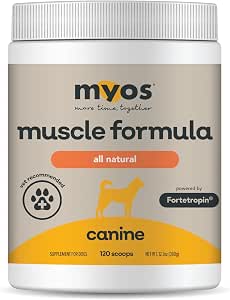
MYOS Canine Muscle Formula is the supplement pick for owners who want to add a muscle-focused powder to a dog’s existing meals rather than replace its food. Its Fortetropin formula is described as supporting muscle maintenance, strength, and mobility, including for senior dogs and dogs recovering from injury or surgery. Because it mixes with wet or dry food, it can fit into a feeding routine more easily than changing diets. Compared with Bully Max Pro Series 2X High-Calorie Chicken Dry Dog Food, MYOS is not a calorie-dense food aimed at weight gain; it is a targeted add-on. The tradeoff is that it does not provide a complete diet or substantial calories on its own, and its muscle and mobility focus does not establish it as treatment for muscle atrophy. It contains eggs, so dogs with that allergy should skip it.
Pros:- Fortetropin-focused formula is designed to support muscle maintenance and strength.
- Can be mixed into wet or dry food without switching the dog’s main diet.
- Designed for dogs of all ages, including seniors and dogs recovering from injury or surgery.
- Description states it contains no fillers or artificial additives.
Cons:- A supplement rather than a complete food, so it does not supply a full diet or meaningful meal calories.
- Contains eggs, which rules it out for dogs with an egg allergy.
- Its stated focus is muscle and mobility support, not treatment of the underlying cause of atrophy.
Best for: Owners of senior dogs or dogs recovering from injury who want a muscle-support powder to mix into the dog’s current wet or dry food.
Not ideal for: Buyers seeking a complete food for weight gain, or dogs with an egg allergy; this supplement is not a substitute for veterinary assessment of muscle loss.
- Form:Powder
- Weight:360 g (12.7 oz)
- Active ingredient:Fortetropin
- Target species:Dog
- Suitable for:All breeds, sizes, and life stages
- Allergen information:Eggs
- Model number:MCMF
Our verdict“Choose MYOS if you want a mix-in muscle-support supplement for an existing diet, not a calorie-dense food or a replacement for veterinary care.”
Bully Max Pro Series 2X High-Calorie Chicken Dry Dog Food, 4 lb
For a dog that needs more calories in a smaller serving, Bully Max Pro Series 2X has a clear point of difference: it lists 600 calories per cup, alongside 31% protein and 25% fat. That makes it more directly suited to supporting weight gain than Purina ONE True Instinct Lean Muscle Dry Dog Food, which emphasizes lean muscle and lists 32% protein but no calorie figure in the provided details. The formula is intended for puppies and adult dogs of all breeds and includes flaxseed plus 19 vitamins and minerals. High energy density calls for careful portioning, particularly if the dog is less active or has other health needs. The 4 lb bag is also a smaller supply than Purina ONE’s 15 lb bag. This food may support nutritional intake, but it is not a treatment for muscle atrophy; a veterinarian should help guide feeding when muscle loss is present.
Pros:- Provides 600 calories per cup, useful when calorie intake is a feeding priority.
- Lists 31% protein and 25% fat to support weight gain and muscle development.
- Formulated for puppies and adult dogs across all breeds.
- Free from corn, wheat, soy, artificial colors, and preservatives according to the product details.
Cons:- High calorie density makes portion control important, especially for dogs with lower energy needs.
- The 4 lb bag provides less supply than the 15 lb Purina ONE True Instinct option.
- A complete food choice does not diagnose or treat the cause of muscle atrophy.
Best for: Caregivers of puppies or adult dogs who need a calorie-dense dry food to support weight gain and want a smaller bag for feeding trials or limited storage.
Not ideal for: Owners who need a lower-calorie option, a larger bag, or a diet selected to address a diagnosed medical cause of muscle loss without veterinary guidance.
- Product type:Dry dog food
- Flavor:Chicken
- Bag weight:4 lb
- Calories:600 calories per cup
- Protein:31%
- Fat:25%
- Age range:Puppies and adult dogs
- Notable ingredients:Flaxseed, 19 vitamins and minerals
Our verdict“Pick Bully Max Pro Series 2X when calorie density and weight support matter more than a larger bag or a lean-muscle-focused formula.”
Purina ONE True Instinct Lean Muscle Dry Dog Food, Beef, 15 lb
Purina ONE True Instinct Lean Muscle is the straightforward adult-food choice here: beef is the first ingredient, and the formula lists 32% protein to support lean muscle. Its 15 lb bag suits owners looking for a regular kibble rather than a powder supplement like MYOS Canine Muscle Formula or a particularly calorie-dense recipe like Bully Max Pro Series 2X. Added vitamins, minerals, and nutrients make it a broader everyday feeding option, while the absence of poultry by-product meal, artificial flavors, and artificial preservatives may appeal to buyers avoiding those ingredients. The stated life stage is adult, so it is not the right pick for puppies. The supplied details do not list calories or fat, which makes it harder to compare for weight gain; protein content alone does not show whether a dog will regain muscle or address why atrophy is occurring.
Pros:- Real beef is listed as the first ingredient.
- Contains 32% protein to support lean muscle.
- Includes added vitamins, minerals, and nutrients for everyday feeding.
- No poultry by-product meal, artificial flavors, or artificial preservatives, according to the product details.
Cons:- Designed for adult dogs and may not suit puppies.
- The supplied specifications do not state calorie or fat content, limiting comparison for weight-gain needs.
- A high-protein kibble does not treat the underlying cause of muscle atrophy.
Best for: Owners of adult dogs who want a regular beef-based kibble with a stated high protein level for lean-muscle support.
Not ideal for: Puppy owners or caregivers specifically seeking a high-calorie weight-gain formula, since this is adult food and the provided details do not list calories or fat.
- Brand:Purina ONE
- Flavor:Beef
- Life stage:Adult
- Form:Dry kibble
- Weight:15 lb
- Protein:32%
- Target species:Dog
- Breed recommendation:All breed sizes
Our verdict“Choose Purina ONE for an adult dog needing everyday beef-based kibble with stated lean-muscle support, rather than puppy food or a calorie-dense weight-gain formula.”

How We Picked
I ranked these products by how directly they can fit into a nutrition plan for a dog losing muscle, while distinguishing complete foods from supplements and chews. I weighed protein and calorie positioning, whether an item is intended as a full diet or an add-on, the practical format and package size, and how clearly each option addresses a different buyer need. I also gave weight to the risk of choosing a calorie-dense product when the dog’s energy needs or medical status are unknown.
The ranking favors complete foods that can serve as a dog’s main diet, followed by a calorie-focused food and supplements that may be discussed with a veterinarian. Purina Pro Plan Sport Chicken and Rice ranks ahead of its salmon counterpart for its larger format and similar stated 30/20 positioning; neither is automatically right for every dog. Bully Max 2X ranks for a narrower calorie-increase need, while supplements and chews rank lower because they do not replace a complete diet or explain why muscle loss is happening. No food or supplement in this roundup should be treated as a cure for atrophy.
| dog food for muscle atrophy | Form | Life stage | Flavor |
|---|---|---|---|
| Bully Max 11-in-1 Dog Muscle B | Soft chews | — | — |
| Bully Max 30/20 High-Protein C | — | Puppies and adults | — |
| Purina Pro Plan Sport 30/20 Hi | Pellet | Adult | Salmon & Rice |
| Weight Gain and Muscle Support | — | — | Chicken |
| Purina Pro Plan Sport 30/20 Hi | — | All life stages | Chicken and rice |
| MYOS Canine Muscle Formula Dog | Powder | — | — |
| Bully Max Pro Series 2X High-C | — | — | Chicken |
| Purina ONE True Instinct Lean | Dry kibble | Adult | Beef |
Factors to Consider When Choosing Dog Food For Muscle Atrophy
Choosing food for muscle loss starts with the dog, not the package claim. I’d use these factors to decide whether a diet change is appropriate, what kind of product fits, and where veterinary guidance should come first.
Find the Cause Before Changing Calories
Muscle loss can accompany aging, reduced activity, pain, nerve or joint problems, and a range of illnesses. A sudden change, weakness, trouble standing, appetite loss, or visible loss on one side deserves prompt veterinary attention rather than an immediate switch to a richer food. Ask whether the dog needs diagnostic work, pain management, rehabilitation, or a nutrition adjustment. Adding calories may increase body fat without rebuilding muscle if the underlying cause remains untreated. A food choice is most useful when it supports a plan based on the dog’s health and activity.
Compare Protein and Calories Together
Protein percentage alone does not tell me whether a food suits a particular dog; calorie density and daily serving size affect how much protein the dog actually eats. A high-protein, high-fat formula such as a 30/20 diet may suit some active dogs, but it can oversupply energy for a dog that is sedentary or prone to weight gain. Conversely, a dog eating too little may need help meeting total energy needs before a protein percentage becomes meaningful. Ask your veterinarian to calculate a suitable daily intake from the dog’s current weight, body condition, and health. Avoid increasing portions by guesswork, since weight gain can add strain without restoring strength.
Choose a Complete Diet or an Add-On Deliberately
A complete-and-balanced food is designed to provide the dog’s daily nutrition; a supplement or chew is not a substitute for that foundation. Add-ons can make sense when a veterinarian identifies a specific role for them, but stacking several products can add calories or overlapping ingredients without a clear benefit. Check feeding directions and the full ingredient list, especially if the dog already takes medication or has a sensitive stomach. If the dog’s current food is working, ask whether an add-on is preferable to changing the entire diet. This distinction matters more than whether a product is marketed for muscle support.
Match the Format to Appetite and Routine
Dry food may be convenient for measuring meals and maintaining a consistent feeding schedule, while chews or powdered supplements may be easier to offer to some dogs. The easiest format is the one the dog will reliably eat and the owner can dose consistently. A large bag can suit a household committed to a formula, but a smaller package may reduce waste when testing acceptance or checking tolerance. Change diets gradually unless a veterinarian gives different instructions, and watch for digestive changes during the switch. Convenience should not outweigh the need to measure portions accurately.
Set Expectations for Rebuilding Muscle
Nutrition can support tissue maintenance, but food alone may not restore muscle when a dog has pain, nerve impairment, or limited movement. Ask the veterinarian whether controlled activity or rehabilitation is appropriate; unsupervised exercise may worsen some conditions. Track body weight, appetite, mobility, and muscle condition over time rather than judging progress from the scale alone. If the dog gains fat while strength continues to decline, the plan needs review. A realistic goal is a monitored care plan, not a fast result promised by a product label.
Frequently Asked Questions
Can dog food reverse muscle atrophy?
Food can provide protein and energy that support a dog’s overall nutrition, but it cannot reliably reverse muscle loss on its own. Atrophy may stem from an illness, pain, reduced mobility, or a neurological problem that needs diagnosis and treatment. A veterinarian can help decide whether the dog needs a different diet, adjusted portions, rehabilitation, or further testing. Avoid treating a high-protein label as proof that the product will rebuild muscle. The safest plan addresses both the cause and the dog’s nutritional needs.
Should I choose a high-calorie food or add a muscle supplement?
That depends on whether the dog needs more total energy, a change to the main diet, or a specific add-on recommended by a veterinarian. A calorie-dense food can be a poor match for a dog whose weight should stay stable, while a supplement will not correct inadequate overall feeding. Review the dog’s body condition, current food intake, activity, and medical history before deciding. Ask the veterinarian to compare the daily calories and ingredients in the current plan with the proposed change. Avoid starting multiple products at once, since that makes tolerance and results harder to track.
Is a 30/20 food appropriate for a dog with muscle loss?
A 30/20 label indicates a high-protein, high-fat positioning, not a universal prescription for muscle atrophy. It may suit some dogs with greater energy needs, but could provide excess calories to a less active dog or one with weight concerns. The dog’s daily portion, total calorie requirement, age, and health conditions all affect whether that formula fits. Ask your veterinarian to review the nutrient profile and feeding amount rather than choosing by the ratio alone. If the dog’s appetite or condition changes after a switch, seek guidance instead of simply increasing the serving.
Can I give a muscle-support chew along with a complete dog food?
Some dogs may be able to take a chew alongside a complete diet, but compatibility depends on its ingredients, calories, dosage, and the dog’s health or medications. Check whether the chew duplicates nutrients or adds meaningful calories to the daily total. Confirm with a veterinarian before using it for a dog with a diagnosed condition, ongoing treatment, or a restricted diet. Introduce only one new product at a time so you can spot digestive upset or other changes. A chew should remain an add-on, not replace balanced meals or a medical evaluation.
How can I tell whether a diet change is helping?
Agree on a baseline with your veterinarian, including body weight, appetite, mobility, and the appearance of the affected muscles. Follow the feeding amount consistently and record changes rather than relying on memory or day-to-day impressions. Improvement should be judged by more than weight gain, since extra fat can raise the scale without restoring muscle. Contact the clinic if weakness worsens, new symptoms appear, or the dog stops eating. The veterinarian can set a review schedule and adjust the plan if progress is limited.
Conclusion
For the best overall diet fit in this lineup, I’d start with Purina Pro Plan Sport 30/20 Chicken and Rice when a veterinarian agrees that its protein-and-fat profile suits the dog; its larger package is practical for ongoing feeding. For value in a larger-format food option, that same 37.5-pound bag is the most straightforward pick, while owners who want a smaller salmon-formula format can compare the 6-pound Purina Pro Plan Sport Salmon and Rice. For a premium calorie-focused choice, Bully Max Pro Series 2X is the more specialized option, best reserved for a dog that actually needs more energy. For beginners, start with the dog’s current complete food and a veterinary check before adding chews or supplements; if a supplement is recommended, MYOS is the clearest distinct option here to discuss. For owners seeking a simple add-on, compare Bully Max 11-in-1 and Weight Gain and Muscle Support Chews by ingredients and serving guidance, but do not treat either as a meal replacement. Muscle atrophy has many possible causes, so I’d make the final choice as part of a veterinary plan rather than relying on a product claim.
Fall Picks
fall essentials
As an affiliate, we earn on qualifying purchases.