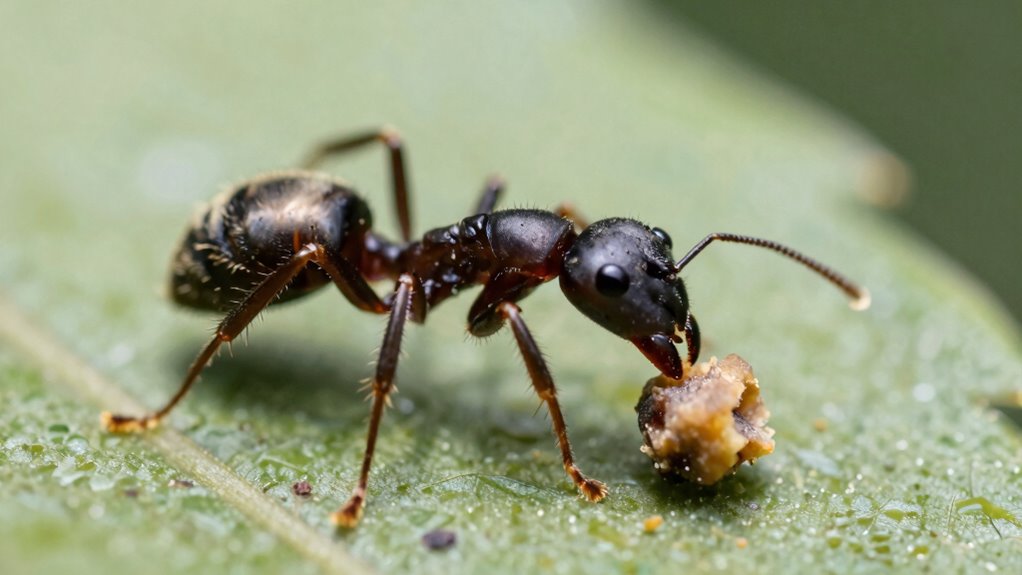

Yes, ants can carry up to 50 times their own body weight, demonstrating incredible strength relative to their size. This strength helps them transport heavy objects like crumbs, soil, or leaves, which is essential for building and maintaining their nests. Their power is supported by teamwork and efficient cooperation, making them strong and adaptable in various environments. If you want to learn more about how ants achieve this impressive feat, keep exploring their fascinating behaviors.
Key Takeaways
- Ants can carry loads up to 50 times their body weight, showcasing remarkable physical strength relative to size.
- Their strength is essential for transporting heavy objects like soil, leaves, and food.
- Cooperative teamwork enhances their ability to move large loads efficiently.
- Physical strength combined with chemical communication ensures effective resource and nest management.
- Their strength and adaptability support survival across diverse environments and nesting conditions.
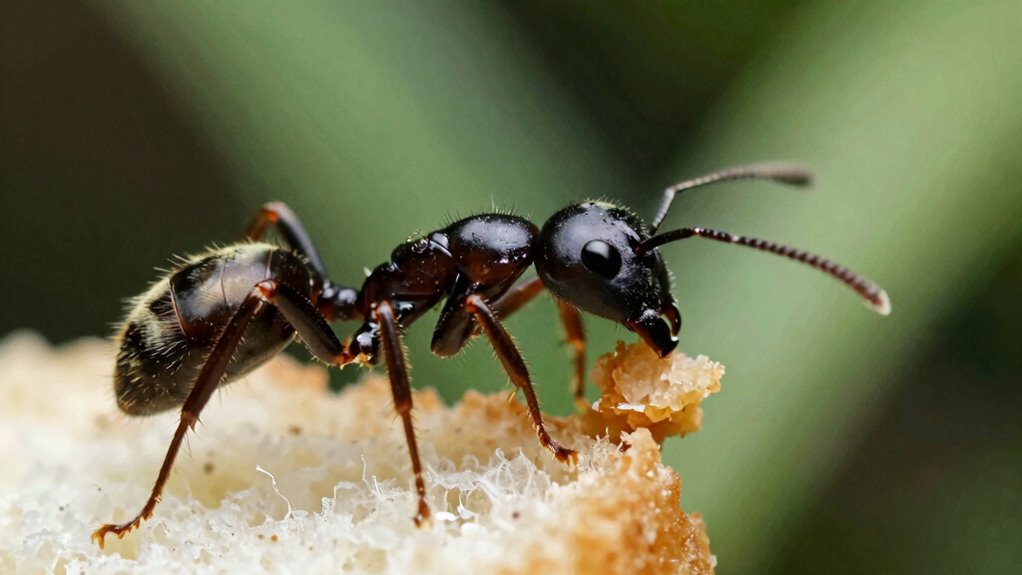
Ants are remarkable creatures capable of carrying loads up to 50 times their own body weight, demonstrating incredible strength relative to their size. This astonishing feat isn’t just about raw power; it’s deeply connected to how they communicate within their colonies and their nesting habits. When you observe an ant hauling a crumb much larger than itself, you’re witnessing a complex system of cooperation and efficiency that’s finely tuned through ant colony communication. These insects use a sophisticated blend of chemical signals called pheromones, which allow them to relay information about food sources, danger, or new nesting sites. This chemical messaging ensures that each ant contributes to the colony’s success, whether it’s by carrying food or defending the nest.
Understanding their communication is essential to appreciating how they coordinate such impressive tasks. When an ant finds a food source, it leaves a pheromone trail that other ants detect and follow. This trail is reinforced with each ant that travels it, creating a robust network of pathways leading to abundant resources. As a result, the colony can mobilize many ants to carry large loads efficiently. Your observation of an ant’s strength becomes even more impressive when you realize it’s part of a collective effort fueled by precise communication. Without this seamless exchange of information, ants wouldn’t be able to organize their labor so effectively, nor would they manage their nesting habits so efficiently. Additionally, their ability to carry heavy loads is closely linked to their collaborative behavior, which is vital for their survival and success as a species. Their colony structure also plays a significant role in how effectively they can undertake such large-scale tasks together. Moreover, their adaptability to environment allows them to modify their nesting and foraging strategies based on available resources and conditions. This adaptability is often supported by their ability to modify their nesting habits in response to environmental changes, ensuring the colony’s resilience. Furthermore, their physical strength is complemented by their efficient teamwork, which maximizes their collective capacity to carry and transport materials.
Speaking of nesting habits, ants prefer to build elaborate underground networks or structure their nests in protected areas. These nesting habits influence how ants forage and transport materials. They often carry soil, leaves, or other debris back to their nest, forming tunnels and chambers that support their community. Their ability to carry such heavy loads is essential for constructing and maintaining these complex nests. As you watch an ant drag a hefty piece of leaf or soil, keep in mind that their strength is crucial for maintaining their home and ensuring the colony’s survival. Their nesting habits also influence their access to food sources, which they communicate about via chemical trails, making their entire system highly efficient. This combination of physical strength and social coordination exemplifies how ants have evolved to thrive in diverse environments.

Transparent Mini Ant Farm with Dual Test Tubes for Thriving Ant Colony Observation
- Expandable Design: Connects to existing ant farms
- Dual-Chamber Habitat: Separates queen and worker ants
- Transparent Observation: 360° clear viewing dome
As an affiliate, we earn on qualifying purchases.
As an affiliate, we earn on qualifying purchases.
Frequently Asked Questions
How Do Ants Build Their Complex Underground Colonies?
You see ants build their underground colonies through intricate ant colony architecture, creating extensive tunnel systems. They dig with their powerful mandibles, carefully excavating soil to form chambers for nurseries, food storage, and queen protection. As they work, they communicate using pheromones, guiding each other through the maze. This collaborative effort results in complex underground tunnel systems that support their colony’s survival and growth efficiently.
What Types of Ants Are the Strongest for Their Size?
You’ll find that army ants and leafcutter ants are among the strongest for their size. Their ant strength allows them to carry objects many times heavier than themselves, showcasing impressive comparative power. Army ants, in particular, excel in sheer strength during their foraging raids, while leafcutters use their powerful mandibles to cut and transport large leaves. Both demonstrate how some ants have evolved exceptional strength relative to their small size.
Can Ants Carry Objects Much Larger Than Themselves?
Yes, ants can carry objects much larger than themselves due to their impressive strength and load management skills. Their ant strength allows them to lift and transport items many times their body weight, often several times more. This capability helps them gather food and build nests efficiently. You’ll notice that their small size doesn’t limit their power; instead, their strength and load management make them incredibly effective at handling large or heavy objects relative to their size.
How Do Ants Communicate During a Heavy Load?
During a heavy load, ants communicate mainly through tactile and chemical signals. You’ll notice they use antennal contact to share information quickly. They also release pheromones as heavy load signals, alerting nearby ants to the burden. This helps coordinate efforts, ensuring the team works efficiently. By recognizing these ant communication methods, you see how they stay organized and efficient even when carrying loads many times their size.
Do All Ant Species Have the Same Carrying Capacity?
You might think all ants share the same strength, but their carrying capacity varies like stars in a sky. Different species display unique ant behaviors and nest architectures, influencing how much they can lift. Some ants are tiny titans, while others are more modest. So, no, not all ant species can carry 50 times their weight. Their strength depends on their species, size, and the design of their underground worlds.
Conclusion
So, now you know that ants can carry up to 50 times their weight, proving they’re more than just tiny bugs. Their strength blows us away, showing that size isn’t everything. Remember, sometimes it’s the little things that pack the biggest punch. Don’t judge a book by its cover—ants teach us that even the smallest creature can have a giant impact. Keep marveling at nature’s surprises; there’s always more than meets the eye!