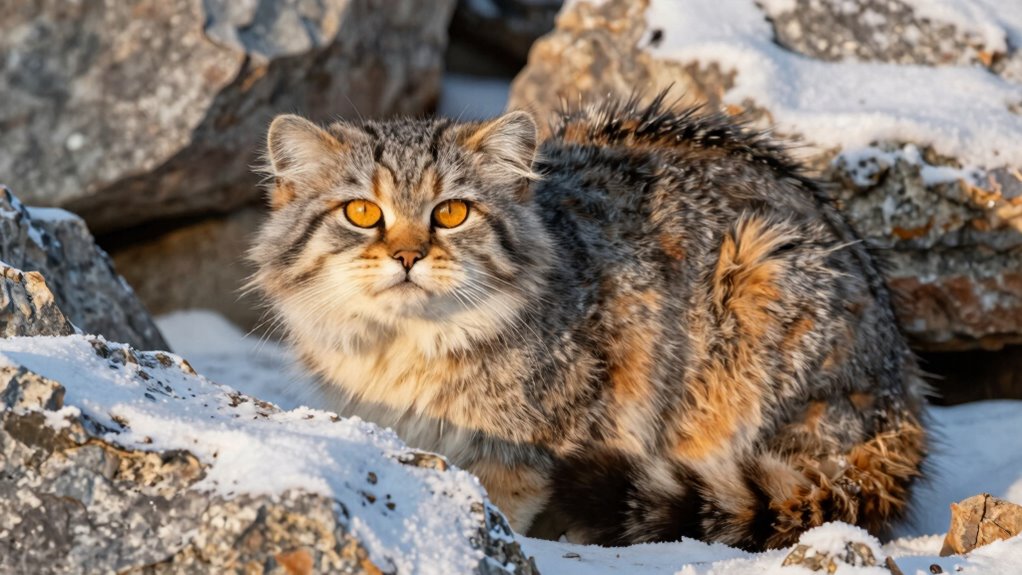

Inside the secret life of the Pallas’s cat, you’ll discover how it thrives in Central Asia’s rugged mountains. Its thick fur, small size, and camouflaged coloring help it blend into rocky, arid terrain. You’ll see how it relies on stealth, patience, and sharp senses to hunt elusive prey. Its solitary, nocturnal habits and energy-efficient hunting techniques are perfect for harsh environments. Keep exploring to uncover more fascinating details about this remarkable creature’s survival skills.
Key Takeaways
- Pallas’s cats are solitary, nocturnal predators that rely on stealth and patience to hunt small prey in their rugged habitat.
- They utilize their thick fur and camouflage to blend seamlessly with rocky, arid terrain for protection and stalking.
- Their hunting involves ambushing prey from hidden crevices, using keen eyesight and sharp claws for quick strikes.
- Adapted to extreme temperature fluctuations, they conserve energy by spending much time in low crouch positions.
- Their survival depends on their specialized physical traits and mastery of a harsh, unforgiving environment.
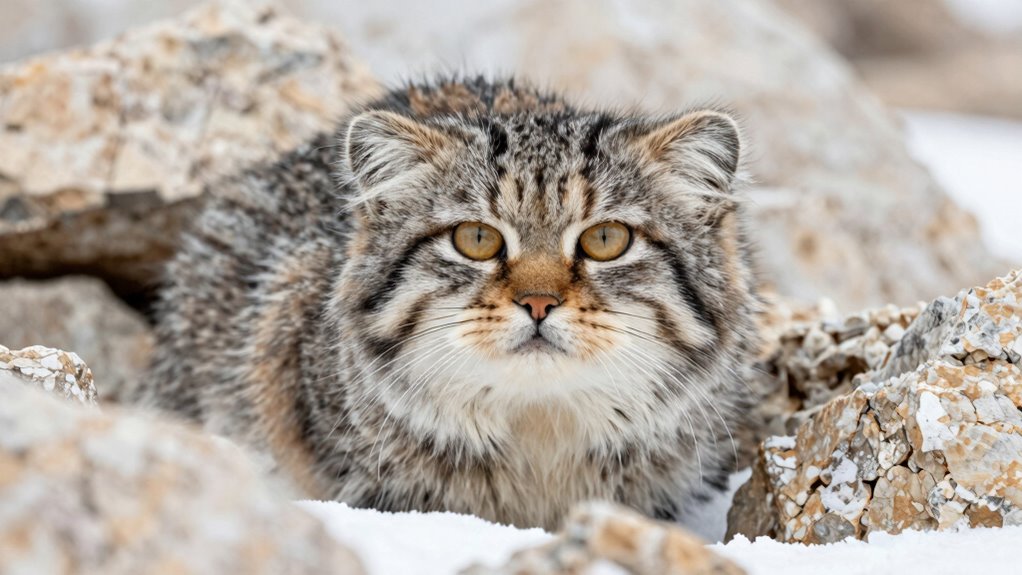
Have you ever wondered what life is truly like for the elusive Pallas’s cat? These mysterious creatures have adapted remarkably to their harsh environments, and understanding their habitat adaptation reveals just how specialized they are. You’ll find them roaming the rugged mountain ranges of Central Asia, where temperatures swing from scorching highs to freezing lows. Instead of lush forests or open plains, they thrive in rocky, arid terrain filled with boulders, cliffs, and sparse vegetation. Their thick fur isn’t just for insulation; it helps them blend seamlessly into the rocky landscape, providing camouflage against predators and prey alike. This adaptation to a tough habitat means they don’t need dense cover to hide — their coloration and small size allow them to vanish into their surroundings effortlessly. This specialized adaptation to a tough environment is a testament to their remarkable ability to survive in some of the most extreme environments on Earth. Their ability to camouflage effectively is vital for both hunting and avoiding threats in their rugged habitat. Interestingly, their small stature also aids in navigating rocky terrain, allowing them to move swiftly and stealthily through narrow crevices and uneven surfaces. When it comes to hunting strategies, the Pallas’s cat employs a combination of patience, stealth, and precision. You might think that their solitary, nocturnal lifestyle means they’re constantly on the move, but in reality, they spend a good deal of time crouched low, waiting for the right moment. They’re patient hunters, relying heavily on their keen eyesight and sharp hearing to detect prey — mainly rodents, birds, and insects — lurking beneath the rocks or hidden in crevices. Their keen senses are crucial for survival in their sparse environment, where prey can be elusive. Instead of chasing after prey at high speed, they use their environment to their advantage, stalking quietly until they’re close enough to pounce with swift accuracy. Their compact size helps them maneuver through tight spaces, giving them an edge when ambushing prey in rocky terrain. Once they spot an opportunity, they strike quickly, using their strong legs and claws to secure their catch. This calculated approach minimizes energy expenditure and maximizes their chances of success, especially in a habitat where food sources can be sparse and unpredictable. In essence, the Pallas’s cat’s survival hinges on its ability to adapt to a rugged, unforgiving environment and employ clever hunting strategies. You can see that every feature, from its thick fur to its stealthy stalking method, is finely tuned for life in a place where few other animals can thrive. Their secret lies in their resilience and their mastery of their unique habitat, making them one of the most fascinating creatures in the animal kingdom.

TIDEWE Hunting Clothes for Men with Fleece Lining, Safety Strap Compatible Water Resistant Silent Jacket and Pants, Hunting Suit for Climbing Hiking Trekking Camping (Next Camo G2 Size L)
- Stealthy Hunting Design: Reduces noise with quiet materials and magnet buckles
- Safety Harness Compatibility: Back safety strap supports harness wear (strap not included)
- Water-Resistant & Breathable: Repels moisture and keeps you dry in light rain
As an affiliate, we earn on qualifying purchases.
As an affiliate, we earn on qualifying purchases.
Frequently Asked Questions
What Do Pallas’s Cats Primarily Eat in the Wild?
You probably wonder what Pallas’s cats eat in the wild. Their diet varies based on availability, but they primarily hunt small mammals like rodents and birds. They use clever hunting strategies, stalking their prey quietly and patiently. Their diet variations depend on the season and region, ensuring they adapt to different environments. These cats are skilled hunters, making the most of what’s available to sustain themselves in their harsh, remote habitats.
How Do Pallas’s Cats Communicate With Each Other?
You’ll notice Pallas’s cats communicate through vocalizations, like sharp yowls and melodic meows, echoing across the silent desert. Their body language acts as a silent language—arched backs, puffed tails, and intense stares serve as signals of warning or curiosity. These subtle gestures and sounds weave a tapestry of connection, allowing them to navigate their harsh environment and maintain social bonds amidst the rugged wilderness.
Are Pallas’s Cats Endangered or at Risk?
You should know that Pallas’s cats are classified as near threatened, facing conservation challenges mainly due to habitat loss and poaching. Their habitat preservation is vital for their survival, as they inhabit the rugged steppes and deserts of Central Asia. Protecting these areas helps prevent further decline. Supporting conservation efforts and raising awareness about their endangered status can make a difference in ensuring these elusive cats thrive in the wild.
How Do Pallas’s Cats Adapt to Their Cold Environment?
Imagine a snowstorm cloaking the mountains—Pallas’s cats blend seamlessly using camouflage strategies that mimic the rocky, icy terrain. You’ll find them stalking with hunting techniques finely tuned to the cold, waiting patiently for prey. Their thick fur acts like a cozy blanket, insulating them from biting winds. Adapted to harsh climates, they’re masters of survival, turning the icy wilderness into their silent, snowy domain.
What Is the Lifespan of a Pallas’s Cat in the Wild?
You’ll find that Pallas’s cats typically live around 8 to 11 years in the wild. Their habitat preferences, such as rocky steppes and mountain ranges, help them survive harsh conditions. Their reproductive behaviors, including solitary habits and seasonal breeding, influence their lifespan. These cats adapt well to their environment, but challenges like food scarcity and harsh weather can shorten their lives.
Conclusion
As you close this glimpse into the Pallas’s cat’s world, imagine the silent snow blanketing the rugged mountains—a quiet guardian of secrets. Like a shadow cloaked in mystery, this feline embodies resilience and solitude, whispering stories of survival in icy silence. Its hidden life reminds you that even in the most remote corners, nature’s quiet symbols hold powerful tales. In the end, the Pallas’s cat is a whisper of life’s enduring mystery, waiting for you to listen.