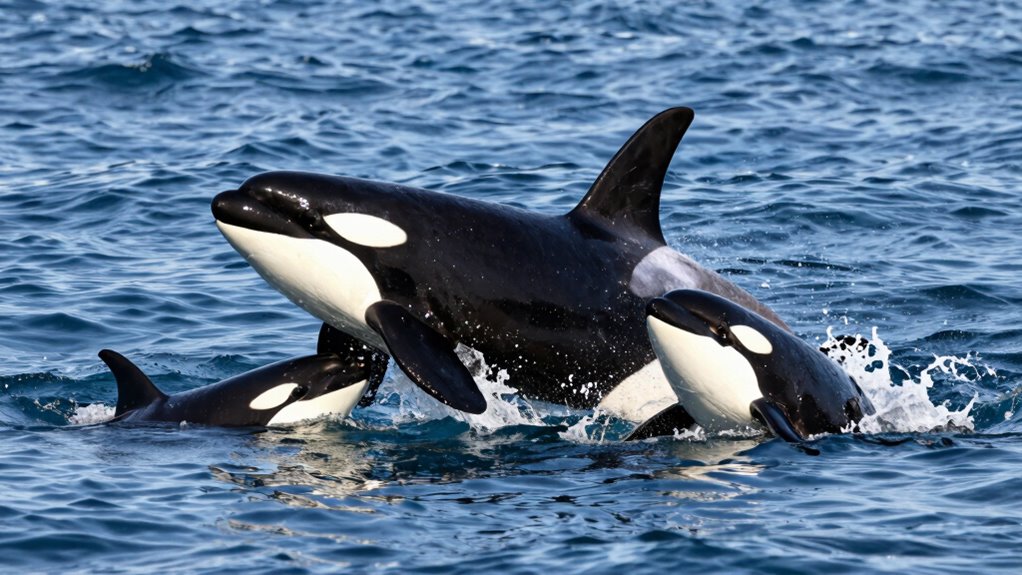

You can see orcas teach hunting skills through active social learning, where they demonstrate techniques and share knowledge within their tight-knit pods. Young orcas learn by observing their mothers and experienced pod members, mimicking vocalizations, movements, and strategies. This ongoing process uses sophisticated sounds to coordinate and instruct, ensuring the skills are passed down through generations. Keep exploring to discover more about these fascinating creatures and how their social bonds shape their hunting success.

Get pet supplies delivered free with Prime
- Fast, free delivery on millions of items
- Prime Video, Amazon Music and more included
- Member-only deals all year
Key Takeaways
- Orcas demonstrate hunting techniques through active teaching and close interaction with calves.
- Calves learn by observing and mimicking the vocalizations and behaviors of experienced pod members.
- Complex vocal signals coordinate hunts and instruct young orcas during social learning sessions.
- Imitation and active participation help young orcas develop individual hunting styles aligned with pod methods.
- Cultural transmission ensures the preservation and refinement of hunting strategies across generations.

Orcas, also known as killer whales, have a remarkable way of passing down hunting skills to their young through active teaching and social learning. When you observe them in their natural environment, it’s clear that their approach isn’t just instinctual; it’s a carefully coordinated process that shapes the behavioral development of the calves. These whales don’t leave their young to figure things out on their own. Instead, they demonstrate techniques, share knowledge, and reinforce lessons through close interaction. The young learn by watching their mothers and other experienced orcas, gradually adopting the complex behaviors needed for effective hunting. This method guarantees that each generation preserves and refines successful strategies, maintaining their place at the top of the marine food chain.
Orcas teach their young through active interaction, ensuring skills are passed down and refined across generations.
Effective communication strategies play a essential role in this teaching process. Orcas use a sophisticated array of vocalizations, including clicks, whistles, and pulsed calls, to coordinate their actions during hunts and to guide their young. These sounds serve multiple purposes: they alert others, coordinate movements, and serve as instructional cues. As a young orca observes and mimics these sounds, it begins to understand the nuances of communication that are necessary during hunts. Over time, the calves become proficient at interpreting subtle vocal signals, which helps them coordinate with the pod when pursuing prey. This active exchange of sounds and signals fosters a social environment where learning is continuous and reinforced through interaction. Additionally, cultural transmission ensures that hunting techniques are passed down effectively through generations, preserving the efficacy of their strategies. Furthermore, the complex social structure of the pod supports ongoing learning and adaptation, emphasizing the importance of group cohesion in their hunting success. Recognizing these social bonds and communication methods underscores how orcas maintain their hunting prowess over generations.
The behavioral development of young orcas is deeply intertwined with these communication strategies. As they grow, they experiment with their own vocalizations and movements, often mimicking the adults’ techniques. This imitation is essential; it helps the calves develop their own hunting styles while adhering to the pod’s proven methods. The social bonds within the pod also strengthen through these shared behaviors, creating a supportive environment for learning. The young orcas don’t just observe; they participate, practice, and receive feedback from members of the pod, which accelerates their mastery of complex hunting techniques. This active engagement guarantees that the skills aren’t just learned passively but are ingrained through experience and social reinforcement. The role of mentorship within the pod further enhances their learning process, demonstrating the importance of social learning in their development.
In essence, the social and communicative processes that orcas use to teach their young are a masterclass in behavioral development. They highlight how intelligence, cooperation, and cultural transmission are essential for survival. Your understanding of these strategies reveals a sophisticated social system where learning is dynamic, purpose-driven, and essential for the continuation of their hunting legacy.
As an affiliate, we earn on qualifying purchases.
Frequently Asked Questions
How Long Do Young Orcas Stay With Their Mothers?
You learn that young orcas stay with their mothers for about a year or even longer, sometimes up to 10 years, depending on their development. During this time, they observe and imitate dolphin communication and hunting techniques, essential for thriving in the marine ecosystem. Their bond with the mother helps them master complex skills needed for survival, ensuring they become skilled hunters and integrated members of their pod.
Do All Orca Pods Teach Hunting in the Same Way?
Not all orca pods teach hunting in the same way. Cultural variations influence their techniques, and social learning plays a key role. You’ll find that some pods specialize in hunting specific prey, like fish or seals, using unique methods passed down through generations. These differences highlight how each pod adapts its hunting skills based on their environment and cultural traditions, making orca teaching methods diverse across populations.
At What Age Do Orca Calves Start Hunting Independently?
You’ll find that orca calves typically start hunting independently around one year of age, marking an important milestone in their development. During this time, calf independence increases as they practice hunting techniques learned from their pod. While they continue to learn and refine their skills, these hunting milestones help calves become more self-reliant, gradually taking on more responsibility in securing food and contributing to the pod’s survival.
How Do Orca Pups Learn to Identify Prey?
You observe orca pups learning prey recognition through their mother’s guidance and social interactions. They watch hunting imitation closely, mimicking their mother’s techniques to identify prey. As they grow, they become skilled at recognizing different prey species by their shape, movement, and scent. This hands-on learning helps pups develop essential hunting skills, ensuring they can successfully catch prey independently when the time comes.
Are There Differences in Teaching Methods Among Orca Populations?
You’ll find that orca populations vary in their teaching methods, much like different dialects in a language. For example, some use complex vocalizations and coordinated group hunts, showcasing unique communication techniques. These cultural variations influence how pups learn to hunt, with each pod passing down specialized skills. This diversity highlights how environmental and social factors shape their teaching styles, making orca families true custodians of distinct hunting traditions.
Conclusion
As you watch orca pods, you realize they’re like a well-orchestrated symphony, each member playing a essential role. The young orcas learn the dance of survival through mimicry and guidance, gradually taking the lead. Their lessons flow seamlessly, building strength and skill with every encounter. Just as a river carves its path, these shared experiences shape the future hunters, ensuring the lineage of prowess continues. In their world, teaching is the current that sustains their mighty, majestic community.
Fall Picks
fall essentials
As an affiliate, we earn on qualifying purchases.