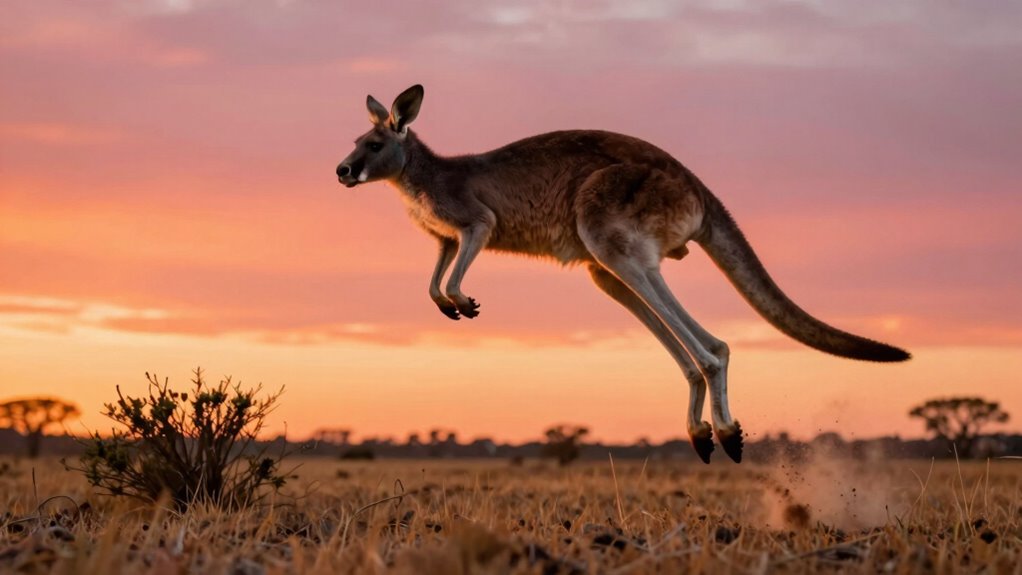

A kangaroo can leap over 8 meters (about 26 feet) in a single jump, allowing it to cover impressive distances quickly. With powerful hind legs and elastic tendons, they can leap over three times their body length, helping them escape predators or find food sources. Their strong muscles, large feet, and balanced tails work together for maximum force and efficiency. Keep exploring to discover how these incredible jumps are made possible by their unique anatomy and evolution.

Get pet supplies delivered free with Prime
- Fast, free delivery on millions of items
- Prime Video, Amazon Music and more included
- Member-only deals all year
Key Takeaways
- Kangaroos can leap over 3 times their body length, roughly reaching 8 meters (26 feet) in a single jump.
- Their powerful hind legs and elastic tendons enable long-distance hopping efficiently.
- The long, muscular tail provides balance and support during jumps.
- Their anatomical adaptations allow for quick, energy-efficient movement across open habitats.
- Jumping helps kangaroos escape predators and travel between food sources over large distances.
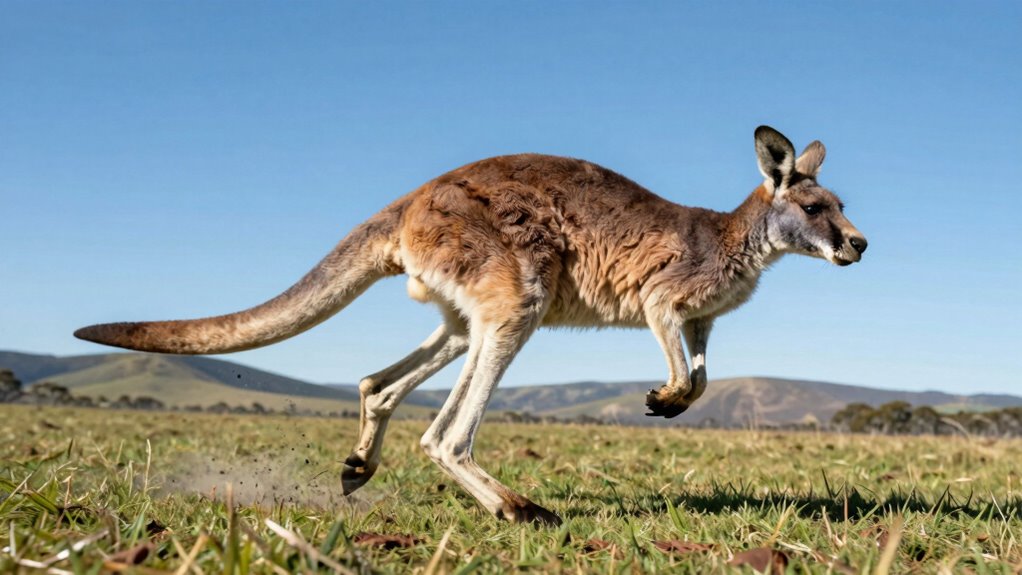
Have you ever wondered how far a kangaroo can jump? It’s quite impressive, considering these animals are among the most remarkable jumpers in the animal kingdom. Their ability to leap great distances isn’t just luck; it’s the result of specific adaptations that have evolved over thousands of years to suit their unique environment. Kangaroo habitat, primarily open grasslands and sparse forests in Australia, demands efficient movement. Instead of running, which can be energy-consuming over long distances, kangaroos have developed powerful hind legs and muscular tails that allow them to hop vast distances with minimal effort. These evolutionary adaptations make them perfectly suited to escape predators, travel between food sources, and conserve energy in their often arid environment.
When you observe a kangaroo in motion, you notice how their muscular legs propel them forward with explosive power. They can leap over 3 times their body length in a single bound, which translates to about 8 meters (roughly 26 feet) in a single jump. This is a feat that enables them to cover significant ground quickly — a vital advantage in the wild where speed can mean the difference between safety and danger. The long, elastic tendons in their legs act like natural springs, storing and releasing energy efficiently with each hop. This not only enhances their jumping distance but also reduces the energy required for each leap, making long-distance travel more sustainable for them.
Their evolutionary adaptations also influence how they jump. Over millions of years, kangaroos have refined their musculature and skeletal structure for maximum leverage and power. The powerful thigh muscles generate the force needed for these leaps, while their large feet push off the ground with incredible force. Their tail acts as a third leg, providing balance and support during rapid movement. These adaptations combine to give kangaroos an almost unparalleled ability to cover large distances quickly and efficiently in their natural habitat. Additionally, their musculoskeletal structure has been specifically shaped to optimize their jumping capability, making them one of the most efficient land mammals for leaping. This specialization also highlights how their bodies are a perfect example of evolutionary adaptation in response to their environment. Furthermore, their ability to jump efficiently is directly linked to the energy conservation strategies that have developed through natural selection.
In essence, the distance a kangaroo can jump is a proof of the power of evolution and adaptation. Their habitat has shaped their bodies to become energy-efficient jumpers, giving them the ability to traverse their environment swiftly and safely. Recent studies on kangaroo biomechanics reveal how their muscle efficiency plays a crucial role in maximizing their jumping potential, further emphasizing the importance of these adaptations in their survival. So next time you watch a kangaroo bounding across the plains, remember that each leap is a carefully honed evolutionary achievement, allowing them to thrive in their challenging landscape.
As an affiliate, we earn on qualifying purchases.
Frequently Asked Questions
Do Male and Female Kangaroos Jump Different Distances?
Yes, male and female kangaroos can jump different distances, often influenced by their size and strength. Males tend to jump farther because they’re larger and stronger, especially during mating season. Their diet of grasses and shrubs in various habitats helps them build muscle for jumping. While habitat type affects their movement, both sexes are impressive jumpers, with males often covering greater distances to establish territory or find mates.
How Does a Kangaroo’s Age Affect Its Jumping Ability?
As a kangaroo ages, its jumping ability gradually declines, especially after reaching maturity. Younger kangaroos, with stronger muscles and energy, jump farther than older ones. Your understanding of their diet and habitats helps explain this decline; a healthy diet supports muscle strength, while diverse habitats provide varied exercise opportunities. Over time, aging impacts their stamina and power, reducing their impressive jumping distances.
Can Kangaroos Jump Backward?
You might think kangaroos can jump backward, but they actually can’t. Their powerful hind legs and muscular tail enable impressive forward leaps, essential for escaping predators and maneuvering their kangaroo habitat. While their diet fuels those incredible jumps, their anatomy limits backward movement. So, as you observe these remarkable creatures, remember—no matter how strong their legs are, backward jumps are beyond their capabilities, adding to their unique, fascinating nature.
What Is the Fastest Kangaroo Species?
You’ll find that the red kangaroo is the fastest species, reaching speeds up to 35 miles per hour. Its diet mainly consists of grasses and leaves, which fuel its bursts of speed. Living in the arid habitats of Australia, red kangaroos use their powerful hind legs to cover vast distances quickly. So, if you’re tracking speed, the red kangaroo outpaces others with its swift, efficient jumps across its diverse habitat.
How Does the Weather Impact a Kangaroo’s Jumping?
Weather considerably impacts a kangaroo’s jumping, as extreme conditions can hinder their performance. High temperatures may cause fatigue, reducing their jumping ability, while rain or muddy terrain affects their footing and safety. Their diet and habitat influence this too; droughts can limit food, weakening muscles needed for jumping. Conversely, favorable weather and a rich habitat boost their energy, allowing them to leap farther and more efficiently.
Conclusion
So, next time you see a kangaroo bounding across the plains, remember how astonishing its leap truly is. It’s almost poetic—nature’s perfect coincidence—that these creatures can jump such incredible distances, seamlessly blending strength and agility. Just like how a single hop can cover so much ground, your own small efforts can lead to big leaps forward. In this dance of life, every jump, every step, reminds you that limits are often just waiting to be broken.
Halloween Picks
halloween
As an affiliate, we earn on qualifying purchases.