
Some animals play dead to fool predators into thinking they’re no longer a threat, improving their chances of escape. This behavior, called thanatosis, relies on predators’ instincts, especially those that rely on sight. When animals go limp and emit foul smells or other cues, predators often lose interest. This clever tactic is an evolutionary adaptation that helps animals avoid conflict without expending much energy. If you’d like to explore how this survival trick works in more detail, keep looking further.

Get pet supplies delivered free with Prime
- Fast, free delivery on millions of items
- Prime Video, Amazon Music and more included
- Member-only deals all year
Key Takeaways
- Playing dead tricks predators into perceiving the animal as no longer a threat, increasing survival chances.
- It exploits predators’ quick judgment based on visual cues, especially effective against sight-based predators.
- The behavior mimics signs of weakness or vulnerability, deterring further attack or predation.
- It is an evolutionary adaptation that conserves energy compared to fighting or fleeing.
- The tactic relies on predator instincts, enhancing survival and passing the trait through natural selection.
Many animals have evolved the fascinating ability to play dead as a survival strategy, fooling predators into thinking they’re no longer a threat. This behavior is a prime example of evolutionary strategies designed to increase an animal’s chances of survival in dangerous environments. When a predator perceives an animal as lifeless, it often loses interest, assuming its prey is no longer a viable target. Playing dead, or thanatosis, is a form of predator deception that relies on the predator’s instincts and perceptions, giving the seemingly helpless animal a chance to escape or avoid further attack.
Many animals use playing dead to deceive predators and increase their chances of survival.
In the wild, predators are often on the lookout for prey that shows signs of weakness or vulnerability. By playing dead, animals deceive their predators into believing they’re already defeated or no longer worth pursuing. This tactic can be especially effective against predators that rely heavily on sight and quick judgment, like birds of prey or some carnivorous mammals. When you see an animal suddenly go limp and remain motionless, it’s likely employing this instinctive survival tactic, honed over countless generations to maximize its chances of avoiding predation.
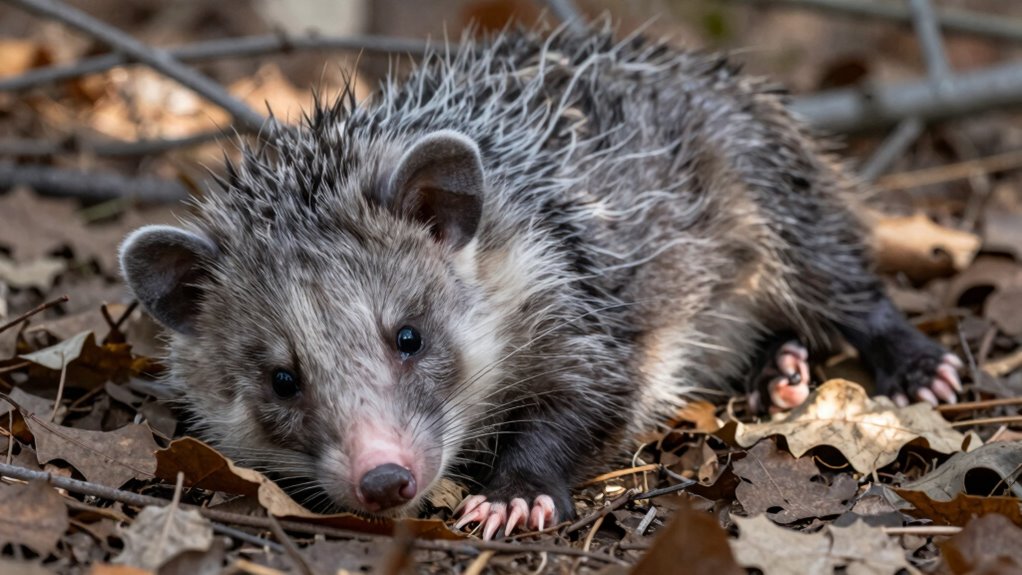
The evolutionary advantage of playing dead is rooted in predator deception. Instead of risking a fight or fleeing and risking exposure, some animals prefer to surrender temporarily, hoping their predator will move on. Many species, including certain insects, reptiles, and even some mammals, use this strategy in specific contexts. For example, the opossum is notorious for this behavior, often collapsing and emitting a foul smell to reinforce the appearance of death. This combination of physical and chemical cues heightens the predator’s perception that the prey is no longer a threat, increasing the animal’s chances of survival. Interestingly, this behavior demonstrates how predator-prey dynamics influence animal adaptations and survival strategies.
This behavior highlights how evolution shapes survival tactics based on predator-prey dynamics. Playing dead is an energy-efficient defense mechanism compared to fighting or fleeing, especially if escape seems unlikely. It’s a calculated risk, relying on the predator’s perception and natural instincts. Over time, animals that effectively use predator deception through playing dead tend to have higher survival rates, passing this trait onto their offspring. Their success in avoiding predation demonstrates how natural selection continuously fine-tunes behaviors that give animals an edge in dangerous environments. So, when you observe an animal suddenly “lifeless,” remember — it’s employing a sophisticated evolutionary strategy designed to outwit predators through predator deception.
As an affiliate, we earn on qualifying purchases.
Frequently Asked Questions
Do All Animals That Play Dead Do so Intentionally?
Not all animals that play dead do so intentionally. Some have evolved this behavior as an evolutionary strategy, relying on predator deception to increase their chances of survival. For these animals, playing dead becomes an automatic response, a natural part of their defense system. While some consciously fake death, others instinctively react this way when threatened, making it a vital survival tactic rooted in their biology.
How Long Can Animals Stay Perfectly Still When Playing Dead?
Ever wondered how long animals can stay perfectly still when playing dead? It varies widely; some can hold the pose for minutes, others even hours. They rely on camouflage tactics and predator deception to stay unnoticed, so they often remain motionless until danger passes. Their ability to stay perfectly still depends on their species, environment, and stress levels. Can you imagine maintaining such a convincing act for an extended period?
Are There Specific Triggers That Cause Animals to Play Dead?
Certain triggers, like sudden threats or close proximity to predators, cause animals to play dead. You’ll notice that their camouflage strategies, such as mimicking inanimate objects, serve as evolutionary advantages, helping them avoid detection. These triggers activate instinctive responses, allowing animals to blend into their environment and increase survival chances. Fundamentally, these cues tap into their natural defense mechanisms, making playing dead an effective strategy when danger looms.
Do Predators Ever Fall for Animals’ Play Dead Tactics?
Yes, predators do sometimes fall for animals’ play dead tactics. When an animal uses this strategy, its camouflage effectiveness and predator deception work together to trick the predator into thinking it’s no longer a threat. If the predator’s focus shifts away from the animal, it might pass by without noticing. This clever defense mechanism can save the animal’s life by exploiting the predator’s momentary distraction and misjudgment.
Can Animals That Play Dead Recover Quickly Afterward?
You watch as a possum lies still, eyes closed, mimicking a lifeless form. Yes, these animals can recover quickly afterward, often within moments, thanks to their camouflage strategies and muscle control. Their ability to play dead offers evolutionary advantages by confusing predators. Once the threat passes, they spring back to life, alert and ready, demonstrating impressive resilience and swift recovery in the wild.
Conclusion
So, next time you see an animal suddenly collapse and appear lifeless, don’t dismiss it as mere coincidence. There’s a reason behind this dramatic act—it’s a clever survival trick that keeps them safe from predators. But what other secrets do animals hide? As you watch nature’s fascinating behaviors, remember—sometimes, what seems like surrender may be their greatest weapon. Keep observing, because the animal kingdom always has surprises up its sleeve.
Halloween Picks
halloween
As an affiliate, we earn on qualifying purchases.