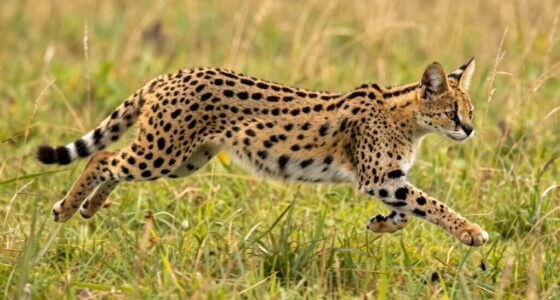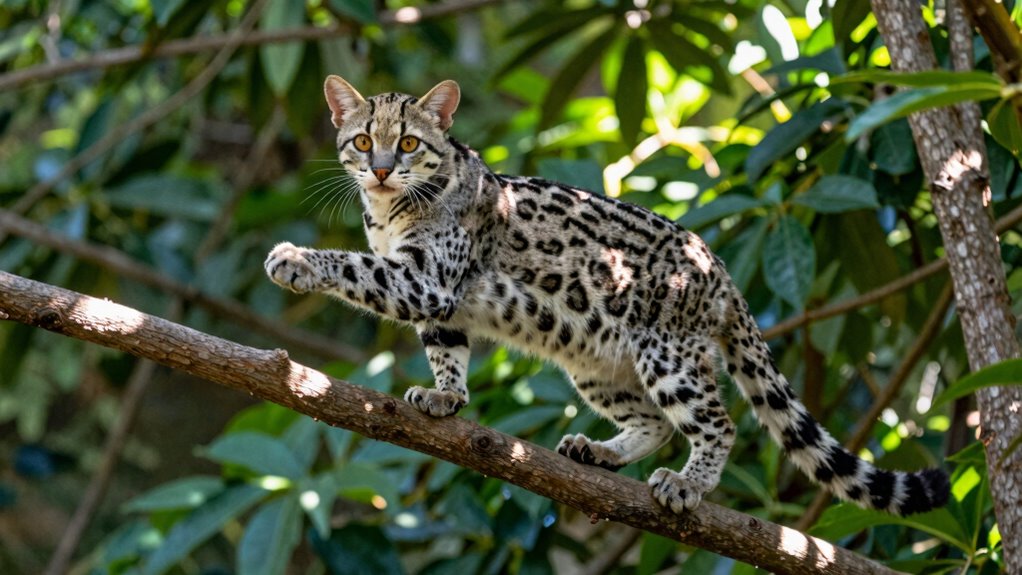

You’ll see why the margay is called the “acrobat cat” because of its incredible agility and grace in the treetops. It moves seamlessly through branches, leaping, hanging, and spinning with ease. Its flexible spine, long limbs, and long tail help it balance perfectly. The margay is a master of stealth and complex movement, hiding during the day and hunting at night. Keep exploring to discover even more fascinating things about this amazing arboreal creature.

Get pet supplies delivered free — and shop member deals
- Fast, free delivery on millions of items
- Access to Prime Big Deal Days deals on October 6–7
- Prime Video, Amazon Music and more included
Key Takeaways
- The margay is called the “acrobat cat” due to its exceptional agility and ability to perform daring climbing and acrobatic feats.
- Its flexible spine and long limbs enable it to twist, flip, and move gracefully through treetops.
- The margay’s long tail provides excellent balance for complex arboreal maneuvers.
- Its stealth, camouflage, and precise movements resemble those of a skilled acrobat.
- These traits allow the margay to navigate and hunt effectively in dense, vertical forest environments.
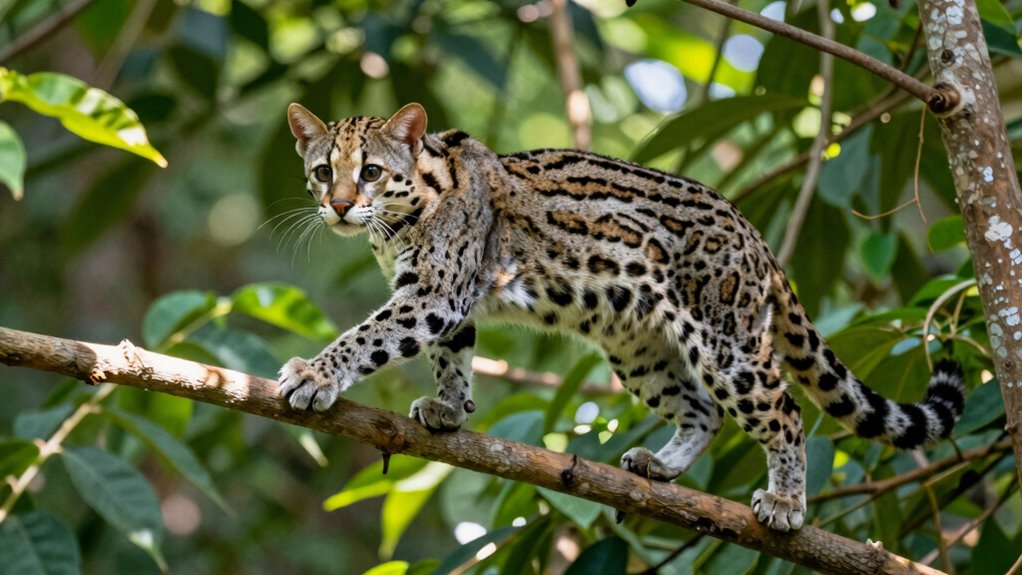
Have you ever wondered why the margay earns the nickname “the acrobat cat“? It’s because of its incredible ability to move through the treetops with unmatched agility and grace. As a nocturnal hunter, the margay spends most of its nights prowling high in the canopy, where it hunts small mammals, birds, and insects. Its keen senses and sharp claws allow it to stalk silently, waiting for the perfect moment to pounce. But what truly sets it apart is its arboreal agility. You’d be amazed how it leaps from branch to branch, often hanging upside down or spinning effortlessly through the trees.
The margay’s body is built for this life among the leaves. Its flexible spine and long limbs give it an extraordinary range of motion, making it capable of climbing and descending with ease. Its tail, almost as long as its body, acts as a balancing tool, helping it stabilize during daring jumps or while hanging. This agility isn’t just for show; it’s essential for survival in the dense forests where it lives. It can climb to impressive heights and navigate narrow branches without slipping, thanks to its padded paws and retractable claws. These features grant it the precision needed to catch agile prey and avoid predators. Additionally, its adaptations for nocturnal living enable it to hunt efficiently under the cover of darkness. Its excellent night vision further enhances its hunting capabilities during nighttime hours. Its ability to navigate complex arboreal environments is vital for avoiding threats and hunting effectively. Moreover, its camouflage in the treetops helps it remain hidden from both prey and predators, making it a true master of stealth.
Because it’s active mainly at night, you won’t see the margay often during the day. Instead, it hides in the treetops, resting in the safety of the leaves. When night falls, it becomes a stealthy predator, blending into the shadows with ease. Its nocturnal habits make it a mysterious creature, but also a master of its environment. You might not notice it until it suddenly appears overhead, effortlessly darting from one branch to another. Its arboreal agility allows it to perform feats that seem almost impossible—twisting, flipping, and hanging with a relaxed confidence that only a true acrobat possesses. This adaptation to nocturnal living is crucial to its survival and success as a forest predator.
As an affiliate, we earn on qualifying purchases.
Frequently Asked Questions
What Is the Lifespan of a Margay in the Wild?
In the wild, you’ll find a margay living around 10 to 12 years. Its habitat preferences include dense forests and tall trees, where it expertly navigates branches. Its reproductive behavior involves giving birth to usually one kitten after a gestation of about 85-92 days. The margay’s agility and climbing skills make it an exceptional arboreal predator, perfectly adapted to its environment and survival needs.
How Does the Margay Communicate With Other Animals?
You might think margays only communicate through scent marks, but they also use nocturnal vocalizations and tree-dwelling signals. These cats emit high-pitched calls at night to mark territory or alert others, and they use body language in trees to convey mood or warnings. This combination helps them stay connected with others in their dense, nocturnal habitats, ensuring they navigate their environment and avoid conflicts effectively.
Are Margays Endangered or at Risk of Extinction?
You should know that margays are considered near-threatened, mainly due to habitat conservation issues and poaching threats. Their forest habitats are shrinking because of deforestation, while illegal wildlife trade targets them for their beautiful fur and exotic appeal. If you care about these acrobatic cats, supporting habitat preservation and anti-poaching efforts can help safeguard their populations from further decline and guarantee they don’t become fully endangered.
What Is the Diet of a Typical Margay?
Think of a margay’s diet as a well-planned menu, with hunting strategies that are as agile as a gymnast. You’d find them hunting mainly small mammals, birds, lizards, and insects within dense forests. Their habitat preferences keep them high in the trees, where they use stealth and precise movements to catch prey. Their specialized skills make them excellent climbers and hunters, perfectly adapted to their arboreal environment.
Can Margays Be Kept as Pets Legally or Ethically?
Keeping a margay as a pet isn’t usually legal due to exotic pet regulations and wildlife conservation ethics. These cats are wild animals with specialized needs, and removing them from their natural habitat can harm their populations. Even if laws permit it, caring for a margay ethically is challenging because they require complex diets and environments. Prioritizing conservation and respecting their natural behaviors helps guarantee their survival and well-being.
Conclusion
So, next time you see a margay gracefully dart through the trees, remember it’s not just a feline—it’s an acrobat in disguise. Its incredible agility and daring leaps make it the true star of the jungle canopy, a living reminder that nature’s wonders often defy our expectations. Do you see it now? The margay isn’t just a cat; it’s a masterful performer, turning the forest into its endless stage—an acrobat in its wild, breathtaking world.
Fall Picks
fall essentials
As an affiliate, we earn on qualifying purchases.